Participating in Socioscientific Issue-Oriented Citizen Science Investigations: Mapping the Digital Terrain
Erin Sperling, Wilfrid Laurier University
G. Michael Bowen, Mount Saint Vincent University
Authors’ Note
Erin Sperling https://orcid.org/0000-0003-2133-1813
G. Michael Bowen https://orcid.org/0000-0002-3145-238X
Graduate student support funding for this project was provided by MSVU’s Research Office and the Faculty of Education and the WLU Work-Study Program.
Correspondence concerning this article should be addressed to Dr. Erin Sperling at esperling@wlu.ca.
Participation in Citizen Science (CitSci) projects can deepen understandings of science and the socially embedded nature of its practices, thereby better understanding science and scientists and better contextualizing science claims and knowledge. This paper draws attention to the reciprocal relationship between a socioscientific issues (SSI) framework and CitSci projects. As part of a broader study of CitSci projects within and across Canada, we developed an SSI analysis framework to understand and interpret how online text resources describing Canadian CitiSci projects integrate SSI perspectives. Our analysis suggests that selected SSI components are underdeveloped in online resources on project websites, and that participant engagement in most projects focus mainly on data collection. This analysis highlights opportunities to further understand and overcome challenges that influence whether such projects are implemented in K–12 and to explore how they might contribute to society and science overall.
Keywords: Citizen Science (CitSci), scoping, socioscientific issues (SSI), SSI framework, public science literacy
Participating in
Socioscientific Issue-Oriented Citizen Science Investigations:
Mapping the Digital Terrain
In times of increasing mis- and dis-information, which can lead to public mistrust of experts and disengagement from knowledge, science educators have a critical responsibility to support students’ understanding of science knowledge production processes and contexts (Osborne et al., 2022). Issue-oriented and affectively-attuned pedagogies and practices that engage the whole learner in real-world contexts may also orient learner identities toward belonging, participation, and decolonization, rather than disengagement and polarization (Martusewicz et al., 2020; Poole, 2025; Schultz et al., 2022). In classrooms and beyond, Citizen Science (CitSci) projects may offer entry points and repair practices toward broader sociopolitical wellbeing for youth and adults.
Citizen science is a term used in a broad range of contexts (Eitzel et al., 2017), but it is generally understood to refer to projects which involve members of the general public, who are not experts in science, interacting with some aspects of real-world science. This participation may be through data collection and/or interactions with, and for, practicing scientists (Land-Zandstra et al., 2021). It may be known or identified through other terms such as participatory or community science, which can have nuanced differences (Hacking et al., 2024). Our broader research project on CitSci is partly motivated by issues related to the public’s impoverished understanding of science knowledge, an issue identified before the pandemic (Funk et al., 2019; Kennedy & Hefferon, 2019); how science as a practice is conducted (Osborne et al., 2022); how science facts are hardened (i.e., how scientific claims come to be accepted as fact; Havstad, 2020); how CitSci may offer entry points to climate change education (Neves et al., 2024; Sperling & Bowen, 2025); and how we can create bridging between formal and informal science education for social wellbeing (Falk & Dierking, 2003). This paper draws attention to the reciprocal relationship between a socioscientific issues (SSI) framework (Zeidler & Sadler, 2023) and CitSci projects.
The importance and value of CitSci projects are now gaining broader recognition in Canadian society. In December 2023, the honour of Membership in the Order of Canada was granted to James M. Richards “for his long-time ecological stewardship … and for his contributions to ornithology as a citizen scientist” (Governor General of Canada, 2023). This was the second time this term was noted in the rationale for selection, the first going to a bird conservation biologist the year prior (Governor General of Canada, 2022). This marks increased recognition of citizen scientists’ contributions to society (although we also note these awards play into the inaccurate stereotype that CitSci is primarily about bird watching). For over two decades, the Government of Canada has also provided opportunities for Canadians to participate in CitSci projects such as the Naturewatch1, CitSci hub (now defunded), and Fluwatcher2. It may be that Canadian federal government acknowledgements of such projects and participants speak to the need for public participation in science knowledge production. This need stems both from diminished funding and the capacity of scientists to gather data and from the inherent value of such participation to democratic practices, as it can help the public understand the origins of knowledge and, by extension, decision-making (Herman et al., 2022). This is where CitSci begins to be in conversation with the SSI framework.
From these entry points of complex issues and public participation, our research team explores the landscape of Canadian CitSci, including the practices, contributions, and potential for formal and informal (i.e., non-school based) science education. We use this opportunity to expand our understanding of CitSci from an SSI framework. SSI has its own histories, underpinnings, and intentionalities within science education, predominantly located in K–12 (Zeidler & Sadler, 2023). By examining Canadian CitSci projects through an SSI lens, we hope to better understand how those projects might contribute to and fulfill SSI educational objectives, and how an SSI framework may create more robust opportunities for CitSci participation, ultimately enhancing the potential for a more scientifically literate citizenry.
An SSI framework represents both a pedagogical approach and a content orientation for science education. SSI are often viewed in formal education as involving “the deliberate use of scientific topics that require students to engage in dialogue, discussion, and debate” around controversial topics with “the added element of requiring a degree of moral reasoning or the evaluation of ethical concerns” (Zeidler & Nichols, 2009, p. 49). These topics have personal meaning, with the overall goal of increasing personal science knowledge. As the complexity of our world is increasing, there are emerging conceptualizations of SSI as “open-ended social problems with substantive connections to science” (Smit et al., 2025, p. 1) with a vision of scientific literacy that encompasses ‘real’ situations that are scientific in nature but are influenced by other factors, such as social, political, and ethical issues. SSI offer the capacity for science learners and teachers to acknowledge a growing tension in science education. Goals are changing over time from information for knowledge’s sake (content-oriented) toward the development of decision-making citizens, especially around anthropogenic impacts on ecosystems. SSI-based learning offers a shift from purely monitoring components or systems toward being open to issues and powerful outcomes that were not certain. This encourages stepping outside disciplinary silos and toward meaningful, multifaceted engagement (Cunningham & Tan, 2026; Smit et al., 2025).
Before and during the pandemic, both media and academia noted that public (mis)trust in and (mis)understandings of science came to the fore (Funk et al., 2019), especially with the spread of false or misleading information through social media (Mann & Hotez, 2025), and that this lack of trust contributes to science resistance, doubt, and denial (Sinatra, 2026). In their review of literature on trust in science, Herman et al. (2022) note that the public’s trust in science in general has been higher than trust in science-in-the-making. Osborne and colleagues (2022, 2023) identify several factors that need to be better addressed in school settings to develop an improved public understanding of science and its practices. Arguing that the role of science education should be primarily to develop ‘competent outsiders’ (Feinstein, 2011; Osborne & Allchin, 2025; Sandoval et al., 2025), whose orientation is less toward ‘judging the evidence’ for themselves, Osborne and collaborators (2022, 2023) contend that science education in schools should work toward developing an understanding of three key concepts: enacted social practices of science communities; the criteria that establish scientific expertise; and the basics of critical digital media literacy. Osborne and Pimentel (2023) further suggest that the first two are necessary to gauge the veracity of knowledge statements made by ‘experts’, in part by understanding just what constitutes expertise in a particular scientific area. However, this raises the question of how these issues can be addressed in K–12 education, highlighting the need to better understand what role informal science education opportunities, such as participating in CitSci projects, might offer.
CitSci projects have been documented around the world for decades (Tsybulsky & Tal, 2025; Vohland et al., 2021). One of the most prominent and renowned is the project hub of the Cornell Lab of Ornithology3, which endeavours to track 10,000 bird species with the input of hundreds of thousands of people, claiming public “support enables discovery of new knowledge, innovation of new technologies to reveal that knowledge, teaching to foster new leaders, inspiration to motivate change, and transforming science to action to make a difference on the ground” (Cornell Lab of Ornithology, 2019). CitSci projects can vary broadly in the practices in which their participants engage. Projects can involve participation on limited days and/or at limited locations (e.g., species counts such as Eagle Watch4); activities that one might engage in regularly (e.g., driving down roads and reporting carcasses via the Canadian Wildlife Health Cooperative5); recording data while participating in recreational everyday pursuits (e.g., RinkWatch6, which collects information on when one starts building a backyard rink and when it is ready for use); transcribing information from historical records provided by researchers into a database (e.g., with Notes from Nature7); or examining astronomical photographs from public archives to note and report particular astronomical events (e.g., the Planet Hunters TESS project8). Regardless, projects like these offer science literacy learning opportunities across spaces, demographics, and skill sets.
Some core benefits and learning opportunities for science literacy occur at the intersection of these two approaches, yet some aspects of SSI education diverge from CitSci. The core distinctions may be noted between knowledge production and sociopolitical complexity. For clarity, CitSci projects offer a method for the public to participate in real science and contribute to knowledge production. Such projects require a combination of technical, data-oriented, and/or direct connection to real-world science activities, while an SSI framework likely does not (Campos & Brito, 2024; Finger et al., 2023). SSI offer a conceptual framework that often requires explicit engagement in, and decision-making about, the sociopolitical dimensions of an issue, understanding of stakeholder interests and power dynamics, as well as inviting controversy, all of which are often underrepresented in CitSci project discourses (Högström et al., 2024; Pedretti & Nazir, 2011; Zeidler, 2014). Figure 1 identifies those constructs to which we are most attuned; the overlapping aspects being real world connections, connections to place, an affective aspect for the participant, and the development of science skills through participation. Of note, the blurry areas outside the circles are meant to demonstrate the fluid/less (un)defined spaces of each, and that each space is in constant dialogue with other spaces in flux, such as science knowledge, social norms, technology, politics, ecology, and so on.
Figure 1
Conceptualizing Overlapping Aspects of SSI and CitSci
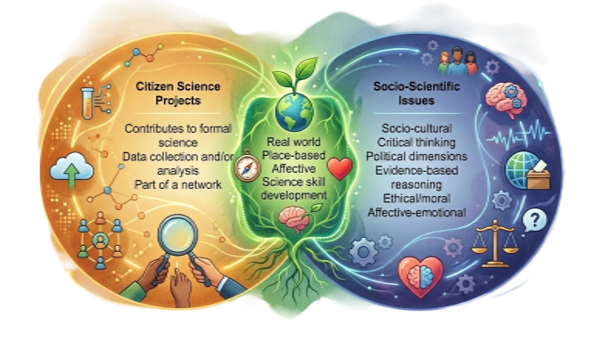
Note. The figure emphasizes the potential overlapping aspects of SSI approaches and CitSci projects. It was developed using Google AI based on an author-created figure for enhanced design purposes only.
In K–12 education, using SSI as an approach to support students’ learning about science has considerable traction (Zeidler & Newton, 2017). Topics identified as being SSI often involve complex real-world societal concerns with social and cultural component interactions. These problems often have socio- and/or eco-ethical considerations. Examples of SSI include anthropogenic climate change, water fluoridation, vaccinations, plastics pollution, stem cell research, genetically modified organisms, and coastal erosion. Students examining these issues through an SSI lens are expected to integrate emergent scientific understanding and reasoning with social, economic, and political factors and actors (Högström et al., 2024). SSI frameworks encourage critical, multidimensional, and systems thinking, as well as consideration of sustainability implications.
Similarly, it has been suggested that engaging the general public with CitSci projects may help develop understandings of SSI in a productive and action-oriented way (Campos & Brito, 2024), and, in general, many (if not all) CitSci projects could be viewed through an SSI lens. However, much of the existing literature on SSI focuses on how to engage K–12 students–not adults–with those topics, even if such participation by adults would contribute to their development as “competent outsiders” (Osborne & Pimentel, 2023, p. 553). Further, there are connections between this research and the concept of Functional Science Literacy (Zeidler, 2014), which ideally concerns how citizenry is informed and develops capacity for more than technical understandings about science in order to make well-informed, evidence-based decisions about SSI. We note similarities in school science literacy goals and the science literacy goals intended for the general public.
Using SSI approaches in classrooms has been found to generate enthusiasm, motivation, and interest in science (Neves et al., 2024; Zeidler & Kahn, 2014). A little-recognized component of being oriented toward SSI (noted in teachers selecting curriculum topics) is the way in which SSI may mobilize passion (Hancock et al., 2019), and this may help explain why individuals voluntarily participate in CitSci projects.
There is some internal tension within the field of CitSci. One variant of CitSci is known as community science. New research is helping to understand what, and how, distinctions may be made between and among citizen and community science (Hacking et al., 2024). CitSci is directly linked to many aspects of formal scientific investigation—irrespective of geographic boundaries—and community science projects are often locally based and are often intended to address local issues. The outcomes of such projects often influence local events and, unlike traditional CitSci projects, infrequently contribute to published scientific, academic literature. From an inclusivity standpoint, however, the label of community science may be perceived as more welcoming, as it destabilizes institutionalized or formal notions of citizenship and the attendant embodiments and representations as a prerequisite for participation (Cooper et al., 2021). Or, more succinctly, all persons in Canada are welcome to participate, regardless of formal citizenship status, which may not be clear from the label of CitSci (which, we note, does not limit participation by citizenship status). In fact, participatory science has become a more commonly used umbrella term within the field itself (Shirk, 2024). Additionally, in an increasingly complex world that competes for teacher and learner time and attention, research indicates that real-world, authentic and place-based learning, as offered by community science, enhances both the experiences and outcomes for all involved (Yemini et al., 2023). For the purposes of this study, all projects with opportunities for data collection (and in some cases beyond that) are included and listed under the label of CitSci.
In a meta-analysis of 157 CitSci projects globally, encompassing over 150,000 participants, Waugh et al. (2023) examined participant identities, demographic representation, and access to participation in CitSci projects. After narrowing their project to CitSci participants in North America, they reported that participants were disproportionately female, white, and educated (i.e., post-secondary). However, less than 8% of CitSci papers in the full dataset reported demographic data, suggesting a need for more studies to provide such information (Waugh et al., 2023). Understanding who may participate is especially important for understanding why individuals do or do not participate, which may support CitSci projects in providing more opportunities for engagement.
A recent typology of CitSci projects suggested “five mutually exclusive types” (National Academies of Sciences, Engineering, and Medicine [NASEM], 2018, p. 30): investigation, virtual, conservation, action, and education. Additionally, our recent research has led us to suggest an additional, sixth typology to consider: Makers (Sperling & Bowen, 2025). The Maker typology emerged through our observations that certain CitSci projects invite participants to create, tinker, or enhance a physical and/or digital aspect of an entity to gather and document data, such as backyard rink-making (e.g., RinkWatch) or air quality testing with homemade kits (e.g., Agroclimate Impact Reporter9). However, in establishing that sixth typology, we also noted that the CitSci typology currently has no designation or recognition of SSI. This is perhaps unsurprising, given that the CitSci focus population is usually adults, while SSI research and practice is often oriented toward K–12 education (Viehmann et al., 2024). A recent systematic literature review by Solé et al. (2024) highlighted four different profiles of student participation in CitSci projects, but it did not report on the roles or learning outcomes in relation to SSI. This perceived dissonance between the age range of participants and formal/informal learning spaces led to this current research, in which we examined CitSci projects through an SSI lens. In this way, we are adopting the perspective that formal science education goals of learning about science and (potentially) its practices may emerge from participation in CitSci projects.
Indeed, much research examines the impact of CitSci as sites of knowledge production in formal science. We note a lack of research on the impacts of CitSci participation on participants’ educational outcomes (Finger et al., 2023). To address this apparent lack of connection in the research literature on CitSci participation and the SSI-based formal education, we pose the following research questions:
(i) How might we assess existing CitSci projects in Canada through an SSI framework?
(ii) What are the possibilities and potentials of understanding CitSci through an SSI lens?
(iii) How might these outcomes be applied to K–12 education?
Overview of Methodology
This project builds on our intention to expand knowledge of CitSci across Canada and apply a socioscientific framework to these projects. It is a mixed-methods research project, building off our case study of one long-range CitSci project that intersects backyard rink-making with climate change data analysis (Sperling & Bowen, 2025). Over the last year, we have conducted a scoping review (Arksey & O’Malley, 2005; Pham et al., 2014) of Canadian CitSci projects, defined in this study as projects run in Canada by Canadian institutions or organizations. To this point, we have identified over 100 such projects, 20 of which were used for this SSI analysis. Projects were selected for the scoping review through a few starting points: researcher prior knowledge, internet searches for keywords such as Canadian AND citizen OR community science, as well as using existing databases such as SciStarter10 and the Government of Canada CitSci Portal11. As part of the analysis, we developed a schema to categorize projects in our database in relation to their SSI alignment(s) and clarify which science practices/SSI skill development would likely emerge from participation in each project.
For our analysis for this paper, we used a modified Interaction Analysis approach (Jordan & Henderson, 1995) combined with discourse analysis (Van Dijk, 2001), with a focus on the affective components of the text that might relate to potential participants’ passions12 as well as their sense of agency development. For each CitSci project, we independently viewed and annotated the data source(s) and framed individual assertions from those using both notes and scoring rubrics. In joint sessions, we collectively examined these individual assertions for each CitSci project, critiqued each perspective, and (re-)examined the database for confirming or disconfirming evidence, which we used to re-frame the collective assertions. Our final joint claims come from many such iterations of this process. To complement our qualitative analysis, we also engaged in a quantitative analysis approach to develop our understanding of cross-relationships for each aspect of the overlap framework (see Figure 1) and the degree to which it is perceived to be enacted using a scoring schema.
Our research team consisted of two primary co-investigators (the co-authors) and four graduate student research assistants over two years, each possessing divergent backgrounds in science and teaching experience. We discussed and highlighted our differing and overlapping positionalities as researchers, teachers, and humans, and how these might entangle with the analysis. We noted potential biases along the identity spectra of gender, age, ability, geographic locations, and our pedagogical and disciplinary preferences. Through the fall of 2025, two research assistants, both with practical experience as classroom teachers (one elementary, one secondary), supported the authors with coding and analysis of the projects in our national database with specific attention to SSI. As a team, we scored each project based on our SSI sub-scales (described in detail below), with regard to both its relevance and potential for classroom teaching. Each of us used publicly available information for 2013 projects in our database to evaluate their potential as a way to learn about SSI. We held regular virtual team meetings to discuss findings from our analyses of CitSci projects for potential classroom implementation. When Interaction Analysis draws on multiple interpretative perspectives, it is said to have greater ‘ecological validity’ (Jordan & Henderson, 1995), thereby leading to a broader and more nuanced interpretation of the data set with greater credibility. This, in turn, establishes an internal validity that reflects an “isomorphism between constructed realities of respondents and the reconstructions attributed to them” (Guba & Lincoln, 1989, p. 237), or, in other words, an assurance that there is a match between the constructed realities of the CitSci projects and those attributed to them through the analytic process.
Coding/Scoring CitSci Projects
Using our knowledge and expertise, along with emergent research on SSI and CitSci, we developed and applied the framework for analysis (described below). We needed to develop this analysis framework because this project engages with a task that has not, as far as we could find, been reported in SSI literature, namely, determining the degree to which learning environments unintentionally and implicitly encourage SSI learning. In this case the tacit learning about SSI arising from engaging in CitSci projects as a participant. This analysis framework consisted of six categories to review aspects of individual active CitSci projects. We used the analysis documents, along with the publicly available project documentation, to elicit the range of SSI connectedness based on our framework. Through these rounds of crystallization (Saldaña, 2021) and interactive discourse analysis, we arrived at our set of findings.
Defining and Operationalizing SSI Concepts
For our coding and analysis, it was important to draw on existing conceptualizations of SSI. Viehmann et al. (2024) offer some insights in their scoping review of a decade of publications, including over 100 articles on SSI in science lessons. How we understand the conduct/expectations of CitSci project participants is based on publicly available information for each project, and from this we provide our subjective but collective analysis of the projects through a constructed SSI lens. SSI as a decision-making practice have been used to support teacher planning processes for backward planning (Dauer et al., 2025). Notably, Högström et al. (2024) state that “there is no single definition advocated for [SSI] in literature” (p. 3110); thus, we drew on several rich research sources, including several systematic reviews (i.e., Smit et al., 2025; Zeidler & Kahn, 2014; Zeidler & Nichols, 2009; Högström et al., 2024), as well as our own experiences and expertise as science teachers and teacher educators. Through the literature and our own professional experience, we disaggregated SSI into the following six categories to examine 20 Canadian CitSci projects randomly selected from our database:
social and cultural implications;
critical thinking;
political/governance dimensions;
evidence-based reasoning;
ethical and moral dimensions; and
affective/emotional-based engagement.
Together, we argue that these categories reflect the main components of SSI learning.
In coding, team members scored the first five categories using a 6-point Likert scale, which removes a neutral option, thereby requiring respondents to take a position and providing more nuanced data (Chomeya, 2010). As described above, each project’s publicly available information (through its website) was examined and scored on the first five subscales. The projects were scored from 1 to 6, with 1 being the lowest resonance or implication of each category and 6 being the highest (according to the operationalized descriptors for each project described below)
Social & Cultural Implications: By definition, SSI have social implications (Hodson, 2009). If the project data collection can lead to social or cultural implications, then it would score high on this scale. If, for instance, a project was about understanding how a development in a city could affect fish in a stream, then it would score higher on this scale. However, if it were a project where the participants searched photographs taken by NASA to find potential meteors, it would score lower (unless, for instance, the project described meteors as having a cultural dimension).
Critical Thinking: Solving problems or making decisions in the project (Where do I sample? How do I decide what bird that is?). For instance, sampling a species by counting it in your backyard is low on critical thinking, while being directed toward evaluating several places and then choosing between them is higher. Using ‘your knowledge’ to identify a bird based on its calls and plumage is middle critical thinking but doing that and cross-referencing with books and making decisions is higher. However, taking a picture and sending the picture to an AI or search engine to identify the bird species is low on critical thinking. Building and maintaining a rink about which you then collect data is higher critical thinking because there is considerable problem solving to reach the point where you can collect data.
Political/Governance Dimensions: This is a determination of the degree to which the CitSci activity engagement is part of or overtly mentions contributing to government policy or decision making, or engagement of the public with politicians to accomplish that, at any level (Herman et al., 2020). For example, if data collected will be used to develop policies or recommendations that will directly be shared with formal municipal government, such as counting and locating near-misses of pedestrian hits by vehicles in order to place signage, speed bumps, etc., it would rank more highly. If it is a butterfly monitoring project with no evidence that information is provided to government bodies, it would score lower on this scale. This relates to the idea that SSI tend to deal with controversial topics.
Evidence-Based Reasoning (EBR): Making decisions in the conduct of the project/data collection based on empirical evidence of some sort. It involves identifying a problem or phenomenon, gathering and examining relevant evidence, formulating an explanation, and then using the evidence to connect the explanation to evidence logically. We define EBR as having five key components: problem framing, evidence gathering, claim formulation, reasoning, and critical evaluation (Ziebell & Skeat, 2020). If a CitSci participant draws conclusions based on the evidence they collect, the project would score high; if participants engage in only one component (such as collecting evidence/data), the project would score lower. If the project participation involved collecting information based on criteria and instructions they were given and then submitting that information to a website/app, that would result in a low score. Some projects provide online access to data to allow anyone in the world to participate in interpretation, which would result in a high EBR score.
Ethical and Moral Dimensions: This category includes projects whose outcomes relate to an ‘up’ or ‘down’ side or have some value alignment, which may differ across social identities. Projects involving conflicting values and beliefs and making objectivity challenging, would score high in this category. If, for instance, the decision about when or where to sample provided information that may benefit one group to the detriment of another, the project would score high on this dimension. An example of a moral or ethical conflict would be found if a participant sampled and counted river biota in a stream downstream from a pulp mill that operated Monday to Friday; thus, deciding to sample on Sunday might give very different results than sampling on a Friday. However, a participant being asked to decide when to sample in this context would score highly on this category. Or if a participant could choose the river for sampling and decide whether to sample a river with a pulp mill or a river that ran out of a conservation area, that would also score high. In both cases, there is a “high” ethical/moral dimension to the actions a participant is asked to take in the project. However, if the project had participants count butterflies in their backyard, it would score lower on this scale.
Affective/Emotional-Based Engagements: These attend to complex issues and can involve conflicting feelings, and sometimes conflict between cognitive and emotional understandings (Herman et al., 2020). Some projects may elicit emotional reactions that may entice or deter participation. Some issues may have negative undertones, such as collecting data on roadkill, while other projects may be positively framed, indicating overt expectations of excitement or discovery. We score this across two sub-categories: What participants are doing (i.e., the ‘activities’ they engage in) and what the project is broadly accomplishing or its ‘intentions.’
The sixth category, Affective/Emotional-Based Engagements, differs from the other categories because projects were scored based on inferences about what a participant would ‘feel’ about the project, which could range from negative to positive emotions. The affective/emotional category was also divided into two components: how participants might feel when engaging in the activity and how they would feel about what the overall project accomplished. Scoring on these scales was conducted differently from the other scales, using a 7-point scale with a middle “Neutral” category and the terminal ends ranging from -3 (negative emotion) to +3 (positive emotion). Each of the six categories is described in more detail below. These descriptions were provided to the team members who were evaluating the CitSci projects.
Analysis of Coded Data
For analysis, (a) scores for each category (one from each of four researchers) were summed to provide a total score out of 18 for each project in each category, (b) these total scores were then averaged and categorized into high/medium/low with frequencies assigned to each, and (c) a total SSI score, summed across the first five categories, was calculated for each project, so that the range of CitSci projects as they related to SSI could be discussed. These were then represented graphically.
Examining Project Logos
A final part of our dataset involved an analysis of some of the graphical “logos” of a representative selection of the projects to discuss the variety of graphic illustrations used. These are part of the ‘visual environment’ (potential) participants encounter with the projects and contribute to their thoughts/feelings about the project. The authors analyzed these using a variation of an Interaction Analysis (Jordan & Henderson, 1995) approach, applying a semiotic lens.
Regionality
We analyzed the projects for regional representation as part of the sociocultural and political/governance constructs, and related to place-based considerations, since locality offers variations in authentic connections to issues. Our examination of project regionality indicated that five of the 20 CitSci projects were at the municipal/local level, two were provincial, eight were national in scope, four were classified as “Other Regional” (i.e., large regions that cross provincial boundaries but do not cover entire provinces), and one was “Other” (an international project run by a Canadian institution with regional breakdowns of the data, most of which are American. It has no all-Canada representation, but it includes three provinces and several smaller Canadian jurisdictions). Some national projects were part of larger international initiatives but were identified as examining “Canadian” issues and oriented toward Canadian participants in their project descriptions.
Logo Analysis
Our analysis of project Logos reveals a variety of approaches. Figure 2 showcases logos of six of the 20 projects we randomly selected that are currently active or operated by Canadian organizations and/or researchers. Some of these are national projects, such as Birds Canada14 or the Community Collaborative Rain, Hail & Snow (CoCoRaHS) network15, and some are hyper-location-specific, such as that of the Tiger Mosquito project16 in Windsor-Essex, Ontario. There are semiotic distinctions in the logos such as orientation towards kids versus adults through abstracted use of professional iconographic representations of organisms studied, and different aspects of sophistication and invitation to participate, which have implications for how a potential participant may interpret a given project.
Figure 2
A Selection of Six CitSci Project Logos from across Canada
Interaction Analysis Discussion Summary
As discussed in the Methods section, the researchers had three one-hour discussions about their viewing of CitSci project webpages, including the publicly available materials for potential citizen scientists and the tools used to enter data. We used an Interaction Analysis approach to focus on collective observations about these materials. For the purposes of this article, we have focused on observations related to SSI-oriented concepts in our sample of 20 CitSci projects and have summarized those as follows:
The projects covered a range of geographic focuses from local/municipal to international, which has implications for any discussions of potential participants and place-based connections to the projects.
Project recruitment is often passive (i.e., based on interested parties finding the website through various means) as opposed to actively recruiting citizen scientists. This has implications for those who participated in such projects.
Participation by the citizen scientists is not often directly connected to the broader goals of the science research project they are affiliated with. For instance, connections to long-range management of an organism, related government policy, and the positioning of the organism in the broader ecosystem are infrequently discussed.
There was little (or no) opportunity for citizen scientists to participate in data analysis, summarization, or discussion of implications either directly or indirectly. Further, opportunities to discuss and critique issues with data collection methodology, a core practice of citizen scientists, were not present.
Few projects were structured in a manner that would encourage or facilitate the participation by students, teachers, or schools. In many cases, this did not mean the projects could not be framed in such a way that participation was more likely.
There were few explicit connections between the CitSci projects and Indigenous perspectives on the research areas being explored (we note an exception in our broader discussion below). We noted many places where such connections could be made.
Examination of SSI Concepts
For our analysis of the project contents and their relationship to SSI, we used the six SSI-attributed categories described in the methodology, subdivided into two sets based on the scales used to code them. Thus, the Affective-Emotional category was analyzed separately from the others. We discuss our findings from this breakdown below.
Affective-Emotional Category
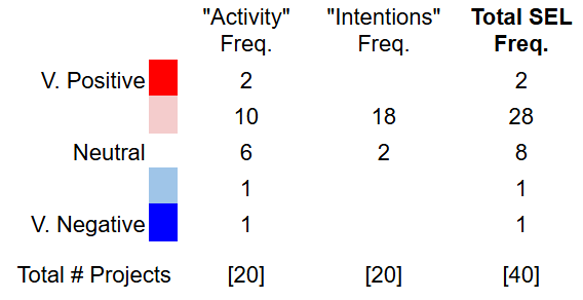
Two affective-emotional scales were scored from Strongly Negative to Strongly Positive emotions for participant engagement (“Activity”) as well as project accomplishments (“Intentions”) for each CitSci project. All scoring was based on the information provided at the publicly available CitSci website for each project, and scores were summed across the four researchers to obtain totals (frequency categories were calculated as ‘Neutral’ [-2 to +2], ‘Medium’ [(+/-)3 to 6], and ‘Very’ [(+/-)7 to 9]). In collating and examining these scores, we determined that two projects would elicit a high positive emotional response, 28 of the 40 affective-emotional responses displayed a lower positive emotional response, and one for each of a low and a high negative emotional response (Figure 3). This means almost half of the ratings (28/40; 10 in the “Activity” category) reflected medium-to-neutral emotional engagement potential for CitSci participants. The two projects with low Affective-Emotional scores in the “Activity” category involved data collecting/reporting about wildlife carcasses near roadsides and people documenting living with chronic pain. Overall, it is notable that 8 of 20 projects had a neutral to low “Activity” score. The projects receiving the strongest positive scores involved participants being out in nature, documenting wild flora and fauna, and contributing to a longstanding database.
Figure 3
Frequency of Affective-Emotional Category Responses
Remaining SSI Categories
The remaining categories–Social & Cultural Implications; Critical Thinking; Political/Governance Dimensions; Evidence-Based Reasoning; and Ethical and Moral Dimensions–were scored on a Likert scale of 1 to 6 by two graduate student researchers and one researcher and author. By applying our SSI scoring tool to the publicly available webpages of 20 randomly selected projects, we observed some patterns. The median frequency for two subscales, Critical Thinking and Political/Governance, were scored in the 8 to 12 (or moderate) range, but the median frequency for Ethical and Moral Dimensions and Evidence-Based Reasoning were scored between 3 and 7, in the lower range. One category, Social & Cultural Implications, had a median score in the moderate range, but also notably had 5 scores (of the possible 20) in the higher 13 to 18 range (the other categories had 0 to 2 scores in the high range).
Figure 4
SSI Category Representation in CitSci Projects
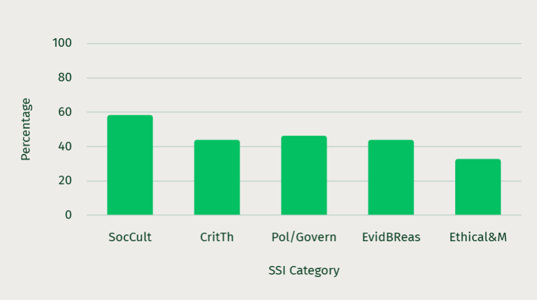
Note. Scoring of CitSci projects was analyzed by arithmetic average response, as a percentage of 18 (the maximum possible average score in each response category).
In graphing the arithmetic average score for each of the first five SSI categories (Figure 4), it becomes evident that none of the individual scales were consistently highly scored, with social and cultural implications scored highest most often (Figure 3). Overall, these findings suggest that the potential for CitSci participation to raise understanding of SSI is poorly realized, or at least under-developed in the website texts provided to the public, despite most of the projects having, in our view, reasonably high implications for environmental knowledge gathering, understanding, and policy-influencing potential in the long term.
A further examination of this data set involved summing the scores across all 5 scales for each of the 20 projects to get a “Total” SSI score for each project (which were then ranked from lowest to highest). This analysis further revealed that none of the individual projects had a particularly high collective score, with a maximum score of 61 points out of a potential 90. The median project SSI total score was 42 points (see Figure 5, below). This further highlights that the CitSci projects we examined could better represent their connections to SSI.
Figure 5
Total SSI Scores for Each of 20 CitSci Projects
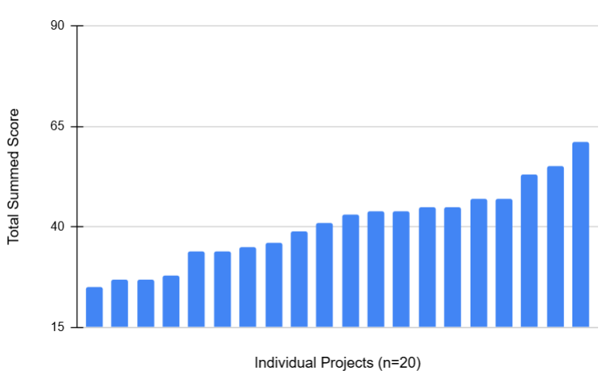
Note. Each of 20 CitSci projects across all the categories, ordered by total score, showcasing that the highest scoring project achieves a score of 61 out of a possible 90.
Impacts and Implications
Based on our scoping review, research, and analysis, we contend that there are a vast range of CitSci projects across Canada, and each attends to, or offers connections to, socioscientific teaching and learning potential in particular ways. For authentic SSI education, CitSci projects may be more valuable when they address as many of the six categories described above as possible in the public interface (websites and other materials).
As noted by Sonnert et al. (2025), as an informal science learning opportunity, CitSci may position the student as follows:
as an autonomous learner, typically in hands-on and active learning formats that make science relevant to the students’ lives … which adds to the intrinsic value [of STEM learning]. … For the individual student, the goal is to develop STEM literacy and a STEM affinity, which can be operationalized as STEM identity. The societal goal is to create a citizenry that appreciates STEM and is able to develop and hold informed opinions about STEM issues that affect society. (p. 3)
In sum, our analyses indicate that, in general, the publicly available information for recruitment, training, and data collection for the majority of the CitSci projects is not highly or even moderately attentive to the potential for engagement with them as SSI on many levels. For instance, even abstract and decontextualized logos do not allow potential participants to draw any affective connections to either the CitSci project itself or the broader research project. In general, this can be seen as a missed opportunity, given the research that highlights higher motivation and interest in science when SSI connections are foregrounded (Högström et al., 2024).
We did note that the highest-scoring projects on the SSI scales had the most obvious connections to government bodies and scientists, with the highest-scoring project being part of a large network of Indigenous and settler community members, federal government scientists and technicians, and industry across the country. The project entitled the Canadian Aquatic Biomonitoring Network (CABIN)17 assesses freshwater quality and requires a high level of training to participate. It provides nationally standardized protocols and online tools to monitor and assess the health of freshwater ecosystems. The data and analytics are readily available for use by the public, including teachers. Thus, this project was incredibly robust across SSI categories but seems to offer limited access for direct student participation, which we mention as a growth opportunity.
A major goal of this overarching project is to consider how we might translate and transfer the student-level and society-level impacts of such informal, place-based learning engagements into formal education that are accessible to science teachers. We see that CitSci projects can also engage learners in practical science knowledge production and data collection. We also highlight that CitSci has considerable potential to develop participant agency, affective connection to knowledge production, sense of science identity, and democratic empowerment, all of which are constructs toward socio-ecological justice education practices (Martusewicz et al., 2020).
Reflections, Challenges, and Next Steps
CitSci projects are often run by volunteers or “off the sides of desks” (i.e., as an adjunct to their main research project and using funding provided for other projects) for many professionals. Participant recruitment may be haphazard or serendipitous, and many projects do not seem to foreground attention to participants’ educational outcomes. We also note that publicly provided information on CitSci project websites does not necessarily draw direct connections to, or marketing for, what and why participation is helpful toward project and broader socioecological goals, as we would hope from the perspective of an SSI orientation.
We observed that the majority of reviewed projects were not explicit or overt about how the participant-collected data was used. In addition, there were no noted opportunities for participants to participate in the analysis or interpretation of CitSci project results, which, in most cases, were not provided to participants in any fashion, in contrast to our case study of one such project reported by Sperling and Bowen (2025). There appeared to be few mechanisms for participants to comment on the results or interpretations of the data made by those running the CitSci projects. This decontextualizes the project’s value from an SSI perspective, diminishing sociocultural, ethical, and political impacts, and critical-thinking experiences (Herman et al., 2020). This deficit may impact on the potential for engagement by lacking the affective or emotional dimensions that help participants understand what the project may be achieving. In essence, in many projects, volunteers fill the role of data collectors or technicians, which means projects lack the opportunity for participants to comment on potential methodological problems in data collection, and participants are not viewed as expert members. This lack of input on methods can have considerable potential consequences when local expertise is ignored, as noted in a project where input from fishers was collected in a fashion that suppressed important insights from their traditional ecological knowledge (Finlayson, 1994). From an SSI perspective, this lack of opportunity for involvement in data compilation, analysis, and interpretation means that the opportunity for engaging in evidence-based reasoning, one of our scored SSI characteristics, is reasonably limited, as is the opportunity for discussion with other participants and those running the CitSci project. However, such discussion opportunities and associated collective engagements are hallmarks of SSI-oriented teaching approaches (Högström et al., 2024).
The presence of CitSci projects continues to expand in Canada and internationally. Even in the process of completing this manuscript, more projects came to light due to professional network expansions and recognition that not all CitSci projects have a robust online presence. This does not preclude such projects from working with citizens to collect ‘good data’ in communities. We build on the work of Falk and Dierking (2003) with our interest in engaging CitSci as an entry to science education beyond non-formal and informal learning into the formalized space, but with participation in, with, and by non-formal science actors.
Among those identified as non-formal science actors, with some controversy, we acknowledge Indigenous practices and ways of knowing the Land. We also acknowledge that Indigenous communities have been doing science, including aspects of CitSci, since time immemorial, and that while documentation processes may be more diverse and divergent from traditional Western science knowledge mobilization, Land-based practice and knowing are valuable parts of knowing the world (Johnson et al., 2016). Two-Eyed Seeing (Bartlett et al., 2012) has opened a gate of practice to work with/in these at times disparate approaches. Two-Eyed Seeing as a lens has been used in science, medicine, and science education, but not expressly or extensively in CitSci. There is some research on the intertwined value of Indigenous Ways of Knowing (IWK) with Western science practices in the South African context (Pasgaard et al., 2023), whereas there has not been a lot of research examining how IWK are woven into CitSci practice in the Canadian landscape. We believe that such a weaving can deepen reconciliation practice as well, through learning and documenting place and relationships with Land. To this point, we further noted that the descriptive text for most projects in this analysis did not encourage or promote Indigenous perspectives or participation, which is a shortcoming given that almost all projects were on environmental issues. We see potential for collaboration in the future.
We had planned to understand the place-based nature of these projects, but our examination of the regionality of projects suggests wide variation across projects. Smaller projects, such as those that are municipally based, occur in participants’ communities. However, even larger projects might encourage participants to sample, count, or identify species in their backyard or neighbourhood, although participants may choose to travel to other provinces to do such collecting, or do so while on vacation. Other projects which were larger than municipal scale were intended to draw participants from locations such as cities to volunteer in more remote areas, highlighting the exotic nature of their locales. It became clear that a wide range of place-based opportunities existed and that developing a nuanced understanding of the place-based nature of Canadian CitSci projects lay beyond the scope of this current study.
Based on this research, we posit that the currently existing typology of CitSci projects would benefit from enhancement based on the SSI category integration. We intend to build on the existing typology of CitSci projects (NASEM, 2018) along with our addition of Makers (i.e., those who are creatively “making” tools or even the research settings to facilitate data collection to support the CitSci project), overlaying and interplaying the six categories inscribed to overlap for SSI and CitSci to potentially locate the best opportunities for implementation. Furthermore, we will apply this emerging analytical framework to all known CitSci projects in Canada.
We also note that publicly available CitSci project information could be considerably enriched to better emphasize how projects reflect many socioscientific perspectives, and that doing so might increase participation. For instance, overt articulations that data collected about the presence of a particular species mean a participant is contributing to understanding changes over time are often absent from most project descriptions. This leaves participants unaware that their project contributions are helping to understand changes in species prevalence over time, which might, in turn, lead to (better) policy decisions by governments. We also note that the Activity involvement for 40% of the projects was not positive, which is unlikely to encourage participation. Given this, and our other commentary above, we encourage CitSci projects to be structured in a manner that better involves participants in data analysis and interpretation, which could address those non-positive participation scores. As our project progresses, we anticipate writing an informational document for those who run CitSci projects so that they can consider such objectives.
Currently, we are surveying CitSci project leadership to elicit details about project goals, expectations for participants, and other information about how they intend to structure their project for public participation. The next phase of our research is to work with classroom teachers and CitSci project leaders to help identify and enhance projects for formal teaching engagements in communities. We have already begun connecting with both stakeholder groups to collaborate on good practices to achieve these goals. In this way, we aim to support and acknowledge the idiosyncratic nature of both classrooms and community-based projects toward re-bridging a new space for science education in local communities. Also, we are selecting case projects in which we will conduct research with participants to understand their experience as citizen scientists and to better understand what they have learned about the topics of the science research projects and about the conduct of science itself through their participation. We realize there is much more work to be done and great potential for learning based on the growing number and impact of CitSci projects in Canada and beyond.
We acknowledge that, by definition and default, CitSci has largely existed outside formal science classrooms. As our research progresses and deepens, we continue to highlight and strengthen the potential of CitSci projects as tools of practice. There is great potential to leverage the strength of an SSI framework in science and STEM education through the actions of CitSci projects. CitSci can also engage students in authentic action to deepen science literacy and scientist identity and to combat misinformation. Additionally, and perhaps of greater socioecological import, we expect that feelings of helplessness and hopelessness within this wicked time of climate change may be ameliorated through a better understanding of the processes and practices of science, which we see as emerging from a better melding of SSI perspectives and CitSci project practices and accessibility to teachers, classrooms, and the public.
Generative AI Disclosure Statement
The authors acknowledge the use of Google Gemini AI solely to aesthetically enhance Figure 1 based on our own original drawing within Google Slides tool.
References
Arksey, H., & O’Malley, L. (2005). Scoping studies: towards a methodological framework. International Journal of Social Research Methodology, 8(1), 19–32. https://doi.org/10.1080/1364557032000119616
Bartlett, C., Marshall, M., & Marshall, A. (2012). Two-eyed seeing and other lessons learned within a co-learning journey of bringing together indigenous and mainstream knowledges and ways of knowing. Journal of Environmental Studies and Sciences, 2(4), 331–340. https://doi.org/10.1007/s13412-012-0086-8
Campos, R., & Brito, B. (2024). The role of citizen science in public engagement with socioscientific debates. ARPHA Proceedings, 6, 19–23. https://doi.org/10.3897/ap.e126291
Chomeya, R. (2010). Quality of psychology test between Likert scale 5 and 6 points. Journal of Social Sciences, 6(3), 399–403. https://doi.org/10.3844/jssp.2010.399.403
Cooper, C. B., Hawn, C. L., Larson, L. R., Parrish, J. K., Bowser, G., Cavalier, D., Dunn, R. R., Haklay, M., Gupta, K. K., Jelks, N. O., Johnson, V. A., Katti, M., Leggett, Z., Wilson, O. R., & Wilson, S. (2021). Inclusion in citizen science: The conundrum of rebranding. Science, 372(6549), 1386–1388. https://doi.org/10.1126/science.abi6487
Cornell Lab of Ornithology. (2019, October 15). About the Cornell Lab of Ornithology. https://www.allaboutbirds.org/news/about-the-cornell-lab-of-ornithology/
Cunningham, L.E., & Tan, Y.S.M. (2026). Powerful re-/connections: The need for curriculum integration in socioscientific issues education. Canadian Journal of Science, Mathematics, and Technology Education, 26, Article 66. https://doi.org/10.1007/s42330-026-00491-4
Dauer, J., Kirby, C., & Sorensen, A. (2025). Defining students’ socioscientific issues classroom decision-making components and practice proficiencies. Disciplinary and Interdisciplinary Science Education Research, 7, Article 12. https://doi.org/10.1186/s43031-025-00132-0
Eitzel, M. V., Cappadonna, J. L., Santos-Lang, C., Duerr, R. E., Virapongse, A., West, S. E., Kyba, C. C. M., Bowser, A., Cooper, C. B., Sforzi, A., Metcalfe, A. N., Harris, E. S., Thiel, M., Haklay, M., Ponciano, L., Roche, J., Ceccaroni, L., Shilling, F. M., Dörler, D., … Jiang, Q. (2017). Citizen science terminology matters: Exploring key terms. Citizen Science: Theory and Practice, 2(1), 1–20. https://doi.org/10.5334/cstp.96
Falk, J. H., & Dierking, L. D. (2003). Lessons without limit: How free-choice learning is transforming education. Altamira Press.
Feinstein, N. (2011), Salvaging science literacy. Science Education, 95(1), 168–185. https://doi.org/10.1002/sce.20414
Finger, L, van den Bogaert, V, Schmidt, L, Fleischer, J, Stadtler, M, Sommer, K., & Wirth, J. (2023). The science of citizen science: a systematic literature review on educational and scientific outcomes. Frontiers in Education. 8, Article 1226529. https://doi.org/10.3389/feduc.2023.1226529
Finlayson, A. C. (1994). Fishing for truth: A sociological analysis of northern cod stock assessments from 1977 to 1990. The Institute of Social and Economic Research.
Funk, C., Hefferon, M., Kennedy, B., & Courtney, J. (2019). Trust and mistrust in Americans’ views of scientific experts. Pew Research Center. https://www.pewresearch.org/science/wp-content/uploads/sites/16/2019/08/PS_08.02.19_trust.in_.scientists_FULLREPORT_8.5.19.pdf
Governor General of Canada. (2022, December 14). List of people invested into the Order of Canada on December 14, 2022. https://www.gg.ca/en/media/order-canada-appointees-december-14-2022
Governor General of Canada. (2023, December 28). Order of Canada appointees–December 2023. https://www.gg.ca/en/order-canada-appointees-december-2023
Guba, E. G., & Lincoln, Y. S. (1989). Fourth generation evaluation. Sage Publications.
Hacking, N., Lewis, J., & Evans, R. (2024). Mapping approaches to ‘citizen science’ and ‘community science’ and everything in-between: The evolution of new epistemic territory? Minerva 62, 549–572. https://doi.org/10.1007/s11024-024-09529-z
Hancock, T. S., Friedrichsen, P. J., Kinslow, A. T., & Sadler, T. D. (2019). Selecting socioscientific issues for teaching: A grounded theory study of how science teachers collaboratively design SSI-based curricula. Science & Education, 28, 639–667. https://doi.org/10.1007/s11191-019-00065-x
Havstad, J. C. (2020). Forty years after laboratory life. Philosophy, Theory, and Practice in Biology, 12, Article 3. https://doi.org/10.3998/ptpbio.16039257.0012.003
Herman, B. C., Clough, M. P., & Rao, A. (2022). Socioscientific issues thinking and action in the midst of science-in-the-making. Science & Education, 31(5), 1105–1139. https://doi.org/10.1007/s11191-021-00306-y
Herman, B. C., Zeidler, D. L., & Newton, M. H. (2020). Students’ emotive reasoning through place-based environmental socioscientific issues. Research in Science Education, 50(5), 2081–2109. https://doi.org/10.1007/s11165-018-9764-1
Hodson, D. (2009). Teaching and learning about science: Language, theories, methods, history, traditions and values. Brill.
Högström, P., Gericke, N., Wallin, J., & Bergman, E. (2024). Teaching socioscientific issues: A systematic review. Science & Education, 34, 3079–3122. https://doi.org/10.1007/s11191-024-00542-y
Johnson, N., Behe, C., Danielsen, F., Krümmel, E. M., Nickels, S., & Pulsifer, P. L. (2016). Community-based monitoring and Indigenous knowledge in a changing Arctic: A review for the Sustaining Arctic Observing Networks. Final report to Sustaining Arctic Observing Networks. Inuit Circumpolar Council. https://www.inuitcircumpolar.com/wp-content/uploads/2019/01/cbm_report_final.pdf
Jordan, B., & Henderson, A. (1995). Interaction Analysis: Foundations and practice. The Journal of the Learning Sciences, 4(1), 39–103. https://doi.org/10.1207/s15327809jls0401_2
Kennedy, B., & Hefferon, M. (2019). What Americans know about science. Pew Research Center. https://www.pewresearch.org/science/wp-content/uploads/sites/16/2019/03/PS_2019.03.28_science-knowledge_FINAL.pdf
Land-Zandstra, A., Agnello, G., & Selman Gültekin, Y. (2021). Chapter 13: Participants in citizen science. In K. Vohland, A. Land-Zandstra, L. Ceccaroni, R. Lemmens, J. Perelló, M. Ponti, R. Samson, & K. Wagenknecht (Eds.). The science of citizen science (pp. 243–259). Springer International Publishing.
Mann, M. E., & Hotez, P. J. (2025). Science under siege: How to fight the five most powerful forces that threaten our world. PublicAffairs.
Martusewicz, R., Edmundson, J., & Lupinacii, J. (2020). Ecojustice education: Towards diverse, democratic and sustainable communities (3rd ed.). Routledge.
National Academies of Sciences, Engineering, and Medicine. (2018). Learning through citizen science: Enhancing opportunities by design. The National Academies Press. https://doi.org/10.17226/25183
Neves, A. T., Boaventura, D., & Galvão, C. (2024). Contributions from citizen science to climate change education: monitoring species distribution on rocky shores involving elementary students. International Journal of Science Education, Part B, 15(1), 65–78. https://doi.org/10.1080/21548455.2024.2322417
Osborne, J., & Allchin, D. (2025). Science literacy in the twenty-first century: Informed trust and the competent outsider. International Journal of Science Education, 47(15–16), 2134–2155. https://doi.org/10.1080/09500693.2024.2331980
Osborne, J., & Pimentel, D. (2023). Science education in an age of misinformation. Science Education, 107(3), 553–571. https://doi.org/10.1002/sce.21790
Osborne, J. F., Pimentel, D., Alberts, B., Allchin, D., Barzilai, S., Bergstrom, C., Coffey, J., Donovan, B., Kivinen, K., Kozyreva, A., & Wineburg, S. (2022). Science education in an age of misinformation. Stanford University.
Osborne, J., Zucker, A., & Pimentel, D. (2023). Tackling scientific misinformation in science education. Stanford University.
Pasgaard, M., Breed, C., Heines, M., Knudsen, L., Brom, P., Schmidt, A., & Engemann, K. (2023). Citizen science beyond science: A collaborative approach for transformative sustainable development. Citizen Science: Theory and Practice, 8(1), Article 41. https://doi.org/10.5334/cstp.574
Pedretti, E., & Nazir, J. (2011). Currents in STSE education: Mapping a complex field, 40 years on. Science Education, 95(4), 601–626. https://doi.org/10.1002/sce.20435
Pham, M. T., Rajićm, A., Greig, J. D., Sargeant, J. M., Papadopoulos, A., & McEwen, S. A. (2014). A scoping review of scoping reviews: Advancing the approach and enhancing the consistency. Research Synthesis Methods, 5, 371–385. https://doi.org/10.1002/jrsm.1123
Poole, T. (2025). Investigating school belonging using socio-ecological systems theory. in education, 30(2), 20–45. https://doi.org/10.37119/ojs2025.v30i2.862
Saldaña, J. (2021). The coding manual for qualitative researchers (4th ed.). Sage Publications.
Sandoval, W., Osborne, J., Feinstein, N., Voitle, F., Kremer, K., Duncan, R., Krishnamoorthy, R., & Tan, E. (2025). What makes a competent outsider? In A. Rajala, A. Cortez, R. Hofmann, A. Jornet, H. Lotz-Sisitka, & L. Markauskaite (Eds.), Proceedings of the 19th International Conference of the Learning Sciences–ICLS 2025 (pp. 2435–2441). International Society of the Learning Sciences. https://repository.isls.org/bitstream/1/11487/1/ICLS2025_2435-2441.pdf
Schultz, C., Kumm, B. E., Legg, E., & Rose, J. (2022). Emotional pedagogies: Strategies for engaging social justice in the classroom. SCHOLE: A Journal of Leisure Studies and Recreation Education, 37(1–2), 82–96. https://doi.org/10.1080/1937156X.2020.1777227
Shirk, J. (2024, April 2). Reintroducing this association: Advancing participatory sciences. Association for Advancing Participatory Sciences. https://participatorysciences.org/2024/04/02/reintroducing-this-association-advancing-participatory-sciences/
Sinatra, G. (2026). The erosion of trust is contributing to science denial. Current Opinion in Psychology. 67, Article 102214. https://doi.org/10.1016/j.copsyc.2025.102214
Smit, R., Rietz, F., & Büchel, D. (2025). Using the socioscientific issue approach to foster secondary students’ argumentation skills, science self-efficacy beliefs and science interest. International Journal of Science Education, 48(9), 1356–1372. https://doi.org/10.1080/09500693.2025.2460050
Solé, C., Couso, D., & Hernández, M. I. (2024). Citizen science in schools: A systematic literature review. International Journal of Science Education, Part B, 14(3), 383–399. https://doi.org/10.1080/21548455.2023.2280009
Sonnert, G., Reid, T., Sunbury, S., & Sadler, P. (2025). How do formal and informal science learning experiences during high school shape students’ career interest and STEM identity? International Journal of STEM Education,12, Article 55. https://doi.org/10.1186/s40594-025-00568-w
Sperling, E., & Bowen, G. M. (2025). Skating on thinning ice: Backyard citizen science for climate change awareness. Post Digital Science and Education, 7, 143–166. https://doi.org/10.1007/s42438-024-00535-8
Tsybulsky, D., & Tal, T. (2025). Citizen science contributions to biology and environmental education: Realities, impacts, and opportunities. Springer International Publishing. https://doi.org/10.1007/978-3-031-99298-8
Vallerand, R. J. (2008). On the psychology of passion: In search of what makes people’s lives most worth living. Canadian Psychology/Psychologie Canadienne, 49(1), 1–13. https://doi.org/10.1037/0708-5591.49.1.1
Van Dijk, T. (2001). Critical discourse analysis. In D. Schiffrin, D. Tannen, & H. E. Hamilton (Eds.), The handbook of discourse analysis (pp. 352–371). Blackwell.
Viehmann, C., Fernández Cárdenas, J. M., & Reynaga Peña, C. G. (2024). The use of socioscientific issues in science lessons: A scoping review. Sustainability, 16(14), 5827. https://doi.org/10.3390/su16145827
Vohland, K., Land-Zandstra, A., Ceccaroni, L., Lemmens, R., Perelló, J., Ponti, M., Samson, R., & Wagenknecht, K. (2021). Editorial: The science of citizen science evolves. In K. Vohland, A. Land-Zandstra, L. Ceccaroni, R. Lemmens, J. Perelló, M. Ponti, R. Samson, & K. Wagenknecht (Eds.), The science of citizen science (pp. 1–12). Springer International Publishing.
Waugh, J. K., Lindsey, J. K., Stewart, M. Z., Winter, J. C., & Parrish, J. K. (2023). Demographics of public participation in science: A meta-analytic approach. Citizen Science: Theory and Practice, 8(1), 1–14. https://doi.org/10.5334/cstp.610
Yemini, M., Engel, L., & Ben Simon, A. (2023). Place-based education–systematic review of literature. Educational Review, 77(2), 640–660. https://doi.org/10.1080/00131911.2023.2177260
Zeidler, D. L. (2014). Socioscientific issues as a curriculum emphasis: Theory, research, and practice. In N. G. Lederman & S. K. Abell (Eds.), Handbook of research on science education (Vol. II, pp. 697–726). Routledge.
Zeidler, D. L., & Kahn, S. (2014). It’s debatable!: Using socioscientific issues to develop scientific literacy K–12. NSTA Press.
Zeidler, D. L., & Newton, M. H. (2017). Using a socioscientific issues framework for climate change education: An ecojustice approach. In D. P. Shepardson, A. Roychoudhury, & A. S. Hirsch (Eds.), Teaching and learning about climate change: A framework for educators (pp. 56–65). Routledge.
Zeidler, D. L., & Nichols, B. (2009). Socioscientific issues: Theory and practice. Journal of Elementary Science Education, 21(2), 49–58. https://doi.org/10.1007/bf03173684
Zeidler, D. L., & Sadler, T. D. (2023). Exploring and expanding the frontiers of socioscientific issues. In N. G. Lederman, D. L. Zeidler, & J. S. Lederman (Eds.), Handbook of research on science education (Vol. III, 1st ed., pp. 899–929). Routledge. https://doi.org/10.4324/9780367855758
Ziebell, N., & Skeat, J. (2020). Evidence-based reasoning processes in education: A model to support interventionist practice. Australian Journal of Teacher Education, 45(3). Article 6. https://doi.org/10.14221/ajte.2020v45n3.6
1 Naturewatch: https://www.naturewatch.ca/.
2 Fluwatcher: https://www.canada.ca/en/public-health/services/diseases/flu-influenza/fluwatcher.html.
3 Cornell Lab of Ornithology: https://www.birds.cornell.edu/home/.
4 Eagle Watch: https://eaglewatch.ca.
5 Canadian Wildlife Health Cooperative: https://cwhc.wildlifesubmissions.org/.
6 RinkWatch: RinkWatch.org.
7 Notes from Nature: Digitizing Biological Collections in Canada: https://www.zooniverse.org/projects/md68135/notes-from-nature-digitizing-biological-collections-in-canada.
8 Planet Hunters Transiting Exoplanet Survey Satellite (TESS). https://www.zooniverse.org/projects/nora-dot-eisner/planet-hunters-tess.
9 Agroclimate Impact Reporter (AIR): https://agriculture.canada.ca/en/agricultural-production/weather/agroclimate-impact-reporter.
10 SciStarter: https://scistarter.org/.
11 Government of Canada Citizen Science Portal: https://science.gc.ca/site/science/en/citizen-science-portal.
12 Passion can be defined as “a strong inclination toward an activity that people like, find important, and in which they invest time and energy” (Vallerand, 2008; p. 1).
13 We examined only 20 projects because our overview of those in relation to our previous analysis of the total database of projects indicated that for the purposes of this article examining 20 was sufficient and that a larger sample would not result in a substantially different discussion.
14 Birds Canada: https://www.birdscanada.org/.
15 Community Collaborative Rain, Hail & Snow (CoCoRaHS) network: https://www.cocorahs.org/.
16 Tiger Mosquito Project: https://letstalkscience.ca/outreach/uwindsor/local-programs/timo-cs.
17 Canadian Aquatic Biomonitoring Network (CABIN) project. https://www.canada.ca/en/environment-climate-change/services/canadian-aquatic-biomonitoring-network.html.