“I Think It Would Just Go Over Their Heads”: An Exploration into Teachers’ Developmental Views of Elementary Students’ Learning about Socioscientific Issues
Emily Krushelnycky, Brock University
Xavier Fazio, Brock University
Authors’ Note
Emily Krushelnycky https://orcid.org/0009-0009-2327-7890
Xavier Fazio https://orcid.org/0000-0002-7095-5772
The authors have no conflicts of interest to disclose.
No generative AI services or tools were used in the writing, editing, or preparation of this article.
Correspondence concerning this article should be addressed to Emily Krushelnycky at ekrushelnycky@brocku.ca.
Abstract
The children of today are destined to inherit a future marked by insurmountable environmental and societal challenges. To cope, students need to be adequately prepared to become active citizens, equipped with vital knowledge, skills, and motivation to understand and make informed decisions about these challenges. While conversations surrounding the incorporation of socioscientific issues (SSI) in the classroom have been ongoing, a gap remains in understanding how to introduce them at the primary (Grades 1 to 3) level. Guided by the SSI theoretical framework and underpinned by theories of child development, this article explores one element of a larger research study which, in part, assessed how elementary teachers’ understanding of child development influenced their SSI teaching practice. The findings examined the qualitative phase of the broader mixed-methods study, in which 10 primary teachers from Ontario, Canada participated in semi-structured interviews. Collectively, these teachers indicated a strong concern that primary-aged students were not capable of learning SSI. Further, they demonstrated a rhetoric-practice cognitive dissonance through inconsistency in their declared beliefs in students’ abilities and their teaching practice. Educators, in one sense, were aligned with developmental psychologists and cognitive scientists who recognized the value of complex science-based learning experiences, while in another described elements of a current child’s developmental stage as a barrier. Informed by these findings, to support both in- and pre-service teachers in integration of SSI topics, this article offers several developmentally appropriate pedagogies rooted in storytelling, alongside general recommendations for teacher education programs and professional learning.
Keywords: socioscientific issues, child development, elementary science education, storytelling, preservice teachers
“I Think
It Would Just Go Over Their Heads”: An Exploration into
Teachers’ Developmental Views of Elementary Students’ Learning
about Socioscientific Issues
The children of today are destined to inherit a future marked by insurmountable environmental and societal challenges. It is projected that by 2050, the average global temperature will increase by approximately 1.5°C to 2°C, and, depending on societal efforts, this increment can range from 1.9℃ to over 4℃ by 2100 (Ellis et al., 2024; Lindsey & Dahlman, 2025). Based on these predictions, children born in the year 2020 will experience a significantly higher number of extreme climate events throughout their lives compared to previous generations (Thompson, 2022; United Nations, n.d.). To cope, students need to be adequately prepared to become active citizens, equipped with vital knowledge, skills, and motivation to understand and make informed decisions about environmental and societal challenges.
Conversations surrounding the incorporation of socioscientific issues (SSI) in science education have been ongoing for several decades (Zeidler, 2014), yet a noticeable gap remains in understanding how to introduce complex, science-based issues to primary1 (Grades 1 to 3) students (Krushelnycky, 2025). Regardless of the cognitive, developmental, and curricular research supporting the integration of SSI, there are limited studies conducted in elementary science classrooms, with even fewer studies sampling primary-aged children (Kahn, 2021). Consequently, these children are excluded from critical conversations and opportunities to grow as actionable citizens, an immeasurably valuable trait given current and future global crises (Fazio, 2023). We argue that young children do not need to wait until adulthood to learn about SSI. They have the right to know about the issues plaguing society and be given the knowledge and tools to navigate these issues (Krushelnycky, 2025).
In this article, we explore one element of a larger research study which, in part, assessed how elementary teachers’ understanding of child development influenced their SSI teaching practice. The purpose of our work is to understand the realities of the primary science classroom to better support teachers by suggesting pedagogical strategies to appropriately introduce SSI at this level. In line with this aim, we begin with an exploration of current literature to provide a brief overview of SSI and its evolution within Canadian science education. Then we examine development in relation to cognitive science and learning theory to better realize primary students’ capabilities in understanding complex SSI-related topics. We then bridge the two overarching themes of SSI and child development by comparing several studies that specifically describe key development-oriented implications for practice. Building upon these, we describe the larger study’s framing as well as the portion of applicable methodology and findings that outline elementary teachers’ attitudes towards teaching SSI and perceptions of young students’ capabilities. We conclude this article with suggestions for developmentally appropriate2 pedagogical approaches that are accessible and practical for primary-level science classrooms, as well as outline necessary in-service and pre-service teacher (PST) learning.
The Emergence of Socioscientific Issues in Canadian Science Education
The landscape of science education has undergone substantial change as rapid advancements in science and technology continue to reshape society. Historically, the Canadian science curriculum prioritized the factory model3 of scientists and engineers for international recognition and to gain a competitive edge in world events (Martinovic & Milner-Bolotin, 2022; Tippett et al., 2019). This was reflected in classrooms across the country, aiming to prepare students for future careers and a society inundated with new technology (Aikenhead, 2005).
The Science Council of Canada’s (1984) seminal report, entitled Science for Every Student: Educating Canadians for Tomorrow’s World, stated that for Canada to cope with the emerging social changes rooted in specialized technologies, citizens required an education comprised of not only the traditional basics of language and mathematics, but a new contemporary culture of science and technology. This report brought forward four aims to build scientific literacy: 1) to encourage full participation in a technological society, 2) to enable further study in science and technology, 3) to facilitate entry into the world of work, and 4) to promote individual intellectual and moral development, with the concluding consensus of “Science for All” (p. 6) dominating the curricular narrative (Di Giuseppe et al., 2007). In its wake, the Canadianized adoption of programming such as Science, Technology, and Society (STS), later with additional nods to environmental considerations (STSE), and SSI (Pedretti, 2003; Pedretti & Nazir, 2011; Zeidler, 2014) began.
While STS, STSE, and SSI are conceptually related, they are distinct. STSE is an issue-based framework that most tightly aligns with Vision I’s idea of ‘school science’ as it assists students in understanding the nature of, and relationships between, science and technology (Di Guseppe et al., 2007; Roberts & Bybee, 2014). Where STS is limited by its lack of theoretical framing, STSE builds upon it significantly (Aikenhead, 2005; Pedretti, 2003). STSE begins to shift the concept towards Vision II, introducing the advocacy of scientific literacy rooted in ethical, individual, and social responsibility, as well as addressing environmental perspectives, and interweaving multifaceted complexities that envelop a scientific and technologically literate citizen (Aikenhead, 2005; Padamsi, 2017, Pedretti, 2003; Pedretti & Nazir, 2011).
The SSI framework can be aligned with Vision III of scientific literacy (Sjöström, 2024), which involves the deliberate use of scientific topics with ethical-social-political ramifications that necessitate students’ participation in various forms of discourse (Zeidler & Sadler, 2023). It contextualizes personally relevant, often controversial, and ill-structured societal issues that inspire scientific, evidence-based reasoning to inform the decision-making process, while orienting curriculum to real-world experiences (Chowdhury et al., 2020; Sjöström, 2024; Zeidler & Sadler, 2023). The SSI framework has both implicit and explicit ethical components that students must experience, which require a degree of moral reasoning. By extension, it helps to accentuate the formation of character, value, and virtue development as long-term pedagogical goals (Zeidler & Sadler, 2023). In this way, SSI goes well beyond what is often expected in ‘school science,’ as it encourages the formation of functional scientific literacy per the promotion of citizenry (Chowdhury et al., 2020). Examples of SSI topics include climate change, vaccinations, genetic engineering, water fluoridation, and genetically modified organisms (GMOs).
Given the reputation of SSI topics being more intense when compared to traditional pedagogy for science, it is justifiable that educators would choose the considerably safer, fact-based approach to content (Zeidler & Sadler, 2023). However, the true benefits emerge from this messiness, as learners who engage with SSI have been found to possess greater overall content knowledge, a stronger understanding of the nature of science, and an enhanced development of ethical, moral, and evidence-based reasoning skills (Sadler & Dawson, 2012). This aligns with cognitive science and developmental theory which point to the necessity of young children’s engagement with increasingly complex scenarios to improve higher-order thinking among them.
In-Service and Pre-Service Teacher Professional Learning
Kinskey and Zeidler (2020) have noted that while formal preparation is necessary for PSTs to feel confident in teaching SSI, little has been done for in-service elementary teachers who may not have a background in science or may not have taken an undergraduate science curriculum and pedagogy course in their teacher education program (Krushelnycky, 2025).
Furthermore, teachers must be competent in applying different pedagogical approaches across disciplines. SSI is inherently an intersectional framework as the multifaceted problems it explores overlap with social, economic, ethical, political, and scientific factors that require cross-disciplinary thinking (Zeidler & Nichols, 2009). In tandem with Zeidler and Sadler (2023), one method to mitigate developmentally centred learning is to become competent in enacting interdisciplinary curriculum. Thus, to proactively approach SSI and encapsulate its complexity, SSI education must begin during teacher education so that PSTs feel capable of applying several disciplines at differing levels of integration in their future classrooms. Deriving from this, both PSTs and in-service elementary educators must unify their knowledge of SSI, interdisciplinarity, and development theory to execute appropriate pedagogical tools.
Development and SSI During the Formative Years
Even in the 21st century, our understanding of child development is still evolving. As an educator, having an informed understanding of a child’s development plays an invaluable role in our awareness of how children learn about SSI and how that knowledge is compartmentalized (Krushelnycky, 2025; Metz, 1997). Throughout history, theories have attempted to organize and make sense of why people are the way they are (Miller, 2022). Notions of childhood and development theory are anchored in the writings of philosophers such as John Locke and Jean Rousseau (Budzyna & Buckley, 2023). Their revolutionary ideas, conceptualizations of integrated curriculum models, and child-centred approach to teaching would eventually emerge and pave the way for modernized approaches (Budzyna & Buckley, 2023; Koops, 2023).
Developmental theorists such as Jean Piaget, a representative of traditional education, and Lev Vygotsky, a figurehead of the social reconstructionists, laid the foundations of how we approach education and underpinned how curriculum is developed (Vadeboncoeur, 1997). Historically, Western education in Canada has been primarily influenced by Piagetian theory (Zhang, 2022), believing that an individual’s thought processes change slowly over time across four distinct developmental stages, each progressively becoming more advanced and nuanced than the last. However, in more recent years, schooling has taken a more Vygotskian approach, emphasizing the role of one’s social environment, the co-construction of knowledge, and the value of socioemotional elements (Cohen, 2017; Keenan et al., 2016; Scott & Cogburn, 2023). While longstanding theories have shaped the concepts of childhood and development for decades, concerns now arise regarding their relevance to current generations, given that advancements in technology and significant social changes have transformed the developmental landscape (Krushelnycky, 2025; Miller, 2022; Ryan & Grieshaber, 2004). Furthermore, these foundational theories inform educators’ perspectives when teaching SSI, making their influence invaluable by way of their role in teachers’ practice.
Learning and Complex Thinking in SSI
As is in the name, the formative years (up to eight years old) of an individual’s life are critical for cognitive, physical, social, and emotional maturation, as well as the most transformative for the development of morality (UNICEF, n.d.). Experiences during this period affect the architecture of the brain, laying the foundation for future learning and behaviours (Center on the Developing Child, n.d.). Countless studies of early cognitive development have highlighted the incredible nature of the mind, labelling it as competent, active, and insightful beginning in infancy (Allen & Kelly, 2015; Ma, 2013).
According to Dehaene (2020), children behave like “budding scientists” (p. 60) from birth, who reason like statisticians and seek logic in the abstract by searching for hidden causes of various phenomena. This innate tendency to question, identify patterns, and construct explanations, reflects the idea that children are capable sense-makers who actively engage with the world around them. These complexities are not limited to tangible manifestations such as object permanence but extend into the realm of morality (Dehaene, 2020). Beginning in early infancy, children begin to recognize the binaries of right and wrong, while continuing to learn moral reasoning through observation of and modelling from perceived influential figures such as parents, guardians, and teachers (Bandura, 1971; Dehaene, 2020; Ma, 2013).
Hence, it becomes especially imperative that young children are provided opportunities to observe, explore, and engage with stimuli that encourage the formation of ethical and moral reasoning skills. This reasoning helps children to recognize perspectives different from their own, think critically about the concepts of right and wrong, and use these to develop a sense of empathy (Killen & Dahl, 2021; LoBue et al., 2011). As children’s empathy and cognition mature, moral development progresses, highlighting the importance of educational programming like SSI that cultivates character growth through ethical dilemmas involving several forms of dialogue. Exposure to these conundrums creates cognitive conflict that necessitates higher order thinking required for development (Kohlberg, 1981; Yilmaz et al., 2019). To fully understand how children learn and grow in conjunction with how they interact with SSI, it is crucial to look beyond the conventional intersection between genetics and the environment, and towards a perspective that incorporates the many sociocultural, biological, and psychological systems that are encountered by children as they move through life (Seifert, 2012).
SSI in the Primary Science Classroom
Debate remains ongoing regarding whether SSI education is possible or desirable in elementary science classrooms, with those citing the need to improve scientific literacy, and those opposed describing knowledge constraints and developmentally inappropriate conversation (Lewis & Leach, 2006; Roberts & Bybee, 2014). For example, while studying environmental ethics, Sobel (2008) observed that young children can easily become overwhelmed by environmental issues. As per Sobel, discussions surrounding SSI should begin at fourth grade or later, as discussing these earlier causes significant emotional distress and ecophobia. Similar findings were reported by Kahn (2021), who notes that the students of Grades 1 and 2 struggled to navigate between real and fake situations, struggled to manoeuvre between emotional and rational thought during scientific argumentation, and experienced difficulty in regulating emotions.
The findings across these studies are not uncommon, with the primary pitfall experienced being premature abstraction while discussing SSI. The concept of abstraction in cognitive science refers to the fundamental process of distilling the complexities of sensory experiences, relationships, and nuances of life into generalizable, symbol-like mental concepts without them being immediately present or tangible (Sheposh, 2022; Shivhare & Kumar, 2016; Suh, 2019). The ability to think in this manner varies at different levels of learning. Both cognitive development and ability evolve gradually from infancy to adolescence (Chaparro-Moreno et al., 2023; Demetriou, 2020; Gleason & White, 2023). Premature abstraction, then, refers to the attempt to accelerate, teach, or force a child to process macro-level concepts beyond their current cognitive abilities (Dumontheil, 2014; Sobel, 2008; Stanborough, 2026). While the ability for a child to think in this way may appear advanced, it can lead to excessive worrying and catastrophizing as they attempt to navigate adult-level concepts without the emotional maturity to cope (Sobel, 2008; Stanborough, 2026). Regarding SSI education, Sobel (2008) specifically cited concerns of stripping the wonder and whimsy from learning.
Similar research situating environmental issues from children’s perspectives has revealed that their concerns were often expressed intensely through sadness, anger, fear, and an overwhelming pessimism towards the future, which often clouded their abilities to fully engage with the SSI (Pihkala, 2024; Strife, 2012). Heightening these already intense emotions, before even entering the classroom, children are often exposed to forms of media (e.g., television, movies, social media, etc.) that tend to frame SSI (most notably climate change and global warming) as apocalyptic via a fear appeal tactic (McKnight, 2010; Strife, 2012). Rather than promoting pro-environmental behaviours, such approaches cause feelings of frustration and powerlessness (Sobel, 2008; Strife, 2012). However, in opposition to Sobel’s call for complete avoidance, Kahn (2021) amplifies the necessity of implementing the SSI framework during early elementary so students could exercise their moral reasoning skills, practice building evidence-based arguments, and better comprehend the nature of science.
It is also worth noticing that Gormley et al. (2019) and Spiteri (2021) mention that young children who engaged with SSI topics did not exhibit ecophobia, but demonstrated positive attitudes towards environmental preservation and conservation, showed enthusiasm for learning others’ perspectives while sharing their own, and made connections to their community through action. Across the empirical studies, broad SSI topics such as pollution, healthy eating, forensics, and native wildlife were localized and presented to elementary students. These real-life issues addressed held significance to students as they were current in their community and personal interests, while being aligned with regional curriculum expectations. Additionally, both Gormley et al. (2019) and Spiteri (2021) suggest that discussion of the SSI topics should be done in a manner that fosters an appreciation for the environment, encourages citizenry, and promotes actionable change, all through a hope-oriented lens. Alongside this, to quell concerns of ecophobia and appropriateness, pedagogical adjustments should be made to adapt to primary students’ current development including age, experiences, and interests (Gormley et al., 2019; Spiteri, 2021).
Theoretical Framing of the Research Study
The larger empirical study that informs this article was guided using the SSI theoretical framework, which holds dual purposes in science education: its utility in addressing SSI in the context of the psychological, social, and emotional maturation of learners, and its flexibility to the sensitive nature of multiple perspectives of research pertaining to scientific literacy (Zeidler, 2014; Zeidler & Sadler, 2023). Conceptually, the SSI theoretical framework was designed to utilize the science curriculum as a vehicle to foster individual moral sense and discernment, character development, and social responsibility. Additionally, this study was informed by several theories of child development of cognition, socioemotional skills, morality, and learning. All domains and interpretations were treated equally, with no single theoretical approach considered over another. The following research questions guided the larger study and inform this article:
How do teachers’ assumptions of primary students’ ability to engage with socioscientific issues impact their implementation?
How might we support primary teachers to navigate the unique challenges of presenting SSI to young students?
The first question delineates the scope of the initial study, the findings of which are presented in the subsequent section. The latter question emerges as a logical extension of these conclusions and examines the prospective approaches of SSI within primary science classrooms.
Methodology
The larger study was approached pragmatically, utilizing an exploratory sequential mixed methods quantitative-qualitative design to address the multifaceted nature of SSI and child development. Quantitative data collection began in October 2024 until February 2025 via an online survey (N=41), directly followed by voluntary, qualitative, individual, virtual semi-structured interviews (n=10) which took place from February 2025 to March 2025 (Krushelnycky, 2025). This article focuses on the findings based on the qualitative interviews.
The participating teachers were a combination of eight generalist and two itinerant primary-level science teachers from a school district in Ontario, Canada. Generalist primary teachers were described as individuals who are not specified science teachers, while primary level science teachers were defined as those who specifically teach science on rotation as an itinerant. Their classroom experience ranges from Long Term Occasional (LTO) to over 30 years’ permanent full-time teaching. Each interview was audio-recorded and transcribed through Microsoft Teams™ AI-generated software. Transcripts were reviewed in tandem with recorded audio to ensure accuracy. Scripts were anonymized and returned to respective interviewees to conduct a member check.
Once the finalized transcripts were returned, an inductive thematic analysis was employed to synthesize common themes and explore the distinct experiences, perspectives, and insights shared by the teachers. A manual coding process, beginning with open coding, was used to thoroughly capture participants’ experiences (Bingham, 2023). This was followed by axial coding to re-examine and identify relationships and patterns amongst surfacing concepts (Simmons, 2017). Scripts were then re-reviewed, and emerging themes were refined through clear definitions. Direct quotes that most aligned with the conceived codes and definitions were identified and culled. A finalized subset of common themes was identified, and conclusions were drawn in relation to the study’s research questions.
For this article, responses to questions that pertained to teachers’ attitudes towards and understanding of SSI and child development are explored in-depth to highlight the intersection of these in science education. When directly referring to a teacher’s response, a pseudonym is used, and the grade they were teaching at the time of data collection is indicated.
Findings and Discussion
Overwhelmingly, the teachers in our study were cautious in their perceptions of students’ learning capabilities (e.g., cognitive abilities, emotional readiness, maturation, etc.) and continuously connected this perception to students’ developmental stages. From this, two systematic cognitive dispositions emerged: a bias based on the perception that children’s stage of development is a deficit to their potential to learn about SSI and a cognitive dissonance centred on the attitudes and execution of educators teaching SSI.
Teachers’ Concerns Around Children’s Developmental Stage as a Hurdle for SSI Education
A frequent concern that emerged from participants was the perception of young students. Teachers reported that children’s developmental stages in the primary years limit their ability to learn about complex science-related topics. Participants suggested that primary students were incapable of meaningfully engaging with SSI topics that require higher order thinking skills, life experience, and a certain level of cognition and maturation that is achieved only in adolescence. Moreover, teachers commented on the developmental appropriateness, which is described as the expectations, environments, and teaching methods that best align with a child’s current age, individual abilities, and cultural background (NAEYC, n.d.; Schon, 2022) of SSI. Many of these concerns were rooted in the fear of scaring students or causing distress. Teachers further perceived students as lacking the cognitive capacity necessary to process SSI without experiencing cognitive overload. Therefore, children’s developmental stage was perceived by these participating teachers as a barrier to potential learning of complex SSI related concepts that involve ethical and moral dimensions, recognition of consequences, identifying cause and effect, recognizing and valuing differing perspectives, risk of ecophobia, etc.
The participating teachers also commented on students’ perceived shortcomings such as egocentrism, lack of maturity, inability to recognize nuances of complex situations, and emotional dysregulation, identifying these as constraints that would only allow surface-level understandings of any SSI topics presented. For instance, Ms. Miller who was involved in teaching science as an itinerant teacher for over 20 years, expressed their perspective on primary students’ ability for abstraction: “Children as a rule are very egocentric … if it’s not in their immediate vicinity, they don’t have the cognitive ability to see the bigger picture.” In the same vein, Ms. Jones, a generalist Grade 2 teacher, had concerns as to whether or not it would be worth introducing SSI in their classroom. They noted that young students would not be able to form meaningful connections between the science concepts and the world around them: “I don’t think they [the Grade 2 students] get the impact locally, but I do think they have a general knowledge and understanding about what it means, but the impact, I think that’s still far away.” Similarly, Ms. Walker, who was involved in teaching science across Grades 1 to 3 for over 20 years, commented, “I think they [the students] are still too little. I mean you could [teach SSI topics], but I don’t think they’re going to fully understand.”
Like other participants, Ms. Summers, a generalist Grade 3 teacher, placed significant weight on the maturity of young students as to whether teaching SSI is worth attempting, stating, “I feel like [for teaching SSI], a junior grade level [Grades 4 to 6] would be appropriate. However, depending on the maturity level of your grade threes [the students of Grade 3], because they’re at the end of primary …, it all depends on the maturity level.” Other teachers were more direct in expressing their concern about younger students’ cognitive abilities. For example, when asked about introducing SSI to primary students, Ms. Rain, a generalist LTO currently teaching in a Grade 2 classroom, claimed, “I think it [the teaching of SSI] would just go over their heads.” Ms. Rain’s statement summarizes the common consensus among teachers’ who shared similar sentiments when parsing rationalizations for not teaching SSI topics in their primary classrooms. Teachers also expressed discomfort around teaching SSI as evident in the following interview excerpt from Ms. Smith, a generalist LTO teaching across the primary division. Ms. Smith commented:
My first instinct is to like, oh my goodness, I have to hide it [the SSI topics] from them … I don’t want to expose them to something scary and traumatic. But I’ve started to realize it’s actually ok to have these conversations about it. ... Children are naturally curious; they [students] ask questions all the time. (Ms. Smith, Individual Interview, March 2025)
Overall, teachers considered primary students’ developmental maturity, cognition, and experience as significant barriers to meaningfully engage with SSI, influencing their decisions to introduce these complex issues in the classroom.
Cognitive Dissonance: Attitude vs. Execution
Across this study’s findings, there was a sense of hesitancy and ambiguity among educators about teaching SSI in primary/elementary grades with the phrase ‘it depends’ preluding most of their responses. Overarchingly, this phrase was used to paint some students as more capable (in terms of cognition, maturation, etc.) than others, which in turn, generalized groups of children in their classroom. Paradoxically, several teachers who held these beliefs also praised primary children’s potential as per their developmental stage. Most teachers expressed this disconnect implicitly, referencing phrases such as children being “like sponges” (Krushelnycky, 2025, p. 99), before going on to list several development-centred challenges as to why it was not possible or desirable to introduce SSI at this grade level. For example, Ms. Carter began by commending young children’s perspectives and abilities to engage abstractly with complex topics at the Grade 2 level as evident in the following interview excerpt:
Children are incredibly bright … they can pay attention to far more things than I think we realize, and I just find, over my years of teaching, I just find that children see things in a different light than maybe even we’re thinking they do. (Ms. Carter, Individual Interview, January 2025)
Yet, they quickly added that certain elements of SSI should be avoided due to their complexity, stating:
If you’re talking about things like a real-world problem, like recycling, I think you can start that as early as JK [Junior Kindergarten]. I think if you’re starting with something a little more complicated or controversial, I would say wait until probably the junior grades [Grades 4 to 6]. (Ms. Carter, Individual Interview, January 2025)
This mismatch between participating teachers’ beliefs and actions reflects cognitive dissonance, a psychological phenomenon in which an individual simultaneously holds two contradicting beliefs that cause discomfort (Harmon-Jones & Mills, 2019; Korteling & Toet, 2020). These primary teachers, in one sense, aligned with developmental psychologists and cognitive scientists in terms of young children’s exceptional learning potential and the value of critical experiences, such as those available through SSI (Gormley et al., 2019; Kahn, 2021). On the other hand, they described elements of a current child’s developmental stage as a barrier to introducing SSI. Research suggests that when an educator experiences discomfort or hesitation in their practice, developmental knowledge prevails (French & Woodring, 2012). This should allude to the idea that teachers would become more inclined to attempt or appropriately adjust SSI topics to suit primary students’ needs because they have the knowledge of foundational child development theory to do so. However, as evident in the findings of this study, even with this awareness, teachers remain wary of teaching SSI in their primary classrooms.
Teachers’ Perceptions of Primary Students
The perspectives expressed by primary teachers closely align with Kahn’s (2021) findings, as they also identified that young children’s science learning abilities are frequently underestimated by the teachers due to deficit-oriented approaches about children’s cognitive abilities and assumptions stemming from limited understandings of development theory. While we can only speculate on the exact turning point of how teachers’ beliefs about children’s developmental stage and concerns around the ability to learn SSI came to be, anecdotal evidence provided by the teachers of this study, holds merit. Alongside well-known challenges of time, lack of Ministry of Education-appointed resources, and limited administrative support (Presley et al., 2013), these teachers described a “generational shift” (Krushelnycky, 2025, p. 59) in terms of how students learn, behave, and socialize with one another. The predominant message reflected in their interviews indicated that the children today cannot do what the children of past decades could. For example, when comparing primary students throughout their years of teaching, Ms. Williams, a generalist Grade 3 teacher with over 20 years of experience, stated: “Students that I had 10 years ago, yes [they could understand SSI]. Students today, again, it depends on the topic … I think that kids today … they are not engaged in what’s going on in the world around them.” This illustrates that SSI was once possible at the primary level, but within the current classroom climate, it does not feel feasible.
Hence, based on the findings of this study and supporting literature (Barr et al., 2024; Krushelnycky, 2025; Miller, 2022), it can be theorized that the hesitation of teachers to integrate SSI may stem in part from misunderstanding of child development in theory and practice. Children, as noted, are being raised under incredibly different circumstances in comparison to those observed when foundational theories were emerging. Modern factors, including increased screen time beginning in infancy (McArthur et al., 2022; Muppalla et al., 2023; Ponti et al., 2022), sedentary lifestyles (Prince et al., 2020), limited socialization caused by the COVID-19 pandemic lockdowns (Larivière-Bastien et al., 2022), and contemporary parenting practices (Masamba, 2024; Sanvictores & Mendez, 2022) could not have been originally accounted for in some of these foundational developmental theories, possibly resulting in a disconnect between teachers’ understanding of children’s potential per developmental and cognitive science. To this end, it can be theorized that teachers’ understanding of child development may not be reflective of current realities of children and their learning. As such, reliance on classical developmental theories may be hindering how teachers perceive young students and their abilities to engage in SSI (Cantor et al., 2019, Krushelnycky, 2025). Although SSI are inherently complex, young children possess incipient reasoning, empathy, evidence-based explanations, and sense making that can be intentionally cultivated through developmentally appropriate pedagogies (Krushelnycky, 2025; McCrory & Reiss, 2023). SSI should not be positioned as cognitively unavailable for primary learners; rather, when carefully scaffolded, they may constitute a powerful teaching approach through which children can exercise and further develop these emerging capabilities.
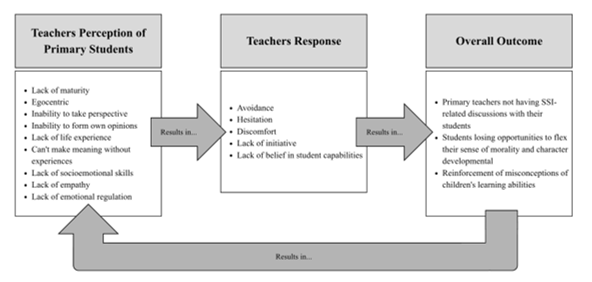
Based on the findings of this study, we suggest that consistent phrasing from teachers in terms of children lacking cognition and socioemotional skills not only diminishes their potential but also reinforces the faulty narrative that children are incapable of meaningfully learning about complex SSI topics (see Figure 1). To quell these uncomfortable feelings, teachers avoid introducing SSI topics to their students and are far less likely to take the initiative of integrating such topics into their practice. These decisions are rationalized per the initial assumptions of primary students’ developmental state. Consequently, the outcome of these teacher behaviours is crucial as it results in the absence of teaching and learning opportunities of SSI topics during children’s formative years. Eventually, should this cycle continue as children progress through the primary grades, this will lead to the risk of decreased motivation and interest in critical science topics, lowered scientific literacy, and potentially create further societal challenges in future as also evident in the previous studies (Allen & Kelly, 2015; Bastani, 2016; Zeidler & Sadler, 2023). It is important to note that these findings do not intend to blame educators for holding particular beliefs about children and their developmental stages. Instead, they highlight that the issue of introducing SSI at the primary level is incredibly complex. Because an individual teacher’s content knowledge about specific SSI topics, comfortability, emotions, and personal beliefs of what is ‘best’ for their students, influences their decisions as to whether teaching and learning of SSI should be addressed at this age-level. Alongside these, the multifaceted demands that are placed on teachers and the complexities of the classrooms also play a significant role in the decision-making process.
In the next section, we describe some developmentally appropriate pedagogical strategies for introducing SSI in primary science classrooms that may help interrupt this cycle.
Figure 1
Model of How Primary Teacher Perceptions Develop
Recommendations for SSI-based Pedagogical Strategies with Young Children
To support in-service primary teachers’ and PSTs’ integration of SSI topics into their science teaching practice, an understanding of developmentally appropriate pedagogical approaches is needed. At present, literature describing the incorporation of SSI topics in primary science classrooms is relatively scarce, with most studies sampling university, secondary, and upper elementary (Grades 4 to 8) students. To compensate, we draw from early childhood development research while interweaving familiar, accessible pedagogy that may allow generalist primary teachers to confidently explore SSI with a child-centred approach. In the following section we discuss storytelling and its various forms as potential pedagogical strategies for teaching SSI to young children.
Storytelling
Despite being one of the most fundamental tools available, storytelling is often overlooked in science education (Andrade, 2025). The concept of storytelling and orality exists universally across cultures as our most natural and familiar way of compartmentalizing experiences (Bruner, 1996). In fact, it is the way in which most human knowledge is constructed within the context of personal stories and relevance (Bowman, 2018; Landrum et al., 2019). Storytelling in a teaching capacity serves several purposes, including fostering interest, providing structure for content, sharing information through an accessible medium, and helping in creating a more personal connection between knowledge and learner (Green, 2004; Landrum et al., 2019). As a pedagogical tool, its effectiveness emerges from its concreteness, specificity, and narrative organization (Walan & Enochsson, 2019). From a cognitive science standpoint, storytelling is considered psychologically privileged in terms of memorability. At its core, the human brain reacts to what is happening in a story as though it were a genuine experience (Landrum et al., 2019). This is because it has evolved to process lived experiences sequentially in scripts akin to narratives (Copeland et al., 2015). This intersubjectivity allows learners to empathize with characters and fill-in undisclosed gaps regarding their perspectives via active comprehension (Landrum et al., 2019).
Many of the benefits of storytelling align with the work of Kieran Egan, whose theory of imaginative education proposed a five-stage model that described children’s development through successive, increasingly sophisticated cognitive tools, the most applicable at this time being mythic (Krushelnycky & Karrow, 2024; Egan et al., 2016; Judson et al, 2021). Although there is no defined age per stage, mythic understanding tends to develop during early childhood, when children begin to categorize the world through binary opposites (e.g., good vs. evil, love vs. hate, sustainability vs. greed, bravery vs. cowardice, etc.), clear beginnings, middles, and ends as they parse through subtleties and nuances of knowledge (Egan, 1986). Alongside this, Egan (2005) proposed a reversal of what is referred to as ad hoc principles, the basis of which stems from the assertion that education relies too heavily on logic and ignores the natural whimsy of a child’s mind. Instead, Egan recommended working from the abstract to the concrete, allowing children to explore complex ideas through imaginative means. Science as a discipline already presents young children with countless abstract concepts that can be difficult to fully grasp, with SSI going beyond general content knowledge and necessitating additional higher order processing skills. Through storytelling, these abstract ideas are woven into concrete ones by anchoring them into familiar experiences that children can relate and feel connected to (Hadzigeorgiou, 2016). The narrative structure also provides clear sequencing of cause-and-effect relationships, helping children to visualize abstract aspects of SSI and of how their decisions and actions can and will impact the natural world around them. When combined with intentional fostering of environmental empathy (McKnight, 2010), storytelling offers a cognitively and developmentally favourable strategy that supports simplification of difficult topics and makes them palatable for young children.
As mentioned previously, the art of storytelling comes in many forms, with the medium in which it is delivered shaping how the message is received, interpreted, and understood by the audience (McLuhan, 1964; Rowcliffe, 2004). The remainder of this section will examine a range of storytelling approaches and explore their potential to effectively introduce SSI to primary students.
Picturebooks
Picturebooks4 may appear simplistic on their surface, but they are a complex weaving of multimodal elements that rely on the interplay between words and images, allowing children to process information both verbally and visually (Crawford et al., 2024; Larragueta & Ceballos-Viro, 2018). Typically, both aspects are crafted purposefully with deliberate, meaningful aesthetics, intended to complement one another. Colour and imagery, for example, are meant to elicit emotional reactions, while the words offer aids in engaging the reader through rhythm, sound, and descriptive language, often using child-directed speech, although they appeal to all ages (Ciecierski et al., 2017; Crawford et al., 2024; Montag et al., 2015).
As a pedagogical tool, picturebooks have been shown to hold incredible power regarding cognitive and socioemotional development (Crawford et al., 2024; Saçkes et al., 2009). Broadly speaking, students’ language acquisition and vocabulary improve, critical thinking and comprehension skills strengthen, creativity is enhanced, and empathy is fostered through picturebooks (Niland, 2023; Stewart & Koopmans, 2025). In terms of science education, picturebooks play an invaluable role by presenting content knowledge that is perceived as abstract to young learners and making it concrete while improving both general literacy skills and scientific literacy as well as cultivating scientific inquiry (Fazio & Gallagher, 2019; Saçkes et al., 2009; Sohn et al., 2018).
Using images as cognitive supports, children can bridge seemingly out-of-reach concepts (e.g., climate change, pollution) by presenting such ideas through familiar, affectively stimulating narratives via the combination of visuals and text to enhance understanding (Spielger, 2020). This is especially imperative when addressing SSI topics, as concerns surrounding cognition and complexity can be mitigated through selecting a resource to support learning. Picturebooks have been recorded to be exceptionally effective for character education by facilitating the transfer of core values, with some guidance from educators (Breitfeld et al., 2021; Parker & Ackerman, 2007; Turan & Ulutas, 2016). In their review of the literature, Strouse et al. (2018) found that primary-aged children may struggle with identifying moral messages and often describe superficial characteristics over deeper themes. To accommodate this, the role of the teacher is to facilitate student learning through read-aloud techniques that scaffold learning using deliberate pauses to evoke thinking, asking intentional questions at points of contention to encourage empathic perspective-taking, and clarifying ethical and moral conundrums present so that children may explore them more meaningfully.
Cartoons and Comics
Incorporating cartoons and comics as pedagogical tools first emerged in the 1990s and has since become integral to the landscape of elementary education (McCrory & Reiss, 2023). Both instruments, although separate entities, serve as innovative methods of visual storytelling (be it digitally animated or graphics on paper) and as a medium to simplify complex topics, explore social commentaries, and engage affective domains to aid in meaningful learning (Kumar & Kumar, 2024). With their vibrant visuals and narrative structures, cartoonists not only have the ability to shape the experiences of the reader, but the work itself has the power to stimulate cognitive processes (e.g., vocabulary and language acquisition), facilitate information retention, and promote a deeper understanding of complex topics in science (Ozdemir, 2022).
As with picturebooks, comics and cartoons translate complex scientific topics into accessible, developmentally approachable visual narratives. Their multimodal structure supports primary students’ SSI comprehension by providing concrete, stimulating representations of seemingly abstract concepts (e.g., the impact of climate change, the necessity of sustainability and conservation, and GMOs). Through the story form, comics and cartoons present a range of viewpoints about science ideas in situations using characters that students can interpret the actions (or lack thereof) and identify consequences or consider alternative outcomes, providing opportunities to improve evidence-based reasoning, promote dialogue, develop scientific understanding and achieve higher quality argumentation skills (Abrori et al., 2026; McCrory & Reiss, 2023).
Puppeteering
Puppetry is a cross-cultural ancient form of artistic expression that is a variation of storytelling and human theatrical productions (McCrory & Reiss, 2023; Speaight, 2023). While there are several different types of puppets (e.g., hand, marionettes, rod, etc.) for varying purposes, a puppet constitutes a moveable doll, whose emotions, thoughts, and (potential) vocalizations are conducted by a puppeteer (Kröger & Nupponen, 2019).
Current media has popularized puppets in children’s programming, such as Sesame Street™ and the Muppets™, to not only provide entertainment, but support cognitive, socioemotional, and physical development (Hensley, 2019). Sesame Street™ particularly has been known to tackle complex conversations, including racism, homelessness, grief, trauma, and significant family changes. Additionally, puppets are frequently used as a tool in therapies with young children to help them explore difficult emotions and concerns in non-threatening ways so that they may project their feelings onto a character and process troubling experiences indirectly (Hartwig, 2021).
In formal primary education, puppets have long been successfully used in the dramatic arts and literacy to assist young students in developing academic skills (e.g., communication, language, comprehension), enhancing various cognitive functions (e.g., memory, concentration), and understanding of complex topics (McCrory & Reiss, 2023). Science education is no exception. As puppets function as intermediaries between teachers and students, educators can introduce more controversial, morally loaded topics in a less intimidating manner (Råde, 2021). This form of distancing enables children to experience difficult emotions (e.g., ecophobia, helplessness) that may arise when learning about seemingly bleak issues by humanizing the puppet as a separate entity from themselves (Lillard, 2022). Through thoughtful narrative scripting that appropriately integrates science concepts, educators can use puppets to model various elements of SSI, including argumentation, ethical and moral decision making, perspective taking, and how to draw interpretations using evidence. When students themselves manipulate puppets, they shift their initial recall of science content to one where they are using their knowledge to reason about the issue they have learned with a higher degree of thought, as well as take on the perspective of the embodied puppet who is enduring the SSI from an alternate lens.
Drama and Role-Playing
Storytelling through forms of theatrics has existed for centuries and involves students in the transmission of both individual and collaborative stories, often embedding metanarratives (whether explicitly or implicitly) while exploring an overarching topic (Verriour, 1990). During childhood, forms of imaginative and dramatic play are incredibly common, beginning as early as 18 months old, increasing with complexity and structure as they mature (Keough, 2024). As children progress, they begin to use this medium to formulate storylines and take on ‘roles’ as they play. When engaging in these roles, children exhibit the personality, behaviours, and perspectives of the character they embody, often reacting in the ways in which the character would, based on their understanding of the persona and situation. Focusing on primary-level students, drama strategies can be mutually directional forms of play and exist on a spectrum of unstructured to structured, pending educator intent (Ambrosio, 2023).
In primary science, types of dramatic play, such as sociodramatic play, have been shown to serve as a valuable tool for learning about anxiety-inducing issues as children are allowed to grapple with their fears safely (Ambrosio, 2023; Ungvarsky, 2025). This is especially helpful for teachers to quell their concerns about young students developing ecophobia when introducing SSI. Younger students feel comfortable expressing their ideas via a character in a role and for the teacher or peers to question them, helping students develop their thinking about what is ethical in science and why (Peleg et al., 2018). A significant advantage of drama is the element of role play. Role-playing allows students to embody multiple, perhaps conflicting perspectives, which fosters empathy and enhances argumentation skills, through participating in forms of dialogue (McCrory, 2014; McCrory & Reiss, 2023). Through role-play, educators can also facilitate modelling of different moral behaviours and actions via scenarios that encourage students to think critically about choices made by the ‘characters’ and make connections to their own reactions during similar experiences.
Guidelines for Integrating Storytelling and Implementing SSI in Elementary Science Classrooms
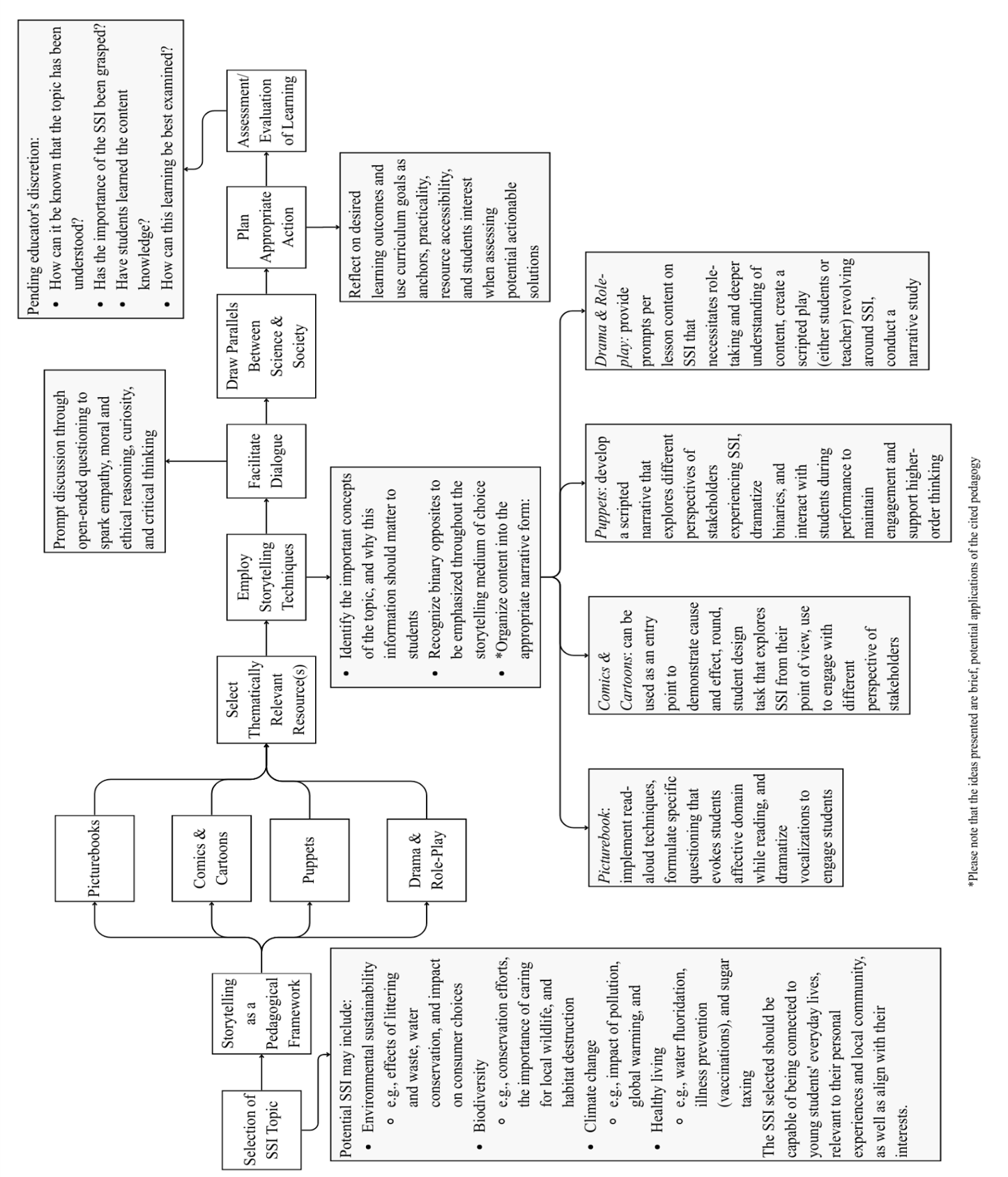
Many primary-level science resources available offer surface-level exploration into standard science concepts, following the traditionally dominant Vision I standard of school science. To move beyond this, two priorities arise: the first being the need for developmentally appropriate materials that explicitly discuss SSI topics, and the second concerning educators’ understanding of how to utilize available resources to introduce these concepts effectively. As practical SSI materials for primary students remain scarce, it is important to support teachers’ general dissemination of content using what is currently accessible. Figure 2 presents detailed guidelines of SSI implementation as a flow chart.
To summarize, the first step is selecting an SSI topic that can be approached meaningfully by the primary students. As with other aspects of curriculum, it is important to interweave an SSI topic that is both relevant and interesting that will spark initial engagement, while also offering opportunities to develop scientific literacy, explore differing perspectives, create opportunities for students to share their thoughts, and work towards actionable change. Additionally, the SSI topic chosen should be age appropriate and aligned with curriculum goals and expectations. Following this, the medium for how the narrative is to be presented is selected based on teacher and student preference, theatrical needs, creative constraints, and the intentionality of the desired message. The remainder of the steps are inspired in part by Egan’s (1986) story form as well as general lesson preparation. SSI, when paired with a developmentally appropriate pedagogy, like storytelling, can make complex topics, accessible while aligning with primary students’ current capabilities.
Figure 2
Implementing SSI Through Storytelling
Conclusion and Significance
SSI are fundamentally complex, fraught with ethical conundrums and social considerations (Zeidler & Sadler, 2023), and the idea of introducing them at the primary level can feel unviable. The thought patterns displayed by the participating teachers in this study reflect a greater issue of cyclical hesitation and avoidance of SSI teaching based on teachers’ assumption of children’s capabilities. However, there is still hope for change.
Science education during early elementary is not only crucial to several aspects of children’s cognitive and socioemotional maturation, but also to foster an interest in critical science topics (Saçkes et al., 2009). The value of science education as a force for citizenry is invaluable in the way of driving change. Should SSI continue to be circumvented, the potential for harm only increases as children move through their lives, incapable of understanding the issues they will confront. For change to occur, teachers must first acquire a thorough understanding of cognitive science as it relates to current learning and development during formative years. Overreliance on foundational developmental theories without factoring contemporary societal factors may preclude judgment of children’s capacity to effectively and meaningfully learn about complex SSI. This necessitates teachers’ understanding of the conditions shaping students learning and adapting their practice accordingly. Comparably, generalist primary PSTs may be unfamiliar with the concept of SSI. As such, exposure during science methods courses and supplemental professional learning opportunities that introduce developmentally responsive pedagogy, such as storytelling, and how to integrate SSI topics into their practice are critical to inform PSTs’ understandings of teaching SSI to primary students.
Primary students are far more capable than perceived and withholding the reality of their future will only result in ignorance and apathy towards the world around them. Through the careful planning, primary teachers can begin scaffolding complex SSI and encourage young students to explore their potential as contributing citizens in a safe and nurturing environment.
References
Abrori, F. M., Lavicza, Z., & Cahyono, A. N. (2026). Socioscientific issues comics: A scoping literature review. Journal of Graphic Novels and Comics, 17(3), 595–614. https://doi.org/10.1080/21504857.2024.2447311
Aikenhead, G. S. (2005). Research into STS science education. Educación Química, 16(3), 384–397. https://doi.org/10.22201/fq.18708404e.2005.3.66101
Allen, L., & Kelly, B. B. (2015). Committee on the science of children birth to age 8: Deepening and broadening the foundation for success. In Board on Children, Youth, And Families, Institute of Medicine, & National Research Council (Eds.), Transforming the workforce for children birth through age 8: A unifying foundation. National Academies Press. https://www.nationalacademies.org/read/19401/chapter
Ambrosio, L. (2023). The impact of dramatic play in early childhood education. Penn Foster. https://bento.pbs.org/prod/filer_public/pbsnc-redesign-phase-1/education/child-care-101/importance-of-play/14c2549650_Dramatic_Play.pdf?utm_source=(direct)&utm_medium=(none)
Andrade, B. B. (2025). The art of storytelling in science: A personal journey. Journal of Medical Education and Curricular Development, 12 (2025), 1–3. https://doi.org/10.1177/23821205251318188
Bandura, A. (1971). Social learning theory. General Learning Press. http://www.asecib.ase.ro/mps/Bandura_SocialLearningTheory.pdf
Barr, R., Kirkorian, H., Coyne, S., & Radesky, J. (2024). Early childhood and digital media. Cambridge University Press. https://doi.org/10.1017/9781108885751
Bastani, R. (2016). Enhancing children’s understanding of complex systems: A study of the design considerations of an effective learning environment. In Proceedings of EdMedia 2016: World Conference on Educational Media and Technology (pp. 1348–1353). Association for the Advancement of Computing in Education.
Bingham, A. J. (2023). From data management to actionable findings: A five-phase process of qualitative data analysis. International Journal of Qualitative Methods, 22, 1–12. https://doi.org/10.1177/16094069231183620
Bowman, R. F. (2018). Teaching and learning in a storytelling culture, the clearing house. A Journal of Educational Strategies, Issues and Ideas, 91(3), 97–102. https://doi.org/10.1080/00098655.2017.1373547
Breitfeld, E., Potter, C. E., & Lew-Williams, C. (2021). Children simultaneously learn multiple dimensions of information during shared book reading. Journal of Cognition and Development: Official Journal of the Cognitive Development Society, 22(5), 744–766. https://doi.org/10.1080/15248372.2021.1939353
Bruner, J. (1996). The culture of education. Harvard University Press. https://doi.org/10.2307/j.ctv136c601
Budzyna, D., & Buckley, D. (2023). The whole child: Development in the early years. ROTEL Project. https://rotel.pressbooks.pub/whole-child/
Cantor, P., Osher, D., Berg, J., Steyer, I., & Rose, T. (2019). Malleability, plasticity, and individuality: How children learn, and develop in context. Applied Developmental Science, 23(4), 307–337. https://doi.org/10.1080/10888691.2017.1398649
Center on the Developing Child. (n.d.). Brain architecture. Harvard University. https://developingchild.harvard.edu/key-concept/brain-architecture/#:~:text=Learn%20how%20early%20experiences%20shape,more%20complex%20circuits%20and%20skills
Chaparro-Moreno, L. J., Lin, T. J., Justice, L. M., Mills, A. K., & Uanhoro, J. O. (2023). The influence of context on the abstraction level of children’s conversations in the preschool classroom. Early Education and Development, 34(3), 705–724. https://doi.org/10.1080/10409289.2022.2067429
Chowdhury, T. B. M, Holbrook, J., & Rannikmäe, M. (2020). Socioscientific issues within science education and their role in promoting the desire citizenry. Science Education International, 31(2), 203–208. https://doi.org/10.33828/sei.v31.i2.10
Ciecierski, L., Nageldinger, J., Bintz, W. P., & Moore, S. D. (2017). New perspectives on picture books. Athens Journal of Education, 4(2), 123–136. https://doi.org/10.30958/aje.4-2-2
Cohen, D. (2017). How the child’s mind develops. Routledge. https://doi.org/10.4324/9781315201375
Copeland, D. E., Larson, K. G., & Palena, M. T. (2015). Remembering stories: Constructing elaborate situation models in memory. In K. Brakke & J. A. Houska (Eds.), Telling stories: The art and science of storytelling as an instructional strategy (pp. 40–48). American Psychological Association.
Crawford, P., Roberts, S., & Lacina, J. (2024). Picturebooks and young children: Potential, power, and practices. Early Childhood Education Journal, 52, 1273–1279. https://doi.org/10.1007/s10643-024-01701-0
Dehaene, S. (2020). How we learn: Why brains learn better than any machine-for now. Penguin Random House LLC.
Demetriou, A. (2020). Abstracting abstraction in development and cognitive ability. Behavioral and Brain Sciences, 43, Article e127. https://doi.org/10.1017/S0140525X19002930
Di Giuseppe, M., Fazio, X., Bowers, R., & Mok, W. Y. (2007). Science education: A summary of research, theories, and practice–A Canadian perspective. Thomas Nelson.
Dumontheil, I. (2014). Development of abstract thinking during childhood and adolescence: The role of rostrolateral prefrontal cortex. Developmental Cognitive Neuroscience, 10, 57–76. https://doi.org/10.1016/j.dcn.2014.07.009
Egan, K. (1986). Teaching as storytelling: An alternative approach to teaching and curriculum in the elementary school. Althouse Press.
Egan, K. (2005). An imaginative approach to teaching. Joey-Bass.
Egan, K., Bullock, S., & Chodakowski, A. (2016). Learning to teach, imaginatively: Supporting the development of new teachers through cognitive tools. McGill Journal of Education, 51(3), 999–1012. https://doi.org/10.7202/1039625ar
Ellis, J., Geiges, A., Gonzales-Zuñiga, S., Hare, B., Heck, S., Helfmann, L., Höhne, N., Missirliu, A., Han, F., & Pelekh, N. (2024). Climate action tracker: 2024 warming projections global update. Climate Analytics. https://ca1-clm.edcdn.com/CAT_2024-11-14_GlobalUpdate_COP29_2024-11-14-062702_mbaz.pdf
Fazio, X. (2023). Introduction. In X. Fazio (Ed.), Science curriculum for the Anthropocene (Vol. 2, pp.1–12). Palgrave Macmillan. https://doi.org/10.1007/978-3-031-37391-6
Fazio, X., & Gallagher, T. (2019). Science and learning integration in elementary classrooms: Instructional enactments and student learning outcomes. Research in Science Education, 49(4), 959–976. https://doi.org/10.1007/s11165-019-9850-z
French, L. A., & Woodring, S. D. (2012). Science education in the early years. In O. N. Saracho & B. Spodek (Eds.), Handbook of research on the education of young children (pp. 179–196). Routledge. https://doi.org/10.4324/9780203841198
Gleason, T., & White, R. (2023). Pretend play as abstraction: Implications for early development and beyond. Neuroscience & Biobehavioural Reviews, 147, Article 105090. https://doi.org/10.1016/j.neubiorev.2023.105090
Green, M. C. (2004, April 1). Storytelling in teaching. Association for Psychological Science. https://www.psychologicalscience.org/observer/storytelling-in-teaching
Gormley, K., Birdsall, S., & France, B. (2019). Socio-scientific issues in primary schools. Set: Research Information for Teachers, 2, 11–19. https://doi.org/10.18296/set.0139
Hadzigeorgiou, Y. (2016). Narrative thinking and storytelling in science education. In Y. Hadzigeorgiou (Ed.), Imaginative science education: The central role of imagination in science education (pp. 83–119). Springer. https://doi.org/10.1007/978-3-319-29526-8_4
Harmon-Jones, E., & Mills, J. (2019). An introduction to cognitive dissonance theory and an overview of current perspectives on the theory. In E. Harmon-Jones (Ed.), Cognitive dissonance: Reexamining a pivotal theory in psychology (2nd ed., pp. 3–24). American Psychological Association. https://doi.org/10.1037/0000135-001
Hartwig, E. K. (2021). Puppet play therapy. In Play therapy with children: Modalities for change (pp. 107–124). American Psychological Association. https://doi.org/10.1037/0000217-008
Hensley, L. (2019, August 20). Children who watch ‘Sesame Street’ may perform better at school, study finds. Global News. https://globalnews.ca/news/5787769/watching-sesame-street-child-development-study/
Judson, G., Powell, R., & Robinson, K. (2021). Educating “perfinkers”: How cognitive tools support affective engagement in teacher education. Canadian Journal for the Scholarship of Teaching and Learning, 12(1), 1–15. https://doi.org/10.5206/cjsotlrcacea.2021.1.10793
Kahn, S. (2021). No child too young: A teacher research study of socioscientific issues implementation at the elementary level. In W. A. Powell (Ed.), Socioscientific issues-based instruction for scientific literacy development (pp. 1–30). IGI Global. https://doi.org/10.4018/978-1-7998-4558-4
Keenan, T., Evans, S., & Crowley, K. (2016). An introduction to child development. Sage. https://doi.org/10.4135/9781036235048
Keough, K. L. (2024). How pretend play helps children build skills. Child Mind Institute. https://childmind.org/blog/how-pretend-play-helps-children-build-skills/
Killen, M., & Dahl, A. (2021). Moral reasoning enables developmental and societal change. Perspectives on Psychological Science, 16(6), 1209–1225. https://doi.org/10.1177/1745691620964076
Kinskey, M., & Zeidler, D. (2020). Elementary preservice teachers’ challenges in designing and implementing socioscientific issues-based lessons. Journal of Science Teacher Education, 32(3), 350–372. https://doi.org/10.1080/1046560X.2020.1826079
Kohlberg, L. (1981). The philosophy of moral development: Moral stages and the idea of justice. Harper & Row.
Koops, W. (2023). Developmental Psychology in cultural historical context–overview and further reflections. Current Issues in Personality Psychology, 11(2), 130–136. https://doi.org/10.5114/cipp/159600
Korteling, J. E., & Toet, A. (2020). Cognitive biases. In S. Della Sala (Ed.), Reference module in neuroscience and behavioural psychology (pp. 610–619). Elsevier. https://doi.org/10.1016/B978-0-12-809324-5.24105-9
Kröger, T. & Nupponen, A. (2019). Puppet as a pedagogical tool: A literature review. International Electronic Journal of Elementary Education, 11(4), 393–401. https://doi.org/10.26822/iejee.2019450797
Krushelnycky, E. (2025). The ‘sanitization’ of science education: Connecting theory and practice of socioscientific issues in elementary science classrooms [Master’s thesis, Brock University]. Scholaris. https://brocku.scholaris.ca/items/443ea725-423e-4490-86bf-bc23ddfa4d83
Krushelnycky, E., & Karrow, D. D. (2024). Science, technology, engineering, & mathematics, curricular integration, and the story form. Future in Educational Research, 3(1), 67–91. https://doi.org/10.1002/fer3.48
Kumar, P., & Kumar, P. (2024). Beyond entertainment: Examining the role of animation in fostering emotional intelligence. Proceedings of Emerging Trends in Design & Arts (ICETDA, 2024) (Vol. 2, pp. 73-79), Poornima University, Jaipur. https://icetda.poornima.edu.in/Proceeding%20ICETDA%202024.pdf
Landrum, R. E., Brakke, K. & M. A. McCarthy. (2019). The pedagogical power of storytelling. Scholarship of Teaching and Learning in Psychology, 5(3), 247–253. https://doi.org/10.1037/stl0000152
Larivière-Bastien, D., Aubuchon, O., Blondin, A., Dupont, D., Libenstein, J., Séguin, F., Tremblay, A., Zarglayoun, W., Herba, C. M., & Beauchamp, M. H. (2022). Children’s perspectives on friendships and socialization during the COVID-19 pandemic: A qualitative approach. Child: Care, Health and Development, 48(6), 1017–1030. https://doi.org/10.1111/cch.12998
Larragueta, M., & Ceballos-Viro, I. (2018). What kind of book? Selecting picture books for vocabulary acquisition. The Reading Teacher, 72(1), 81–87. https://doi.org/10.1002/trtr.1681
Lewis, J., & Leach, J. (2006). Discussion of socio‐scientific issues: The role of science knowledge. International Journal of Science Education, 28(11), 1267–1287. https://doi.org/10.1080/09500690500439348
Lillard, A. S. (2022). Pretending at hand: How children perceive and process puppets. Cognitive Development, 63. https://doi.org/10.1016/j.cogdev.2022.101202
Lindsey, R., & Dahlman, L. (2025, May 29). Climate change: Global temperature. NOAA Climate.gov. https://www.climate.gov/news-features/understanding-climate/climate-change-global-temperature
LoBue, V., Nishida, T., Chiong, C., DeLoache, J. S., & Haidt, J. (2011). When getting something good is bad: Even three-year-olds react to inequality. Social Development (Oxford, England), 20(1), 154–170. https://doi.org/10.1111/j.1467-9507.2009.00560.x
Ma, H. K. (2013). The moral development of the child: An integrated model. Frontiers in Public Health, 1. Article 57. https://doi.org/10.3389/fpubh.2013.00057
Martinovic, D., & Milner-Bolotin, M. (2022). Problematizing STEM: What it is, what it is not, and why it matters. In C. Michelsen, A. Beckmann, V. Freiman, U. Thomas Jankvist, & A. Savard (Eds.), Mathematics and its connections to the arts and sciences (MACAS) 15 years of interdisciplinary mathematics education (pp. 135–162). Springer Nature. https://link.springer.com/chapter/10.1007/978-3-031-10518-0_8
Masamba, H. (2024). Cultural influences on parenting styles and child development. International Journal of Humanity and Social Sciences, 2(3), 15–27. https://doi.org/10.47941/ijhss.1783
McArthur, B., Tough, S., & Madigan, S. (2022). Screen time and developmental and behavioral outcomes for preschool children. Pediatric Research, 91, 1616–1621. https://doi.org/10.1038/s41390-021-01572-w
McCrory, A. (2014). Investigating the moral and scientific thinking of 7-8 year olds when taught socio-scientific issues related to energy and genetics [Unpublished doctoral dissertation, University of London Institute of Education]. UCL Discovery. https://discovery.ucl.ac.uk/id/eprint/10034050
McCrory, A., & Reiss, M. J. (2023). The place of ethics in science education. Bloomsbury Publishing.
McKnight, D. M. (2010), Overcoming “ecophobia”: Fostering environmental empathy through narrative in children’s science literature. Frontiers in Ecology and the Environment, 8, 10–15. https://doi.org/10.1890/100041
McLuhan, M. (1964). Understanding media: The extensions of man. McGraw-Hill.
Metz, K. E. (1997). On the complex relation between cognitive development research and children’s science curricula. Review of Educational Research, 67(1), 151–163. https://doi.org/10.2307/1170622
Miller, P. H. (2022). Developmental theories: Past, present, and future. Developmental Review, 66, 1–13. https://doi.org/10.1016/j.dr.2022.101049
Montag, J., Jones, M. N., & Smith, L. B. (2015). The words children hear: Picture books and the statistics for language learning. Psychological Science, 26(9), 1489–1496. https://doi.org/10.1177/0956797615594361
Muppalla, S. K., Vuppalapati, S., Reddy Pulliahgaru, A., & Sreenivasulu, H. (2023). Effects of excessive screen time on child development: An updated review and strategies for management. Cureus, 15(6). Article e40608. https://doi.org/10.7759/cureus.40608
National Association for the Education of Young Children (NAEYC). (n.d.). DAP: Defining developmentally appropriate practice. https://www.naeyc.org/resources/position-statements/dap/definition
Niland, A. (2023). Picture books, imagination and play: Pathways to positive reading identities for young children. Education Sciences, 13(5), Article 511. https://doi.org/10.3390/educsci13050511
Ozdemir, E. (2022). Animated concept cartoons as a starter for cognitive conflict in online science learning: A case of circular motion. Journal of Science Learning, 5(2), 242–249. https://doi.org/10.17509/jsl.v5i2.41191
Padamsi, Z. (2017). Why pursue STEM when we have STSE? A Canadian perspective. Journal for Activist Science and Technology Education, 8(1), 18–20.
Parker, K. L. & Ackerman, B. E. (2007). Character education in literature-based instruction. Faculty Publications and Presentations, 33, 1–3. http://digitalcommons.liberty.edu/educ_fac_pubs/33
Pedretti, E. (2003). Teaching science, technology, society, and environment (STSE) education. In D. L. Zeidler (Ed), The role of moral reasoning on socioscientific issues and discourse in science education (Vol. 19, pp. 219–239). Springer Nature. https://doi.org/10.1007/1-4020-4996-X_12
Pedretti, E., & Nazir, J. (2011). Currents in STSE education: Mapping a complex field, 40 years on. Science Education, 95(4), 601–626. https://doi.org/10.1002/sce.20435
Peleg, R., Østern, A.-L., Strømme, A., & Baram Tsabari, A. (2018). Drama as a learning medium in science education. In O. Tsivitandou, P. Gray, E. Rybska, L. Louca, & C. Constantinou (Eds.), Professional development for inquiry-based science teaching and learning: Contributions to science education research (Vol. 5, pp. 65–83). Springer. https://doi.org/10.1007/978-3-319-91406-0_4
Pihkala, P. (2024). Emotional and affective issues in environmental and sustainability education. In L. H. Meyer (Ed.), Oxford bibliographies in education. Oxford University Press. https://doi.org/10.1093/obo/9780199756810-0310
Ponti, M. (2023). Screen time and preschool children: Promoting health and development in a digital world. Paediatric & Child Health, 28(3). 184–192. https://doi.org/10.1093/pch/pxac125
Presley M. L., Sickel, A. J. Muslu, N. Merle-Johnson, D., Witzig, S. B., & Sadler, T. D. (2013). A framework for socio-scientific issues-based education. Science Educator, 22(1), 26–32. https://eric.ed.gov/?id=EJ1062183
Prince, S. A., Melvin, A., & Thompson, W. (2020). Sedentary behaviour surveillance in Canada: Trends, challenges and lessons learned. International Journal of Behavioral Nutrition and Physical Activity, 17, Article 34. https://doi.org/10.1186/s12966-020-00925-8
Råde, A. (2021). Theories supporting the use of puppets as a pedagogical tool with young children. Universal Journal of Educational Research, 9(7), 1359–1368. https://doi.org/10.13189/ujer.2021.090702
Roberts, D., & Bybee, R. (2014). Scientific literacy, science literacy and science education. In N. G. Lederman & S. K. Abell (Eds.), Handbook of research on science education (pp. 545–558). Routledge. https://doi.org/10.4324/9780203097267
Rowcliffe, S. (2004). Storytelling in science. School Science Review, 86(314), 121–126. https://www.academia.edu/5051952/Storytelling_in_science
Ryan, S., & Grieshaber, S. (2004). It’s more than child development: Critical theories, research, and teaching young children. YC Young Children, 59(6), 44–52. https://www.jstor.org/stable/42729844
Saçkes, M., Trundle, K., & Flevares, L. (2009). Using children’s literature to teach standard-based science concepts in early years. Early Childhood Education Journal, 36, 415–422. https://doi.org/10.1007/s10643-009-0304-5
Sadler, T. D., Dawson, V. (2012). Socio-scientific issues in science education: Contexts for the promotion of key learning outcomes. In B. Fraser, K. Tobin, & C. McRobbie (Eds.), Second international handbook of science education (Vol. 24, pp. 709–899). Springer. https://doi.org/10.1007/978-1-4020-9041-7_53
Sanvictores, T., & Mendez, M. D. (2022). Types of parenting styles and effects on children. StatPearls Publishing. https://www.ncbi.nlm.nih.gov/books/NBK568743/
Schon, D. (2022, October 24). What is developmentally appropriate in early childhood? School Administrators of Iowa. https://www.sai-iowa.org/news/what-is-developmentally-appropriate-in-early-childhood
Science Council of Canada. (1984). Science for every student: Educating Canadians for tomorrow’s world (Report No. 36). https://www.uottawa.ca/research-innovation/sites/g/files/bhrskd326/files/2022-08/report-no.-36-science-for-every-student-educating-canadians-for-tomorrows-world.pdf
Scott, H. K., & Cogburn, M. (2023). Piaget. In StatPearls. StatPearls Publishing. https://pubmed.ncbi.nlm.nih.gov/28846231/
Seifert, K. L. (2012). Cognitive development and the education of young children. In O. N. Saracho & B. Spodek (Eds.), Handbook of research on the education of young children (pp. 19–32). Routledge. https://doi-org./10.4324/9780203841198
Sheposh, R. (2022). Abstraction. EBSCO. https://www.ebsco.com/research-starters/religion-and-philosophy/abstraction
Shivhare, R., & Kumar, C. A. (2016). On the cognitive process of abstraction. Procedia Computer Science, 89, 243–252. https://doi.org/10.1016/j.procs.2016.06.051
Simmons, N. (2017). Axial coding. In M. Allens (Ed.) The sage encyclopedia of communication research methods (Vol. 4, pp. 80–82). SAGE Publications Inc. https://doi.org/10.4135/9781483381411.n33
Sjöström, J. (2024). Vision III of scientific literacy and science education: an alternative vision for science education emphasising the ethico-socio-political and relational-existential. Studies in Science Education, 61(2), 239–274. https://doi-org./10.1080/03057267.2024.2405229
Sobel, D. (2008). Childhood and nature: Design principles for educators. Stenhouse Publishers.
Sohn, L. N., Rodriquez, R. C., & Juarez, L. M. (2018). Connecting children’s literature and science education through writing. Texas Association for Literacy Education Yearbook, 5, 110–121. https://eric.ed.gov/?id=EJ1290998
Speaight, G. (2023). Puppetry. Britannica. https://www.britannica.com/art/puppetry
Spielger, J. (2020). Picture books can open doors to tough topics. Urban Libraries Council. https://www.urbanlibraries.org/blog/picture-books-can-open-doors-to-tough-topics
Spiteri, J. (2021). Can you hear me? Young children’s understanding of environmental issues. International Studies in Sociology of Education, 30(1-2), 191–213. https://doi.org/10.1080/09620214.2020.1859401
Stanborough, R. (2026). Abstract thinking: What it is, why we need it, and when to rein it in. Healthline. https://www.healthline.com/health/abstract-thinking
Stewart, C., & Koopmans, H. (2025). Critical picture book literacy. Journal of Visual Literacy, 44(1), 71–93. https://doi.org/10.1080/1051144X.2025.2458444
Strife, S. (2012). Children’s environmental concerns: Expressing ecophobia. The Journal of Environmental Education, 43, 37–54. https://doi.org/10.1080/00958964.2011.602131
Strouse, G. A., Nyhout, A., & Ganea, P. A. (2018). The role of book features in young children’s transfer of information from picture books to real-world contexts. Frontiers in Psychology, 9, Article 50. https://doi.org/10.3389/fpsyg.2018.00050
Suh, R. (2019). Abstract thinking skills. EBSCO. https://www.ebsco.com/research-starters/religion-and-philosophy/abstract-thinking-skills
Thompson, A. (2022, February 1). How climate change will hit younger generations. Scientific American. https://www.scientificamerican.com/article/how-climate-change-will-hit-younger-generations/
Tippett, C. D., Milford, T. M., & Yore, L. D. (2019). Epilogue: The current context of Canadian science education and issues for further consideration. In C. D. Tippett & T. M. Milford (Eds.), Science education in Canada: Consistencies, commonalities, and distinctions (pp. 311–337). Springer International Publishing. https://doi.org/10.1007/978-3-030-06191-3_15
Turan, F., & Ulutas, I. (2016). Using storybooks as a character education tools. Journal of Education and Practice, 7(15), 169–176. https://files.eric.ed.gov/fulltext/EJ1103139.pdf
Ungvarsky, J. (2025). Sociodramatic play. EBSCO. https://www.ebsco.com/research-starters/social-sciences-and-humanities/sociodramatic-play
UNICEF. (n.d.). The formative years: UNICEF’s work on measuring early childhood development. https://data.unicef.org/wp-content/uploads/2019/09/Formative-Years-ECD-Brochure-EN.pdf
United Nations. (n.d.). Causes and effects of climate change. Retrieved November 24, 2025, from https://www.un.org/en/climatechange/science/causes-effects-climate-change
Vadeboncoeur, J. (1997). Child development and the purpose of education: A historical context for constructivism in teacher education. In V. Richardson (Ed.), Constructivist teacher education: Building a world of new understandings (pp. 15–38). Taylor & Francis. https://doi.org/10.4324/9780203973684-9
Verriour, P. (1990). Storying and storytelling in drama. Language Arts, 67(2), 144–150. https://www.jstor.org/stable/41961715
Walan, S., & Enochsson, A. B. (2019). The potential of using a combination of storytelling and drama, when teaching young children science. European Early Childhood Education Research Journal, 27(6), 821–836. https://doi.org/10.1080/1350293X.2019.1678923
Yilmaz, O., Bahçekapili, H. G., & Sevi, B. (2019). Theory of moral development. In T. Shackelford & V. Weekes-Shackelford (Eds.), Encyclopedia of evolutionary psychological science (pp. 1–5). Springer. https://doi.org/10.1007/978-3-319-16999-6_171-1
Zeidler, D. L. (2014). Socioscientific issues as a curriculum emphasis: Theory, research and practice. In N. G. Lederman & S. K. Abell (Eds.), Handbook of research on science education (Vol. 1, pp. 697–721). Routledge.
Zeidler, D. L., & Nichols, B. H. (2009). Socioscientific issues: Theory and practice. Journal of Elementary Science Education, 21(2), 49–58. https://doi.org/10.1007/BF03173684
Zeidler, D. L., & Sadler, T. D. (2023). Exploring and expanding the frontiers of socioscientific issues. In N. G. Lederman, D. L. Zeidler, & J. S. Lederman. Handbook of research on science education (Vol. 3, pp. 899–930). Routledge.
Zhang, J. (2022). The influence of Piaget in the field of learning science. Higher Education Studies, 12(3), 162–168. https://doi.org/10.5539/hes.v12n3p162
1 In Ontario, Canada, the term primary in education refers to students in Grades 1 to 3 who are between the ages of five and eight. The terms elementary and early elementary will be used interchangeably with primary throughout the article.
2 The term developmentally appropriate, based in part on the definition provided by the National Association for the Education of Young Children (NAEYC) (n.d.), refers to teaching methods, activities, and environments that promote children’s optimal development and learning and match their age, personal strengths, and cultural background.
3 The factory model of education reflects the framing of schooling in Canada occurring primarily during the 19th century to refer to the school-to-career pipeline.
4 The spelling of picturebooks as a single word signifies the inseparable relationship between words and pictures per research on literacy and storytelling (Crawford et al., 2024).