Building Thinking
Classrooms in Mathematics: Learning About Sustained Changes in Teacher Practice
through the Interconnected Model of Teacher Professional Growth
Candy L.
Jones, Brandon University
Author’s Note
Candy L.
Jones https://orcid.org/0000-0001-5204-6930
This research was funded by the
Brandon University Research Committee (BURC), which is funded in part by the
Social Sciences and Humanities Research Council of Canada (SSHRC).
Correspondence concerning this article
should be addressed to Candy L. Jones at jonesc@brandonu.ca
Abstract
The Building
Thinking Classrooms (BTC) Initiative, a sub-group of a larger Critical Friends
Model of teacher professional development (PD) in an urban Manitoba school
division, was designed to improve teachers’ sense of
self-efficacy in mathematics instruction and to promote the adoption of
optimal, research-based pedagogical practices. Cohorts of 29-30 primarily
math teachers/coaches worked with Dr. Peter Liljedahl (as a critical friend)
over a series of six PD sessions each year (one in-person and five virtual) to
engage with his research-based classroom practices for enhancing student
learning and enact them in their own classrooms. The case-study research
described in this paper examined data over two years (2022–2023 and 2023–2024)
to look at the impact of the BTC initiative on teaching practice(s), effective
elements of the PD model in supporting and sustaining changes in practice, and perceptions
of impacts on student engagement, achievement, and self-efficacy. Through the
use of Clarke and Hollingsworth’s (2002) Interconnected Model of Teacher
Professional Growth (IMTPG), change processes were modelled, emphasizing four
additional influences on the domains of the teacher’s world in the IMTPG,
suggesting that contextual and personal influences are critical considerations
in the planning of effective PD.
Keywords: Building
Thinking Classrooms, Interconnected Model of Teacher Professional Growth,
mathematics, professional development
Building Thinking Classrooms in
Mathematics: Learning About Sustained Changes in Teacher Practice through the
Interconnected Model of Teacher Professional Growth
In the 2022–2023 school year, an urban
school division in Manitoba, Canada, embarked upon a pilot project to improve teachers’ sense of self-efficacy in mathematics
instruction, and to promote the adoption of optimal, research-based pedagogical
practices in Grades 5–12 mathematics. This
project, which was known as the Building Thinking Classrooms (BTC) Initiative, was
part of a larger Critical Friends Model of teacher professional development
(PD) that brought cohorts of teachers together to work directly with
pedagogical experts to learn about classroom strategies for improving student
learning. In the case of the BTC Initiative, a cohort of 30 teachers worked
with Dr. Peter Liljedahl, a professor from British Columbia, Canada, who wrote
the 2021 book
titled Building Thinking Classrooms in Mathematics: 14 Teaching Practices
for Enhancing Learning (Liljedahl, 2021). Over a series of six sessions
(dispersed throughout the 2022–2023
school year), teachers engaged with Liljedahl’s pedagogical strategies for
enhancing student learning in mathematics, trying them out in their own
classrooms and debriefing together at their sessions.
Two divisional employees (a Numeracy
Specialist and a Continuous Improvement Coordinator) in charge of the BTC Initiative reached out
to me in my role as a middle and senior years (Grades 5–8 and 9–12) mathematics
methods instructor at a local university to see if I would be interested in
partnering with the division to do some research on the project. Because the
goal of the BTC
initiative was to improve teachers’ sense of self-efficacy in mathematics
instruction and to promote the adoption of research-based, optimal practices,
it was important to assess the impact of the initiative on students and
teachers in the division. As a result, the following research questions were
collaboratively framed to guide the study:
1.
How has the pilot project impacted teachers’ classroom
practice(s)?
2.
To what extent (if at all) has the project improved
teachers’ sense of efficacy in meeting mathematics outcomes?
3.
What elements of implementation of the pilot initiative
were effective in changing practice? What elements of the pilot initiative
fostered continuation of these changes in practice over time?
4.
To what extent (if at all) has the project improved
student engagement, achievement, and sense of efficacy in mathematics?
For the purposes of this paper,
emphasis will be placed on changes in teacher practice; elements of the
initiative that were effective in changing (and sustaining changes in)
classroom practice; and perceived impacts on student engagement, achievement,
and sense of efficacy.
In
addition to the research questions mentioned above, I was curious as a
researcher about how this model of PD fits within broader understandings about
effective teacher professional development (PD), how it promoted changes in
teacher practice(s), and the extent to which such changes in practice were
sustained over time. As a result, I utilized both literature from the field on
effective teacher PD and Clarke and Hollingsworth’s (2002) Interconnected
Model of Teacher Professional Growth (IMTPG), a model that illustrates teacher
change, to conduct a case study of the BTC Initiative in the hopes of answering
the research questions and learning more about effective teacher PD and teacher
change.
Literature on Effective Teacher
Professional Development in Mathematics
Many school divisions/districts
across Canada (and elsewhere) incorporate professional development initiatives
as an approach to improving mathematics teaching and student numeracy skills.
Such initiatives frequently involve the introduction of pedagogical
(mathematics) strategies and approaches by experienced speakers, researchers,
coaches, and the like via presentation or through experiential means in a
workshop-type format. The idea is that teachers then incorporate these “new”
strategies and approaches in their own classrooms. Literature on effective
teacher PD, however, generally does not support initiatives that are
“stand-alone” or “one-off” in nature (Campbell et al., 2017; Darling-Hammond et
al., 2010; Hardy, 2009). In fact, the elements of effective teacher PD are both
well-researched and numerous, as is indicated in Table 1.
Table 1
Characteristics
of Effective PD Evident in Literature.
|
Characteristics of Effective PD |
Supported in Literature |
|
1. Focused on student learning |
Campbell et al. (2017); Guskey (2003); Harwell (2003); Higgens
& Parsons (2009); Hunzicker
(2010a); Learning Forward (2011); Mundry (2005);
Murray (2014); Reeves (2010); Skyhar (2018, 2020); Timperley (2008); Whitcomb
et al. (2009) |
|
2. Includes subject-specific content and
pedagogical content knowledge |
Bredeson (2002); Campbell et al. (2017); Harwell (2003); Higgens &
Parsons (2009); Hunzicker (2010a, 2010b); Mundry (2005); Murray (2014); Porter et al. (2003); Quick
et al. (2009); Skyhar (2018, 2020); VanDriel & Berry (2012) |
|
3. Aligned with school, district, curricular, and
individual teacher goals |
Bredeson (2002); Campbell et al. (2017); Hunzicker
(2010a, 2010b); Murray (2014); Porter et al. (2003); Quick et al. (2009);
Skyhar (2018, 2020) |
|
4. Opportunities for active learning |
Campbell et al. (2017); Darling-Hammond & McLaughlin (2011); Hunzicker (2010b); Porter et al. (2003); Quick et al.
(2009); Skyhar (2018, 2020); Timperley (2008); Villegas-Reimers (2003) |
|
5. Collegial and collaborative learning
environment characterized by respect, trust, safety, and
accountability |
Bredeson (2002); Bruce et al. (2010); Campbell et al. (2017);
Darling-Hammond & McLaughlin (2011); Goos et al. (2011); Hargreaves &
O’Connor (2018); Harwell
(2003); Hunzicker
(2010a, 2010b); Learning Forward (2011); Murray (2014); Nelson et al. (2010);
Porter et al. (2003); Quick et al. (2009); Skyhar (2018, 2020); Timperley
(2008); VanDriel & Berry (2012); Whitcomb et al. (2009) |
|
6. Embedded in the daily life of schools |
Bredeson (2002); Bruce et al. (2010); Campbell et al. (2017);
Darling-Hammond & McLaughlin (2011); Goos et al. (2011); Hunzicker (2010a, 2010b); Mundry
(2005); Murray (2014); Quick et al. (2009); Skyhar (2018; 2020) |
|
7. Ongoing in duration |
Campbell et al. (2017); Darling-Hammond & McLaughlin (2011); Harwell (2003); Hunzicker
(2010a, 2010b); Murray (2014); Porter et al. (2003); Quick et al. (2009);
Skyhar (2018, 2020) |
|
8. Scalable and sustainable |
Loucks-Horseley et al. (2010); Skyhar (2018, 2020); Timperley (2008);
Whitcomb et al. (2009) |
|
9. Adequate support in terms of time, resources
and leadership |
Bredeson (2002); Campbell et al. (2017); Darling-Hammond &
McLaughlin (2011); Goos et al. (2011); Hunzicker
(2010a, 2010b); Learning Forward (2011); Mundry
(2005); Quick et al. (2009); Skyhar (2018, 2020); Timperley (2008);
Villegas-Reimers (2003) |
Given the characteristics of
effective teacher PD listed in Table 1, it follows that effective teacher PD in
mathematics should be not only aligned with divisional goals of improving
student numeracy skills but also focused specifically on mathematics content
and pedagogy as well as student learning. In addition, effective teacher PD in
mathematics should include ongoing, job-embedded, active PD opportunities in
which teachers are able to come together in a collegial and collaborative
environment to learn and dialogue about mathematics, mathematics teaching, and
student learning. Such experiences
should occur throughout the year and include adequate time and resources for
teachers to embed their learning within their own classroom contexts.
The BTC Initiative
The BTC
Initiative embodied most (if not all) of the characteristics of effective
teacher PD identified in Table 1. The initiative brought together 30 volunteer
teachers/coaches, comprised of 4 Senior Years (Grades 9–12) teachers, 18.5 Middle Years (Grades
5–8) teachers, 6.5
Academic/Numeracy Support Teachers, and 1 SY Continuous Improvement Coach (note
that some teachers had dual roles and were counted as 0.5 according to their
dual roles). The cohort was co-led by two divisional employees, a Numeracy
Specialist and an Administrator of Continuous Improvement, and met six times
over the course of the 2022–2023
school year for full-day (9 am – 3 pm) PD sessions with Peter Liljedahl (one
in-person in the spring and 5 virtual). At these sessions, Liljedahl, as a
critical friend, shared pedagogical practices (actively and experientially) with
cohort teachers/coaches from his research and the book published about it.
Teachers/Coaches were provided with his book, vertical non-permanent learning
surfaces (VNPSs) in the form of laminated white sheets (Wipebooks),
and dry-erase markers and encouraged to try out his pedagogical strategies in
their own classrooms between sessions. They were then allowed to reflect on
their experiences when they met, before learning about more pedagogical
practices for implementation. As a result, the BTC Initiative was ongoing in
duration; focused on mathematics, mathematics pedagogy and student learning;
aligned with divisional numeracy goals; and provided time, resources, and
leadership. Teachers worked within a collaborative cohort, engaged in active online
and in-person experiences with Liljedahl, and worked to implement strategies
within the contexts of their own classrooms (job-embedded). Finally, the cohort
model allowed for the initiative to be scaled up and sustained over time, as
more teachers joined cohorts, creating a critical mass of teachers in the
division that had experienced Liljedahl’s practices for enhancing student
learning.
Liljedahl’s
Pedagogical Practices for Enhancing Learning
In his
2021 book, Liljedahl describes how he noticed in his observations of
teaching and learning that students weren’t thinking, and teachers were
planning their teaching based “on the assumption that students either couldn’t
or wouldn’t think” (p. 6). This is what spurred him to spend the next 15 years
working with “over 400 K–12 teachers to try to
break through the non-thinking behaviours and get students to think” (p. 12).
What ensued was a series of classroom experiments with teachers, searching for
“local optimal practices” (p. 15) that could be scaled up to work for any
teacher. Weeks were spent fine-tuning each “optimal practice for thinking,” and
the result was a book with a chapter on each of fourteen strategies that impact
thinking in a classroom.
Of the optimal practices described in the book, one of
the most significant changes to traditional mathematics teaching is the use of
VNPSs. Liljedahl proposes in the book that teachers decenter the classroom and
have students work standing at VNPSs in groups of three. This, according to
Liljedahl, promotes thinking and engagement and decreases reliance on the
teacher. Tasks are given to students shortly after entering the room, and
rather than modelling through showing students how to solve problems (e.g. at
the front of a whiteboard or via PowerPoint) and expecting them to mimic
procedures (e.g. on practice questions), teachers require students to approach
novel problems at VNPSs that are open and easily extended. Once students are
working, teachers only provide hints and extensions needed to help students
think, as opposed to answering questions about how to solve the problem or
verifying that students have the correct answer. Learning is consolidated in
such an approach by looking at the work of various groups, noting commonalities
and unique approaches, and having students explain their thinking and the
thinking of others. Finally, notes and homework, frequently used in traditional
classrooms, are optimized in Liljedahl’s ‘thinking classrooms’ as well, as they
are personalized and suggested (not required) for students, giving them
autonomy and choice in how they document and solidify their learning.
The Six PD
Sessions
The six
sessions that were led by Liljedahl broke his fourteen practices down into
smaller chunks known as “toolkits” (see Table 2 below).
Table 2
BTC
Toolkits.
|
Toolkit 1 |
Thinking
tasks, random groupings, vertical non-permanent surfaces (VNPSs) |
|
Toolkit 2 |
Defronting the classroom, answering only keep thinking
questions, give thinking tasks (early, standing, verbally), CYU questions,
mobilize student knowledge |
|
Toolkit 3 |
Use hits
and extensions to maintain flow, consolidate from the bottom up, have
students write meaningful notes |
|
Toolkit 4 |
Evaluate
what I value, help students see where they are and where they are going,
grade based on data not points |
Sessions tended to focus on one toolkit (and section
of chapters in the book) at a time, allowing Cohort teachers to be introduced
to them, work with Liljedahl, and then put them into practice in their
classrooms in between sessions. In this way, the practices were gradually
introduced over the course of the school year with a focus on the implementation
of new learning in a practical setting. By the end of the first year of the BTC
Initiative, all 30 teachers had worked through all four of the toolkits with
Liljedahl and been encouraged to try the practices in their own contexts.
Year 2 of the BTC Initiative
In
2023-2024, two groups essentially emerged in relation to the BTC initiative:
the Original Cohort, which consisted of 8 MY teachers/coaches of the original
30 who continued to meet with the Numeracy Specialist to work on implementing Lildjedahl’s pedagogical practices; and the Secondary
Cohort, a new group of 29 teachers who started a new series of 6 sessions (1
in-person in the fall and 5 virtual) with Liljedahl. While the content of the
Secondary Cohort sessions with Liljedahl was similar, two important changes in
structure were made in response to feedback provided by the 2022-2023 Cohort.
The first was that the spring in-person session with Liljedahl was moved to the
fall in order to ‘see’ Liljedahl’s strategies enacted
(by him, in-person) sooner in the year. The second important change in
structure for the Secondary Cohort was that time was built into the afternoons
of two of the sessions to debrief and unpack what had been said, and to plan
for classroom implementation. This was also done in response to teacher
feedback.
In terms of the meetings held for the Original Cohort
in the second year, a total of three full-day sessions were held in 2023–2024, led by the Numeracy
Specialist. During these sessions, participants reviewed the fourteen BTC
practices (including micro moves), reviewed new BTC research, shared task
resources, and created tasks, navigation instruments, and
check-your-understanding (CYU) questions. Participants had the opportunity to
share how things were going in their own classrooms, ask questions of their
colleagues and the Numeracy Specialist, and hear about new things shared by
Liljedahl at the Secondary Cohort meetings. They were also afforded much-needed
time to work collaboratively on resource development.
Research Methods
A single case study design, an appropriate methodological choice for an in-depth study of a single unit
or bounded system (Creswell, 2007; Flyvbjerg, 2011; Merriam, 1998; Stake,
1995), was utilized for this study. The BTC project provided a bounded case
that was both unique and revelatory (Yin, 2009), allowing for insight to be
gained into the approach to professional development taken, its impact on the
instructional practices of divisional teachers, and the resulting influence of
the project on student engagement, achievement and sense of self-efficacy in
mathematics (note that one teacher also used the strategies in a Physics
context). In order to gain such insight, both primary and secondary data were
collected over the first two years of the initiative (see Table 3 below).
Table 3
Data Sources.
|
Primary Data (Year 1) |
Primary Data (Year 2) |
Secondary Data Provided by
Division |
|
6
teacher/coach interviews: 1 high
school teacher, 4 middle years teachers and 1 middle years
teacher/coach |
4 teacher interviews: 1 high
school teacher and 3 middle years teachers (3 were
interviewed in previous year, 1 was not) |
Financial
information |
|
3 student
focus group conversations with students of teachers/coaches interviewed: 1
high school and 2 middle years focus groups (4-5
students each) |
|
Notes and summaries of
activities from Numeracy Specialist & Continuous Improvement
Administrator |
|
2
interview(s) with pilot project co-leads - Numeracy Specialist and Continuous
Improvement Administrator |
2
interview(s) with pilot project co-leads - Numeracy Specialist and Continuous
Improvement Administrator |
Anonymous
survey data from teachers participating in the pilot (after Year 2) |
Teachers/Coaches and co-leads
were recruited to participate in semi-structured interviews for the study in
both the first and second year via email (with attached letter of invitation). Teacher/Coach
semi-structured interviews focused on questions about what their practice
looked like prior to the BTC Initiative, what it looked like after, effective
elements of the PD initiative, impacts on their sense of efficacy as teachers,
and perceived impacts on student engagement, achievement, and self-efficacy. Co-lead
semi-structured interview questions focused on elements of the initiative and perceived
impacts on teachers’ practice(s) and student engagement, achievement, and
self-efficacy in mathematics.
Students of the teacher
interviewees in the first year were recruited through the use of a physical
letter of invitation to parents and students. All participants (and their
guardians if under 18 years of age) signed a consent form prior to
participation. Focus group questions with students focused on perceived changes
in their teachers’ practices and their own perceptions of their self-efficacy
as math students, their achievement in the class, and their engagement with the
new pedagogical and learning strategies experienced.
Interviews and focus group
discussions were audio-recorded and transcribed for analysis, and all interview
participants were provided with copies of their transcript(s) for editing/adjusting
and verification prior to its/their use as data for the study
(member-checking).
Secondary data in the form of
reports, notes, files, summaries and survey data were also provided annually by
the co-leads of the initiative following their individual interviews. The
school division approved both the study and the forms of data collected prior
to the commencement of the research, as well as all changes made to the
research methods and protocols in the second year.
The first round of data
analysis utilized
reflective thematic analysis, a process involving the following six phases: 1)
familiarizing yourself with the data set, 2) coding, 3) generating initial
themes, 4) developing and reviewing themes, 5) refining, defining, and naming
themes, and 6) writing up the findings (Braun & Clarke, 2022, p. 35-36).
Following transcription and member-checking of interviews and focus group
conversations each year, the researcher familiarized herself with the data and
performed initial coding (Saldaña, 2009) using topics related to literature about
effective teacher PD and the collaboratively designed research questions.
Coding was also extended to include emergent themes from the data before codes
and themes were refined into broad categories or themes. A second round of
coding and data display also took place, utilizing charts/tables and Clarke and
Hollingsworth’s (2002) IMTPG model, as changes in practice for each teacher
were organized into categories and an overall trajectory of teacher change was
displayed using the model.
Theoretical and Conceptual Frameworks
The research conducted draws on
social constructivist theory, which acknowledges that individuals (including
teachers engaging in PD) construct understandings of new phenomena as they
engage in actions (experiences, activities, dialogue and reflection) that allow
new ideas to rub up against existing understandings, beliefs and attitudes
(Richardson, 1997, 1999). All of this happens within a social context that
cannot be separated from the individual learning that occurs (McCullagh, 2012; Pitsoe & Mailia, 2012; Richardson, 1997, 1999). Within
the context of mathematics teachers engaging in PD as cohorts, this means that
the actions they engage in together, including the new information they are
exposed to, the conversations they have together, and the experiences have in
their own classrooms and then unpack together in sessions, foster the
individual construction of new understandings, beliefs, and attitudes that are
influenced in complex ways by the social context in which the learning takes
place.
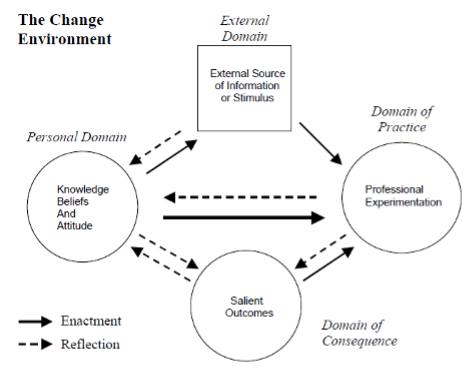
As
a conceptual model, Clarke and Hollingsworth’s (2002) IMTPG model illustrates
the complex process of social construction of new understandings, beliefs, and
attitudes through the process of ‘enactment’ and ‘reflection’ across the four
domains of the teacher’s world: the external domain, the personal domain, the
domain of practice, and the domain of consequence (see Figure 1). As a result,
it is a useful tool for both thinking about teacher change and for looking at
data for evidence of this change.
Figure 1
The IMTPG (Clarke & Hollingsworth, 2002, p. 951)
Findings
Findings
from the study are broken down into five sections: changes in the classroom
practices of teachers; elements of the initiative effective in changing and
sustaining changes in practice; barriers
to affecting changes in practice and suggestions from teachers; illustrating
teacher change with the IMTPG, and
impacts on
student engagement, achievement and efficacy. These sections align with the
collaboratively designed research questions that guided the study. The findings
from the study are also followed by a discussion of their importance in terms
of what is known about effective teacher PD and teacher change.
Changes in
the Classroom Practices of Teachers
After the
second year of the BTC initiative, a survey was sent out to all participants in
the BTC initiative by the Numeracy Specialist. Of the 59 participants in the
initiative, 41 responded to the survey. The survey focused on gathering
information about the degree to which participants planned to implement the 14
BTC practices outlined by Peter Liljedahl in the future. Of the respondents, 35
planned on implementing the fourteen practices in the 2024-2025 school year,
although to varying degrees (19 indicated they would implement some of
the practices, 10 indicated they would implement most of the practices,
and six indicated they would implement all of
the practices). Six of the respondents indicated that they would not be
implementing the practices in the following year (five of these were no longer
teaching math/their teaching assignment had changed, and one felt they did not
have enough time to adapt their lessons to the BTC style, given their other
commitments).
In addition to the survey data, interviews conducted
with participants in both years of the study further explained what classroom
changes had taken place for the Original Cohort (within broad thematic
categories identified through the coding process). In particular, the
trajectory of four of the participants highlighted the varying levels of
changes that took place over 2022-2023 and 2023-2024. Participant 1, for example, implemented many
of the 14 practices consistently, beginning prior to the BTC Initiative and
extending through both years. In addition, they utilized their own assessment
methods, opting to use an ‘ungrading’ strategy in
their high school physics courses.
Table 4
Participant 1 (High School Physics/Math) –
Interviewed in both years.
|
|
Prior to BTC |
Year 1 |
Year 2 |
|
Classroom |
Physics lab with immovable
tables. Smartboard at front. |
Room remained the same with the
addition of VNPSs and “scientist” labels for random groupings. |
|
|
Instruction |
Fairly traditional. Examples on Smartboard at front: “I do, We do, You do” |
Started before BTC initiative.
Utilized visibly random groups, moved between Smartboard and VNPS. |
Continued to use VNPSs and
visibly random groups daily. |
|
Student work |
Individual whiteboards used
during lesson. Independent work after board
work. Cumulative exercise packages
created by teacher (20 problems) – Do
every odd one, even if nec. |
Math - Used problem sets to
create VNPS tasks. Students did them collaboratively at VNPSs. Physics – a couple of scaffolded
problems (would previously have done as examples on board) done at VNPSs. |
Not teaching math. Physics – a couple of scaffolded
problems (would previously have done as examples on board) done at VNPSs. |
|
Clarifying/ Consolidating |
Go over questions the next day
related to the problems. |
Worked on consolidation at VNPSs
after seeing Liljedahl in person. |
Improving consolidation skills
at VNPSs. |
|
Notes |
Notes packages. |
Tried out Liljedahl’s methods
for note-taking. |
Liljedahl’s four corners
note-taking method. |
|
Homework |
Not assigned. Up to student to
do as many questions/problems as needed. |
Math – doing problems at the
VNPS and more specialized problems as independent work. Physics – 3-4 specialized
problems (attempt from multiple perspectives). |
No longer teaching math. Physics – 3-4 specialized
problems (attempt from multiple perspectives). |
|
Assessment |
Moved from traditional tests
(written, outcomes-based) to ‘ungrading’
(portfolios, interviews, skills-based, students self-assess and negotiate
grade with teacher). Mostly in physics. Math remained more traditional. |
Continued with ungrading in physics and traditional tests in math. |
No longer teaching math. Continued with ungrading in physics. |
|
Planning |
|
Math – Used the cumulative
exercises as a starting point for thin slicing tasks. Physics – Used previous examples
and materials to create tasks. Also consulted a lot of websites
and online resources. |
|
Participant 5, on the other hand, had limited
implementation of BTC strategies in their Grade 7 classroom. While they were
able to dabble with the strategies in the first year and work collaboratively
with a Coach at the beginning of Year 2 of the initiative (about six weeks),
competing PD initiatives (ELA) and changes in personnel with whom they were
collaborating made it difficult to fully implement the BTC practices.
Participant 5 continued to use the VNPSs in their classroom; however, primarily
for review purposes.
Table 5
Participant
5 (Grade 7) – Interviewed in both years.
|
|
Prior to BTC |
Year 1 |
Year 2 |
||
|
Classroom |
Desks facing front or table groups (with
defined front). |
Defronted – no table groups facing the front (facing
all directions). |
|||
|
Instruction |
First 20 minutes – mental math game. Next 20 minutes – Teacher introduces new
concepts. |
Tried the VNPSs approximately 10 times over
the course of the year. This involved a 5-minute introduction followed by
30-40 min. of VNPS work before coming back together to consolidate. |
Began the year partnering with a numeracy
specialist for 6 weeks. Began with non-curricular tasks and extended into
curricular tasks. Tried a thin slicing
lesson in October. Continued use of VNPSs for Review. |
||
|
Student work |
20 minutes – students work independently on
practice. |
|
Utilized Mild/Medium/Spicy with VNPS work
in reviews. |
||
|
Clarifying/ Consolidating |
|
|
|
||
|
Notes Homework Assessment |
These were not discussed in the interviews. |
||||
|
Planning |
|
|
When no time to plan, used the banner (at
VNPSs) and reviewed concepts. |
||
Participants 6 and 10 became strong collaborative
partners in Year 2. While Participant 10 had their position change partway
through Year 1 of the initiative, they returned to a Grade 5/6 classroom in
Year 2 and partnered with Participant 6 to fully implement all Lilijedahl’s toolboxes. Participant 6 had the experience of
moving from Grade 5 to Grade 6 over the two years (8 out of 24 students made
the move with them). Participants 6 and 10 met weekly on Tuesdays after school
to plan together and spent a lot of their own time on evenings and weekends
creating materials for use in their classrooms (which they shared both with
each other and to a lesser extent at the Year 2 sessions that met 3 times in 2023-2024).
Both teachers began their second year fully implementing Liljedahl’s
strategies, having tried several of them out in their first year in the BTC
project.
Table 6
Participant 10 (Grade 5 /6) – Only
interviewed in Year 2.
|
|
Prior to BTC |
Year 1 |
Year 2 |
|
Classroom |
|
|
Room defronted.
Desks in groups facing different directions. Whiteboards around classroom. |
|
Instruction |
Instruction at the front (PowerPoint). Used manipulatives. Individual whiteboards. |
Tried lessons with VNPSs a handful of
times. Was pulled out of classroom halfway through
the year. |
Full implementation of Liljedahl strategies
from first day of the year. Almost every day (tasks, thin slicing). Worked a
lot on routines and expectations (also employed video for this). 10 days of
non-curricular tasks and then into place value. Used VNPSs in other subjects
as well. |
|
Student work |
Individual whiteboards. Paper-pencil tasks. Used manipulatives. |
. |
Daily at the boards (used cards with
answers on the back) and then levelled choices (CYU) in their notebooks
(mild, medium, spicy). Focus on justifying thinking. Finds the notebook
provides lots of information about student understanding. |
|
Clarifying/ Consolidating |
|
|
Consolidated at VNPSs and then moved to CYU
questions. |
|
Notes |
|
|
Implemented notes to your future forgetful
self for each topic in the unit. Started out fairly guided in the beginning,
becoming more independent. |
|
Homework |
|
||
|
Assessment |
Written assessments. |
|
Used the CYU in notebooks in addition to 1–2-page
written assessments. Students allowed a notes page/cheat sheet for written
assessments. A lot of work (self/group) assessing norms
and expectations at VNPSs and of work. |
|
Planning |
|
|
Worked with Participant 6. They met once a
week (Tuesdays) throughout the year to plan together plus spent several hours
on their own creating tasks and materials. Participated in Year 2 group of 7-8
participants (3 meetings over the year). |
Table 7
Participant
6 (Grade 5 Year 1, Grade 6 Year 2) – Interviewed in both years.
|
|
Prior to BTC Grade 5/6 |
Year 1 Grade 5 |
Year 2 Grade 6 |
|
Classroom |
|
Groups/Centers/Clusters of desks defronted. |
|
|
Instruction |
Centers used – each group has a math menu
with 2-ish must do activities for a 30 min. class. Lessons taught through center groups or
full class. |
Continued with centers (but not math
menus). Began to implement lessons with VNPSs and
CYU questions (mild, medium and spicy). (2X per week). Tried some thin
slicing and banners. |
8/24 students experienced VNPSs the
previous year with the teacher. Full implementation of Liljedahl strategies
from first day of the year. Almost every day. A lot of thin slicing and
larger curricular tasks at VNPSs. |
|
Student work |
Math Menus – ‘Must do’ activities (lesson
with the teacher, find the error, etc.) and ‘may do’ activities once finished
(e.g. sudoku, Esti-mysteries, which one doesn’t belong, etc.). Collaborative
or independent. |
Began to implement Check Your Understanding
(CYU) questions with levels – mild, medium and spicy. |
Daily at the VNPSs and then levelled
choices (CYU) in their notebooks (mild, medium, spicy), noted this helped
identify struggling students and misconceptions. Also used Fullerton’s Big 4 this year – 4
big questions on the topic (not leveled). |
|
Clarifying/ Consolidating |
|
Started some consolidation when trying VNPS
tasks. |
Consolidated at VNPSs and then moved to CYU
questions. |
|
Notes |
Teacher directed. |
Used scaffolded notes where notes were
given and students found errors in problems. Also had students find their own
examples. |
Implemented notes to your future forgetful
self for each topic in the unit. Started out fairly guided in the beginning,
becoming more independent. Employed Liljedahl’s four corners/quadrant
note-taking method. |
|
Homework |
Did not assign homework |
||
|
Assessment |
Written assessments for each grade (5 and
6). |
Tried outcomes-based learning
maps/checklists suggested by Liljedahl. Started to include leveled questions (mild,
medium, spicy) on assessments. |
Continued with leveled questions on written
assessments. Students allowed a notes page they made on blank template. Students self-assess their group work
skills. |
|
Planning |
|
|
Worked with Participant 10. They met once a
week (Tuesdays) throughout the year to plan together plus spent several hours
on their own creating tasks and materials. Participated in Year 2 group of 8-9
participants (3 meetings). |
Overall, these tables illustrate the varying degrees
of implementation and change among teachers in the BTC initiative. Some
teachers dabbled in using the strategies, while others engaged in sustained,
ongoing growth and change over the 2022–2023 and
2023–2024 school years.
Elements
of the Initiative Effective in Changing and Sustaining Changes in Practice
Participants
in the study identified many elements of the initiative that were effective in
changing practice and supporting student learning, and that contributed to the continuation
of changes in practice over time. Included in the effective elements were several
factors related to support in the working environment, such as the support
provided by peers (other Cohort teachers/coaches), the Numeracy Specialist,
Numeracy Coaches in the division, administrators, and Liljedahl, himself
(particularly when in-person). Additionally, participants found working in an
environment with like-minded colleagues (colleagues in the same school or who
were also part of the Cohort) especially beneficial (at sessions and in the
Year 2 follow-up), although they noted that having a personal commitment to the
process, including a willingness to spend hours of personal time to create
tasks, plan and collaborate, was also important. Overall, teachers liked the
accessibility of the online sessions, despite a few technology issues, and
noted that the ongoing nature of the PD promoted change as is evident in the
following statement: “I did like the idea of it being
like a yearlong, kind of ongoing, ongoing process, as opposed to like, doing it
one day, and then kind of, you know, forgetting about it, almost” (P5
Interview, Year 2). Finally, one of the participants noted that elements of
crossover between other Critical Friends Model PD sessions (specifically one
focused on developing an understanding of the ‘numerate learner’) were also
helpful.
Barriers to Affecting Changes in Practice and
Suggestions from Teachers
In
addition to identifying effective elements of the model, teachers/coaches also
identified several challenges/barriers to affecting and sustaining changes in
practice. For example, Participant 1 noted that high school teachers were not
included in the three Year 2 follow-up sessions offered to middle years teachers
in the Original Cohort (minimizing their ability to continue with the support
of colleagues). In addition, while participants understood the financial
constraints in the division, they noted that it was much more beneficial to
work with Liljedahl in person than virtually, due to technology glitches and
the isolating nature of working online. Several participants, including the
Numeracy Specialist and Continuous Improvement Coordinator, also acknowledged
varying levels of buy-in from teachers, attributing this to a variety of
factors such as complex classroom/working environments (e.g. challenging student
behaviors, background gaps due to COVID, heavy workloads, lack of substitute
teachers to attend PD sessions, competing PD initiatives and service work, lack
of time to collaborate with others, lack of access to colleagues in the same
building to plan with, and lack of BTC-related resources/tasks), and individual
teacher factors (e.g. lack of personal time to plan, and level of personal
commitment, including a tendency to revert to traditional methods).
In analyzing the changes in
practice evident in the interview data and the effective elements and barriers
described by teachers alongside the literature on effective teacher PD, it is
evident that the BTC Initiative (overall) aligned very well with many
characteristics of effective PD. In particular, its alignment with the
division’s numeracy goals and other initiatives in the division (teachers spoke
about crossover) was effective for teachers, as were both the collaboration
with peers (or like-minded colleagues) and the ongoing nature of the PD (six
sessions over the course of the year). Even though working with Liljedahl
online posed some technical difficulties, the many sessions over the course of
the year, supported by the leadership of the Numeracy Specialist
and Continuous Improvement Coordinator, were described as effective by teachers
consistently. As discussed in the next section, teachers also found the strong
focus on student engagement and learning alongside the specific pedagogical strategies
(actively) presented particularly effective, aligning with what is known about
effective PD as well; and although teachers didn’t explicitly speak about the
scalability of the initiative, some were able to sustain significant changes in
practice over time. Interviews with the Numeracy Specialist and Continuous
Improvement Coordinator also described the division’s plan to scale up the
initiative at length, indicating that there were strong elements of scalability
and sustainability built into the model.
Despite very strong alignment with
what is known about effective teacher PD, there was still variance in terms of
both the depth of changes in practice seen and the degree to which changes were
sustained over time. These differences largely reflected individual
circumstances (personal and/or in terms of classroom/school/divisional context).
Table 8 outlines four primary influences on teachers’ ability to make changes
in practice and/or to sustain changes in practice over time (along with
descriptions of how they were evident in the study data).
Table 8
Influences
on Teacher Change.
|
Influence |
Description |
|
Personal Time |
The two teachers (Participants 6
and 10) who engaged in robust growth and implementation of the Liljedahl
strategies in year 2 of the study spent an incredible amount of their own
personal time to keep the cycles of growth going. Teachers with small children
at home or without the personal time to devote to this growth may not have
been able to continue as effectively over time. |
|
Personal Commitment |
Some teachers in the project did
not have a high level of commitment to the strategies they were exposed to.
The reasons for this were varied (e.g. skepticism about the research, concern
about student behaviour, being ‘voluntold’ to participate in the initiative
rather than volunteering themselves). Those teachers who didn’t have a high
level of commitment were not able to continue with the strategies effectively
over time. |
|
Classroom Environment |
Changes in teaching assignments
altered teachers’ ability to engage in ongoing, sustained change, as did the
students and student behaviours. Teachers made decisions about how much to
implement the practices based on perceived student needs. For example, one
teacher interviewed in the first year (Participant 7) elected to use the
strategies only for enrichment. In addition, positive student experiences
(e.g. students in FG 2 who were the students of Participant 1) also fostered
continuation of teacher changes in practice over time. |
|
School/ |
The broader environment in the
school/division also impacted what teachers were able to manage in terms of
changes in practice. For example, competing initiatives impacted the Domain
of Practice for some teachers (e.g. Participant 5) overtaxing their capacity
for engaging in PD, for being away from the classroom, and for implementing
new classroom strategies. This interrupted networks of growth and/or made
ongoing growth difficult. Other divisional initiatives (e.g. PD related to
developing a vision of the numerate learner) fed into the growth network as
additional external information/stimulus, thereby fostering change/growth. |
In terms of elements of effective teacher PD, these
four influences impacted aspects of several of the elements, including:
alignment with teacher goals, teacher accountability, the sustainability of
both changes in practice and engagement with the PD/Initiative, and the amount
of time that was available for ongoing learning. Such impacts decreased the
effectiveness of the PD for individual teachers.
Illustrating
Teacher Change with the IMTPG
As part of
the second round of data analysis, Clarke and Hollingsworth’s (2002) IMTPG
Model was used to model/illustrate teacher changes in practice as described in
the study data. The characteristics of the BTC Model, including the elements of
effective PD it incorporated in its design, allowed for significant changes in
teacher practice to take place; for improvements in student engagement,
achievement, and sense of efficacy to occur; and for growth in teacher
knowledge, beliefs and values to transpire. Such a change, along with the
influences described in Table 8, could be illustrated using the IMTPG model as
follows:
Figure 2
Changes in the BTC Initiative as Illustrated
Using the IMTPG Model
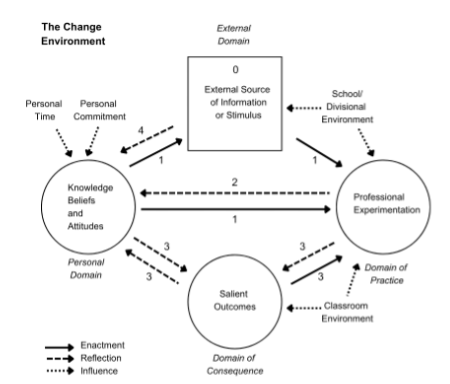
The numbers superimposed on the
IMTPG model in Figure 2 illustrate the change process (as evident in the study
data) through what Clarke and Hollingsworth (2002) call change sequences
and growth networks. Change sequences, according to Clarke and
Hollingsworth (2002), can be described as follows:
A change sequence consists of two or more
domains together with the reflective or enactive links connecting these
domains, where empirical data support both the occurrence of change in each
domain and their causal connection. A change in one domain may not lead to a change
in another. Where it does, we employ the term “change sequence.” Such a change may be fleeting, a
single instance of experimentation, quickly relinquished. (p. 958)
Participant 5’s experience of
trying out Liljedahl’s strategies but relinquishing them except for during unit
reviews is an example of a change sequence in which the Domain of Practice
was temporarily changed, but in which the Personal Domain and Domain
of Practice were not changed long-term. Growth networks, however, are more
lasting in nature, according to Clarke and Hollingsworth (2002), and can be
described in the following way:
The term “growth” is reserved for more
lasting change. This does not preclude a changed practice or belief from being
further adapted or refined. Indeed, the adoption of a growth perspective
conceives of change as ongoing. Where data have demonstrated the occurrence of a
change that is more than momentary, then this more lasting change is taken to
signify professional growth. A change sequence associated with such
professional growth is termed a “growth network”. (p. 958)
In the case of participants in the
BTC Initiative (e.g. Participant 6 and 10), growth networks (through the
processes of enactment and reflection) could be described by the
numbers superimposed on Figure 2 as follows:
0. Participant reads Liljedahl’s book
and attends initial PD session(s)
1. Participant reflects on own
knowledge, beliefs and attitudes about effective mathematics teaching and
learning and implements the first toolkit in the classroom (utilizing both own
understandings and the information gathered from Liljedahl’s work).
2. Participants reflect on what they
experience as they enact the toolkit, informing their knowledge, beliefs and
attitudes about effective mathematics teaching and learning.
3. Participant observes/assesses
student engagement and understanding of curricular outcomes, which impacts
their next steps in practice and their knowledge, beliefs and attitudes about
effective mathematics teaching and learning.
4. Participant accesses further
information through additional PD sessions, own research, discussions with
other teachers, collaboration, etc., and the cycle begins again (with new
information/toolkits/knowledge)
It
is important to note that the strongest growth networks, like the one
illustrated by the number sequence in Figure 2, included accessing
external information in a cyclical, ongoing way. It was important in the BTC
project to not only have PD sessions over a year, but for teachers to continue
learning through their own research, planning, discussion and reflection. The ongoing
nature of the BTC initiative, along with its cyclical integration of new
toolkits, fostered multiple, interrelated change sequences that created an
environment in which growth networks could emerge. For those teachers who were
able to continuously engage (e.g. Participant 6 and 10) over the two years
(including spending significant amounts of their own time in between sessions),
deep changes in practice resulted. For those who didn’t have ongoing support
for reflection and enactment in the second year (e.g. Participant 1), changes
in practice were sustained but didn’t necessarily grow further. And for those
who were not able to continuously engage in cycles of enactment and reflection
(e.g. Participant 5), little lasting change was possible. Personal and
contextual influences, such as commitment to the initiative, personal time
available outside of the sessions to continue the work, and
classroom/school/division contexts, played a significant role in the robustness
and sustainability of growth networks that supported lasting change.
Student
Perceptions of Impacts on Engagement, Achievement and Efficacy
Impacts on
student engagement, achievement and sense of efficacy in mathematics/science
were evident in both student focus group comments and in the teacher/coach
interviews. Table 9 (below) summarizes key themes found in student comments
from the focus group discussions.
Table 9
Student
Comments Related to Engagement, Achievement and Efficacy.
|
|
Summary |
Sample Student Comments |
|
Engagement |
Students found the BTC
strategies engaging. The BTC strategies fostered
connection between students. |
“When she first told us we
were going to start working at the whiteboards and stuff, most of the people
in our class didn't think it was going to be fun or anything. And then when
we started it, it gets kind of fun. Like if she
said, “No more whiteboards; We're not doing whiteboards anymore,” I don't
think any of us in this class would be happy” (Student 1, FG 1). “Booklets are boring,
whiteboards are not boring” (Student 3, FG 1). “Yeah, because like it's
generally like associated with a hard course, but [teacher] makes it fun and
easy” (Student 1, FG 2). “It's [check your understanding
questions] optional, so I'll do it. I don't know. It just makes me want to do
it more” (Student 1, FG 2). “It's fun!” (Student 3, FG 3). “I just really like people
telling me why they did certain things. You get to learn your board mates’ .
. . strengths and weaknesses” (Student 2, FG 3). “Everyone in the class mostly knows each
other by this time because there is not one person you haven't . . . sat down
beside in class, so it just helps the entire class just like get to know each
other” (Student 3, FG 2). |
|
Achievement |
Students’ comments about achievement were
inconsistent. Some students (usually with high marks already) felt their
marks were the same. One student in Physics noted Physics was their lowest
mark. Some students felt they were doing better. |
“Well, I always get the same 100%. . . But
I study at school and also at home” (Student 5,
FG 1). “My physics has, I'd say the same as last
semester” (Student 3, FG2). “I have the lowest mark [92%] from all of
my classes in physics class” (Student 4, FG 2). “I was mediocre at math, and
I feel like I'm kind of better now” (Student 1, FG 1). “I used to be okay at math
and now I'm a lot better [up 15-20%]” (Student 3, FG 1). “I feel like I'm doing way better than in the
last physics class” (Student 2, FG 2). “[I did] 100% better. Doing that on a piece
of paper was just a pain” (Student 4, FG 3). |
|
Efficacy |
Students felt safer to take
risks in front of their peers. Students indicated that working
with their peers helped them learn math/science. Students felt capable of problem
solving/engaging in thinking tasks in their classrooms. |
“You can trust the other person to
criticize you. You're open to their criticism, which is nice because now you
know that, oh, I'm wrong and now I know the right thing” (Student 1, FG 3). “Because then if you make a
simple mistake and they realize, then you don't get it wrong because you just
made a mistake. Then they can correct you and help you learn it better”
(Student 2, FG 3). “More
working with friends. If you can try your best, you make mistakes, there's
people who help you” (Student 5, FG 1). “We just learn better together”
(Student 3, FG 1). “Honestly, we can figure this
out together” (Student 2, FG 3). “This was a big difference [from other
classes], but it wasn't that hard to get used to because you get to actually come to class, relax, and look at each
topic on its own and see what you have to do to
get better information” (Student 3, FG2). |
In addition to student comments, teachers/coaches also
described many ways in which they noticed improvements in student engagement,
achievement and efficacy in mathematics/ science in both years of the study. Table
10 (below) identifies the frequency of teacher/coach perceptions of student
improvements identified in the interviews conducted each year.
Table 10
Teacher/Coach
Perceptions of Student Improvement.
|
Themes in Year 1 Interviews |
Frequency |
Themes in Year 2 Interviews |
Frequency |
|
Improved
engagement |
6 |
Improved engagement |
3 |
|
Opportunities
for success for students who may not traditionally have experienced success |
5 |
Improved collaborative/problem solving
culture |
3 |
|
Increased
confidence and risk-taking demonstrated |
4 |
Students feel more successful |
2 |
|
Improvements
in social and/or collaborative skills |
3 |
Improved awareness of own learning |
2 |
|
Improved
resilience/stick-with-it-ness/struggle |
3 |
Program growth |
1 |
|
Evidence
of academic improvement |
2 |
Culture of problem solving |
1 |
|
Improved
ability to show work/use mathematical notation |
2 |
Dropping failure rates |
1 |
|
Students
traditionally demonstrating memorization/mimicking improved problem-solving
skills |
2 |
|
|
|
Improved
language (EAL) opportunities and skills |
1 |
|
|
|
Increased
enrolment in high level courses (e.g. physics, advanced calculus) |
1 |
|
|
Discussion
As
previously outlined, the BTC Initiative contained many elements of effective PD
as outlined in the literature. What is interesting in the data is the
variability of growth that occurred for the teachers interviewed. According to Clarke
and Hollingsworth (2002),
The context in which teachers work (the
Change Environment) can have a substantial impact on their professional growth.
The school context can impinge on a teacher’s professional growth at every
stage of the professional development process: access to opportunities for
professional development; restriction or support for particular types of
participation; encouragement or discouragement to experiment with new teaching
techniques; and administrative restrictions or support in the long-term
application of new ideas. (p. 962)
The impact
of classroom/school/division contexts was evident in the interview data of
several participants. For example, Participant 5 cited competing initiatives
and changes in colleagues as negatively influencing their ability to make
significant changes in practice. Participant 1 also noted a lack of colleagues
to collaborate with in their school, tempering their ability to engage in
robust growth. Further, Participant 7 elected to use Liljedahl’s strategies
only for enrichment purposes. This was done largely due to the way they and their
colleague divided up the students in their classes (they worked with the
stronger group). In these ways (and as illustrated in Figure 2), classroom
context impacted both the Domain of Practice and the Domain of
Consequence. Similarly, school and divisional context influenced both the External
Domain (stimulating growth) and the Domain of Practice (when
teachers made choices about whether or how to engage with the strategies
shared).
In addition to the influence of context
on teacher change, personal circumstances also profoundly impacted teachers’
ability to engage in growth networks and sustained changes in practice (through
the Personal Domain). The
personal time teachers had available to work on changes in practice and their
commitment to the PD and implementing new pedagogical strategies were significant
factors. Those teachers who had significant personal time and were committed to
the process (i.e. Participants 6 and 10) were able to engage in robust growth
and change. Those who did not experienced decreased impacts on practice.
In terms of the BTC Initiative and
the school division involved in the case study, these findings suggest that several
factors should be considered when recruiting teachers in their Critical Friends
initiatives. First, the classroom environment of teachers, including their
student makeup, should be considered. For participants in the study, additional
sessions on topics such as problematic behaviours, attending to diversity in
learning styles, and addressing background holes due to the COVID-19 pandemic
would have been helpful. Moreover, attention should be paid to ways of
fostering opportunities for collaboration within schools (such as recruiting
teachers in pairs/teams), and ways of avoiding competing initiatives. Finally, the
personal commitment of teachers to making changes in practice and the amount of
personal time they have to engage in such change are of critical
importance. Interviewing teachers prior
to having them sign up to assess these factors could be helpful, as could clear
expectations about engagement, ongoing support and encouragement. Moreover,
finding ways to increase time provided for teachers to engage in the work of
change (e.g. follow-up sessions or additional time to plan and create) could
decrease the burden on the personal time of teachers, making PD more
accessible.
In terms of what is known about
effective teacher PD, the findings from the study highlight the importance of
personal and contextual factors in supporting and sustaining changes in teacher
practice. While the BTC Initiative checked many of the boxes in terms of what
is known about effective teacher PD; and although the initiative resulted in
significant changes in practice for some teachers and positive perceptions of
student engagement, achievement and efficacy; the success of the BTC project
for individual teachers came down to the contexts in which they worked, their
personal commitment to the initiative, and the time they had available to
engage in the difficult work of change.
Limitations and Future Directions
While the findings of this case
study are limited due to the nature of the case study, making it impossible to
extrapolate findings to PD in other contexts, they do call into question what can
be done to strengthen the positive (and minimize the negative) influences of
personal and contextual factors on teacher change. Others providing teacher PD
that checks many (or all) of the boxes in terms of what is known about
effective teacher PD may want to pay close attention to these factors to help
support teachers, thereby optimizing individual teacher change. Future research
in the areas of teacher motivation and decision-making around changing practice
may be helpful to understand how best to support teachers. Moreover, further
analysis of the personal and professional time spent engaging in changes to
practice, as well as effective strategies for carving out more time in the professional
lives of teachers, could also be helpful in both improving the effectiveness of
PD initiatives and the individual success of teachers making robust and
sustained changes in practice.
References
Braun, V.,
& Clarke, V. (2022). Thematic analysis: A practical guide. Sage.
Bredeson, P. V. (2002). The architecture of
professional development: Materials, messages and meaning. International Journal of Educational Research, 37(8), 661-675. https://doi.org/10.1016/S0883-0355(03)00064-8
Bruce,
C. D., Esmonde, I., Ross, J., Dookie, L., & Beatty, R. (2010). The effects
of sustained classroom-embedded teacher professional learning on teacher
efficacy and related student achievement. Teaching
and Teacher Education, 26, 1598-1608. https://doi.org/10.1016/j.tate.2010.06.011
Campbell, C.,
Osmond-Johnson, P., Faubert, B., Zeichner, K., & Hobbs-Johnson, A. (2017). The
state of educators’ professional learning in Canada: Final research report. Learning
Forward. https://www.researchgate.net/publication/325483416_The_State_of_Educators'_Professional_Learning_in_Canada
Clarke,
D., & Hollingsworth, H. (2002). Elaborating a model of teacher professional
growth. Teaching and Teacher Education, 18, 947-967. https://doi.org/10.1016/S0742-051X(02)00053-7
Creswell, J. W. (2007). Qualitative
inquiry and research design: Choosing among five approaches (2nd
ed.). Sage.
Darling-Hammond,
L., & McLaughlin, M. W. (2011). Policies that support professional
development in an era of reform. Phi
Delta Kappan, 92(6), 81-92. https://doi.org/10.1177/003172171109200622
Darling-Hammond,
L., Wei, R. C., & Andree, A. (2010). How high-achieving countries
develop great teachers. Stanford Center for Opportunity Policy in
Education.
Flyvbjerg,
B. (2011). Case study. In N. K. Denzin & Y. S. Lincoln (Eds.), The SAGE handbook of qualitative research
(4th ed., pp. 301-316).
Sage.
Goos, M., Dole, S.,
& Geiger, V. (2011). Improving numeracy education in
rural schools: A professional development approach. Mathematics Education Research Journal, 23, 129-148. https://doi.org/10.1007/s13394-011-0008-1
Guskey,
T. R. (2003). What makes professional development effective? Phi Delta Kappan,
84(10), 748-750.
https://doi.org/10.1177/003172170308401007
Hardy,
I. (2009). Teacher professional development: A sociological study of senior
educators' PD priorities in Ontario. Canadian Journal of
Education/Revue canadienne de l'éducation, 32(3),
509-532.
Hargreaves,
A., & O’Connor, M. T. (2018). Solidarity with solidity: The case for
collaborative professionalism. Phi Delta Kappan,
100(1), 20-24. https://doi.org/10.1177/0031721718797116
Harwell,
S. H. (2003). Teacher professional
development: It’s not an event, it’s a process. CORD. http://citeseerx.ist.psu.edu/viewdoc/download?doi=10.1.1.111.9200&rep=rep1&type=pdf
Higgins,
J., & Parsons, R. (2009). A successful professional development model in
mathematics: A system-wide New Zealand case. Journal of Teacher Education, 60(3),
231-242. https://doi.org/10.1177/0022487109336894
Hunzicker, J. (2010a). Characteristics of effective professional development: A checklist.
https://eric.ed.gov/?id=ED510366
Hunzicker, J. (2010b). Effective professional
development for teachers: A checklist. Professional
Development in Education, 37(2), 177-179. https://doi.org/10.1080/19415257.2010.523955
Learning Forward. (2011). Standards for professional learning. Learning
Forward.
Liljedahl,
P. (2021). Building thinking classrooms in mathematics, grades K-12: 14 teaching
practices for enhancing learning. Corwin.
Loucks-Horsley, S., Stiles, K. E.,
Mundry, S., Love, N., & Hewson, P. W. (2010). Designing professional development for
teachers of science and mathematics (3rd ed.). Corwin.
McCullagh, J. F. (2012). How can video supported
reflection enhance teachers’ professional development? Cultural Studies of Science Education, 7, 137-152. https://doi.org/10.1007/s11422-012-9396-0
Merriam,
S. B. (1998). Qualitative research and
case study applications in education. Jossey-Bass.
Mundry, S. (2005). Changing perspectives in professional
development. Science Educator, 14(1),
9-15. https://files.eric.ed.gov/fulltext/EJ740949.pdf
Murray, J. (2014). Designing and implementing
effective professional learning. Corwin Press.
Nelson, T. H., Deuel, A., Slavit,
D., & Kennedy, A. (2010). Leading deep conversations in collaborative
inquiry groups. The Clearing House, 83,
175-179. https://doi.org/10.1080/00098650903505498
Pitsoe, V. J., & Maila, W. M. (2012).
Towards constructivist teacher professional development. Journal of Social Sciences, 8(3), 318-324. https://doi.org/10.3844/jssp.2012.318.324
Porter, A. C., Garet, M. S., Desimone, L. M.,
& Birman, B. F. (2003). Providing effective professional development:
Lessons from the Eisenhower program. Science
Educator, 12(1), 23-40.
Quick, H. E.,
Holtzman, D. J., & Chaney, K. R. (2009). Professional development and
instructional practice: Conceptions and evidence of effectiveness. Journal of Education for Students Placed at
Risk (JESPAR), 14(1), 45-71. https://doi.org/10.1080/10824660802715429
Reeves, D. B.
(2010). Transforming professional
development into student results. ASCD.
Richardson, V. (1997). Constructivist
teacher education: Building new understandings. Falmer Press.
Richardson, V. (1999). Teacher education and the construction of
meaning. In G. A. Griffin & M. Early (Eds.), The education of teachers: Ninety-eighth yearbook of the National
Society for the Study of Education (pp. 145-166). University of Chicago Press.
Saldaña, J.
(2009). The coding manual for qualitative researchers. Sage.
Skyhar, C. L. (2018). Grassroots professional growth: Inquiring
into the effectiveness of a locally constructed professional development model
for rural teachers (Doctoral dissertation, University of Manitoba). https://mspace.lib.umanitoba.ca/xmlui/handle/1993/33295
Skyhar,
C. L. (2020). Thinking outside the box: Providing effective professional
development for rural teachers. Theory and Practice in Rural Education, 10(1),
42-72. https://doi.org/10.3776/tpre.2020.v10n1p42-72
Stake,
R. E. (1995). The art of case study
research. Sage.
Timperley, H. (2008). Teacher professional
learning and development. International
Academy of Education Educational Practices Series-18. http://www.iaoed.org/downloads/EdPractices_18.pdf
Van
Driel, J. H., & Berry, A. (2012). Teacher professional development focusing
on pedagogical content knowledge. Educational
Researcher, 41(1), 26-28.
https://doi.org/10.3102/0013189X11431010
Villegas-Reimers, E. (2003). Teacher professional development: An
international review of the literature. International Institute for
Educational Planning. https://www.iiep.unesco.org/en/publication/teacher-professional-development-international-review-literature
Whitcomb, J., Borko, H., & Liston, D.
(2009). Growing talent: Promising professional development models and
practices. Journal of Teacher Education,
60(3), 207-212. https://doi.org/10.1177/0022487109337280
Yin,
R. K. (2009). Case study research: Design
and methods (4th ed.). Sage.