The Art and Science of Teaching Reading: Understanding Teacher Mindsets
About Teaching Reading and Salient Influential Factors
Robin
Bright, University of Lethbridge
Chris
Mattatall, University of Lethbridge
Adam
Browning, Horizon School District
Authors’ Notes
Robin Bright https://orcid.org/0009-0007-1678-673X
This research was supported by internal funding from
the Office of Research and Innovation Services at the University
of Lethbridge.
Correspondence
concerning this article should be addressed to: Dr. Robin Bright at brightr@uleth.ca
Abstract
During a
period of heightened attention to the science of reading, shifting curricular
landscapes, and growing public and political discourse about literacy, the
purpose of this study was to investigate the mindsets of elementary teachers
about their understanding of reading development and instruction. A mixed-methods
approach was used to conduct this study. Quantitative data were collected
through the Literacy Acquisition
Perception Profile (LAPP) Survey, and qualitative data through open-ended
questions from the LAPP Survey, pre- and post-study interviews, and teacher
feedback obtained during professional development (PD) sessions and site
visits. Responses from the open-ended questions and the interviews were coded
and themed, using Corbin and Strauss’s (1998) constant comparative method,
which involved multiple steps (Saldaña, 2021), comparing incidents in the data
to refine codes, categories, and thematic relationships. Through open, axial,
and selective coding, we traced how teacher perceptions clustered around
broader conceptual themes. Our data showed
that teachers’ mindsets about teaching reading were significantly impacted by
two main factors: their knowledge of a skills-based approach that incorporates
phonemic awareness and phonics as important to the development of early
reading, and knowledge of a
contextual-based approach that values sociocultural contexts, the role of
writing, choice and quality of children’s literature, and rich literacy
environments. In this sense, their understanding of reading requires valuing
both the science and the art of reading instruction. While our findings
suggest that teacher knowledge from multiple domains may interact with
perceptions of efficacy, the current study does not establish causal
relationships between these constructs. Professional development played a
central role in shaping teachers’ sense of promise and efficacy. Teachers
consistently identified sustained, collaborative PD—particularly that which
connects theory with classroom application—as a key influence on their
understanding of reading instruction. Understanding these realities is critical
for policymakers, school leaders, and PD providers who seek to support teachers
in improving student literacy achievement.
Keywords: teacher efficacy, effective practices, foundational
literacy skills, professional development
The Art and Science of Teaching Reading:
Understanding Teacher Mindsets About Teaching Reading and Salient Influential
Factors
Introduction
Learning to read is a cognitively complex
task which requires the oral language regions of the brain to be co-opted to
recognize, manipulate and create orthographic representations of sound and
meaning (Dehaene, 2009). It does not occur naturally, as speech does, and
requires direct, explicit and systematic teaching of reading (Adams, 1990; Ehri, 2022; Moats & Foorman,
2003). Although the home environment and parental influence can have a significant
impact on a child’s ability to learn to read, it is often the classroom teacher
who has the greatest influence on children learning to read (Reutzel &
Cooter, 2024; Right to Read,
2022). An effective classroom teacher has knowledge about reading development
and how reading is acquired (Moats & Foorman,
2003), what some would identify as the science behind reading
development, and is the teacher who has the ability to teach reading to a
diverse group of students with a wide range of experiences, knowledge and
capability (Reutzel & Cooter, 2024), or what some would call the art or
craft of teaching reading.
Across North America, public and professional discourse about the ‘science
of reading’ has intensified, often framing reading instruction in binary terms:
either rooted in skills-based practice or grounded in contextual,
meaning-oriented literacy work. This binary framing is problematic; it
oversimplifies a large, multidisciplinary research base (Aukerman, 2024;
Shanahan, 2024; Tierney & Pearson, 2024). Teachers must navigate this
landscape while simultaneously responding to evolving curriculum mandates, diverse
classroom needs, and pressures emerging from media narratives claiming that the
science of reading is ‘settled.’
Mindset—understood here as the beliefs, assumptions, and internal
dialogue that shape teachers’ instructional decisions—plays a critical role in
how teachers interpret and enact reading instruction (Tay et al., 2023).
Teacher mindsets shape confidence, perceived efficacy, and the degree to which
teachers feel capable of influencing student learning (Donohoo, 2016).
Understanding teacher mindsets about reading, therefore, provides an important
avenue for examining how knowledge, experience, and PD intersect with daily
instructional practice.
Research Focus
This study investigated elementary teachers’ mindsets regarding reading
development and instruction, focusing on how teachers understand reading, the
factors influencing their beliefs, and the professional learning conditions
that shape their confidence and practice. The study also examined these
mindsets within a sociopolitical context in which reading debates have become
tied to governance, policy agendas, and curriculum reform. Given the polarized
discourse, this research sought to document the nuance and complexity of
teachers’ current thinking.
The research question guiding this study was:
Are teachers’
mindsets influenced predominantly by a particular pedagogical or
epistemological stance on reading instruction, as evidenced through an online
survey and interviews? The two dominant approaches are: 1) a skills-based
approach that incorporates phonemic awareness and phonics, as well as the
ability to read phonetically irregular words, as important to the development
of early reading, or by a 2) contextual-based approach that incorporates psychological
factors such as motivation and engagement, sociocultural context, writing,
choice and quality of children’s literature, and rich literacy environments?
Literacy Acquisition
Perception Profile (LAPP)
The Literacy
Acquisition Perception Profile, originally developed by McMahon, Richmond, and Reeves-Kazelskis (1998/2001), contrasts early conceptions of ‘reading
readiness’ with ‘emergent literacy’ philosophies. Previous studies (e.g., Giles
& Tunks, 2015; Mardhani-Bayne
& Shamchuk, 2022) have used the LAPP to examine
whether teachers lean toward skills-based or contextual-based conceptions of
early literacy. For the purposes of this study, ‘reading readiness’ aligns
roughly with skills-based approaches (though not perfectly) and “emergent
literacy” aligns roughly with contextual-based approaches (though not
perfectly). We clarify that these constructs do not map identically onto
contemporary reading debates, but they provide a useful lens for examining
teacher instructional preferences. The survey includes Likert-scale items
measuring teachers’ agreement with statements representing each approach.
This research also sought to understand the
relationship between teachers’ mindsets and their years of experience, grade
level, PD, curriculum, and self-efficacy in affecting students’ reading
achievement (Beachy et al., 2023). Employing a mixed-methods structure, this study occurred over three
phases. We used an iterative methodological design wherein we conducted a
literature review, gathered quantitative data (surveys) and qualitative data
(interviews), analyzed data using [thematic coding, open coding, etc.], and
engaged in collaborative discussion of findings before the commencement of the writing
phase. The first phase of this research began in
Fall 2023 with the administration of the Literacy
Acquisition Perception Profile (LAPP) (McMahon et al., 1998) survey and
pre-study interviews.
Phase two continued into Spring and Summer
2024 with site visits, PD – described later - based on the results of the LAPP survey and interviews, and included gathering feedback from teachers about
their experiences teaching reading. Phase Three included post-interviews, data
analysis, and writing the research findings.
In the literature review, we detail the
current understanding of reading science, the ways in which reading develops,
and research-informed instructional practices. In addition, we discuss the role
of teacher self- and collective efficacy in teaching reading, and the
importance of professional development that is collaborative, context-specific,
and sustainable in order to support teachers in their work in teaching reading.
Literature
Review
A Research-Based Science of Reading
The teaching of reading has benefited from
research from a variety of fields, including education, educational psychology,
linguistics, neuroscience, and socio-cultural scholarship, contributing to a
broad body of research pertinent to reading instruction. According to Shanahan
(2024), a research-based science of reading “should [therefore] refer to all
empirical studies of any aspect of learning to read, write, and spell in any language”
(para. 7). Despite this breadth,
media reporting and some advocacy groups have narrowed the term ‘science of
reading’ to emphasize foundational skills, often portraying these as the only
legitimate route to early literacy learning. This framing has contributed to
teacher uncertainty, professional doubt, and, at times, demoralization
(Aukerman, 2024; Reinking et al., 2023).
This has led to a misunderstanding of reading
science as narrowly emphasizing skills-based approaches over other robust
contextual-based approaches that include phonics, comprehension, writing, and
other forms of literacy learning that motivate young learners. This is,
according to Aukerman (2024), an error in sufficient understanding of the
nuanced and expansive field of reading science and unfairly discredits contextual-based
approaches such as ‘balanced literacy,’ which have predominated instruction
over the past twenty years.
Researchers Tierney and Pearson note that
“never have we witnessed anything like this current push for a return to
foundational skills that flies under the banner of the ‘Science of Reading’(SoR)” (Shanahan, 2024, para. 7). This perspective has been
countered by many in the field of reading, indicating the current fragmentary
dissemination of elements of the broad field of SoR and
does not present a complete picture of how reading is taught (Aukerman, 2024;
Bowers, 2020; Reinking et al., 2023); while contributing to the denigration of
teachers’ professional knowledge and questioning decades of peer-reviewed
research. Several researchers and educators have spoken recently about the ‘pendulum
swinging’ in reading, having witnessed historical shifts in how teachers
approach reading pedagogy (Gear, 2021; Tierney & Pearson, 2024). The ‘balanced
literacy’ advocates have acknowledged the importance of phonemic awareness and
phonics in early reading instruction but have also recognized a wide variety of
other factors that affect reading achievement, such as oral language
development, background knowledge and experience, motivation, and broader
social factors such as poverty and hunger.
In addition, a recent Ontario Human Rights
Commission report, Right to Read (February 2022), posits that some
teachers may not be teaching reading satisfactorily in schools because they are
not being shown how to teach reading properly (pp. 190-198). Other highly
publicized reports, such as the one told through Emily Hanford’s podcast, Sold a Story: How Teaching Kids to Read Went
So Wrong (beginning in late 2022) have circulated widely in the public
discourse and in teacher circles and may be causing teachers to question what
they know about teaching reading and doubt whether or not they have sufficient
knowledge to help children to learn to read.
Furthermore, several Canadian provinces and
US states have introduced new language and literacy curricula or the elementary
grades. Ontario’s 2023 language curriculum foregrounds structured literacy and
prescriptive phonics sequences, while New Brunswick’s 2023 revisions similarly
emphasize decoding benchmarks and standardized early screening—illustrating how
curriculum change has become intertwined with public pressure and political
agendas surrounding reading achievement.
It appears the
reading field is once again a site of debate and controversy—first appearing
nearly 200 years ago (Tierney & Pearson, 2024)—and it is in this context
that we examined what teachers know and believe about reading development and
the teaching of reading and their role in enacting it. This research answers
the call for more studies on teachers’ thinking and on teaching practices and
what might be done in different contexts to enhance reading instruction
(Seidenberg, 2023).
Models of Reading Development
There is little disagreement that reading is
a complex, multidimensional process (Catts, 2018). A great deal is known about
the nature of the reading process (Dehaene, 2009; Wolf, 2008), though less
about how best to teach reading. While acknowledging the value of basic
research, which “has been distinguished from applied science based on its
apparent distance from practical problems” (p. 238), Shanahan (2022) warns
against drawing pedagogical conclusions from non-instructional studies. So, to
explain how reading develops, we examined four main reading models (although
there are others), from Gough and Tunmer’s Simple of
View of Reading (1986) to Scarborough’s Reading Rope (2001), to the
Componential model (Joshi & Aaron, 2012), and finally to Duke and
Cartwright’s Active View of Reading model (2021). Each of these theories
provides insight into how reading develops and leads to greater understanding
of what the reader does in learning to read. However, these are theories of
reading, not theories of reading instruction. These reading models undoubtedly
inform teachers in deepening their understanding of reading, but they also need
to be aware of the findings of instructional studies that help to identify
efficient ways to teach a broad audience of learners. In other words, while
helpful to educators on the level of understanding reading, these theories do
not, in and of themselves, help teachers understand the best ways to teach
reading to a diverse group of students. As Kirschner and
Hendrick (2020) emphasize, epistemology (how learning occurs) is not pedagogy
(how instruction should be enacted).
Teaching reading is complex work (Mausbach
& Kazmierczak, 2023). Jeanne Chall (1979) declared that it is “the teacher
that makes the difference” (p. 6), adding that skilled teachers understand what
their learners need at a given point in time. Yet, the current dialogue on
teaching reading has caused many teachers to lose confidence and feel like
their needs to address students’ learning are being ignored. Accordingly, we
are interested in knowing: Do teachers understand how reading develops? If so, how
does their understanding influence their mindset about the reading instruction
they provide? If teachers are influenced by either a skills-based or a contextual-based
view of reading development, how will that affect their instruction? It makes
sense that teachers who hold a skills-based understanding of reading
development may offer instruction that focuses on cognitive skills such as
quick letter and sound knowledge, phonemic and phonics skills, as well as
phonetically irregular words, and perhaps on syntactic comprehension and
figurative language. Teachers who hold a contextual-based view of reading
development might expand instruction to include psychological and sociocultural
factors such as motivation, engagement, classroom and home environment, and
semantics. We wondered, is it possible for teachers’ reading instruction to be
influenced by both approaches?
Balanced literacy approaches, while often criticized in recent public
discourse, draw on robust evidence supporting the role of oral language
development, background knowledge, motivation, engagement, and children’s
literature in the reading process. Aukerman (2024) argues that balanced
literacy, when thoughtfully enacted, reflects a comprehensive,
research-informed approach rather than a rejection of skills-based instruction.
Nuance is therefore essential: the debate is not between skills and context,
but perhaps about how to integrate both meaningfully.
Teacher
buy-in, effort, and desire to teach reading in specific ways, as well as their
beliefs about how successful they will be in teaching reading and reach the
goals they have set for their students, determine their behaviours, or what we
refer to as efficacy, will likely be influenced by how they view reading
development. What is believed about how reading develops will likely guide
decisions about which programs and resources to use and which instructional
practices to embrace. Yet, it must be acknowledged that teachers may be
compelled to adopt specific programs, attend PD, and implement resources that
do not align with their instructional beliefs.
Teacher Self-Efficacy and Knowledge
Teachers’ sense of self-efficacy, combined
with their knowledge, positively correlates with the quality of the
instructional activities they employ (Holzberger et al., 2013) as well as
student achievement (Ashton & Webb, 1986). Bandura coined the term
“self-efficacy” when referring to a person’s belief in their capability to
perform in certain situations (Ryan & Hendry, 2022). Using Bandura’s social
cognitive theory, Ryan & Hendry (2022) studied teacher efficacy in teaching
reading, concluding that high levels of teacher efficacy correlated with
student achievement and teachers’ enhanced wellbeing and commitment to their
profession. The relationship between teacher knowledge and effective
instruction has been well established, and teacher knowledge contributes to
feelings of confidence and self-efficacy in teaching reading (Ryan &
Hendry, 2022). According to Cantrell and Hughes (2008):
preservice and
in-service educators would do well to pay attention to personal efficacy as an
important disposition that should be developed. Because middle and high school
teachers often express lower levels of efficacy related to teaching literacy in
the content areas, their sense of personal efficacy with literacy teaching
should be considered and fostered to promote higher levels of content literacy
implementation. (p. 123)
What does teacher knowledge about reading
entail? According to Louise Moats (1999), it is the ability to understand areas
such as linguistics, cognitive psychology, neuroscience, and education in order
to teach reading effectively or what she calls the “linguistic foundations” of
reading. It is being able to understand: the language structures of phonology,
the study of the patterns of sounds in a language; semantics, the study of word
meanings; syntax, the study of how words are ordered to convey meaning; morphology,
the study of the structure of words; and pragmatics, the study of how language
is used in specific situations. Other researchers have called upon teachers to
have additional domains of knowledge when it comes to reading, including
“usable” knowledge, meaning understanding how foundational knowledge about
reading can be applied in instruction (Carlisle et al., 2011). Such knowledge
encompasses motivation and engagement, as well as sociocultural influences, and
might best be characterized as encompassing a contextual-based understanding of
reading. In addition, teachers need to understand the “components of reading”
(National Reading Panel, 2000). The NRP report linked these components to
effective reading instruction: 1. Alphabetics (phonemic awareness instruction
and phonics instruction), 2. Fluency, 3. Comprehension (vocabulary instruction,
text comprehension, and teacher preparation and comprehension strategies
instruction), 4. Teacher Education and Reading Instruction; and 5. Computer
Technology and Reading Instruction.
According to Aukerman (2024), comprehensive,
research-informed literacy instruction would not only include attention to the
components of reading, but would necessarily include content literacy goals,
child-centred approaches, attention to culture, context, and developmental
appropriateness, social interaction and opportunities for rich student talk,
and techniques to improve reading motivation and self-efficacy. This stance
suggests that a comprehensive curriculum “orchestrates synergies among a range
of necessary developmental facets.”
Classroom complexity further shapes teachers’ perceptions of efficacy.
Classroom complexity refers to the simultaneous, layered demands of meeting
linguistic diversity, learning needs, behavioural
needs, curriculum requirements, and instructional pacing (Burns & Ysseldyke, 2009). High complexity can diminish teachers’ perceived influence and compromise instructional
coherence, particularly in early literacy classrooms.
Professional Development
Teacher self-efficacy and professional
development (PD) are often the “keys” to teachers developing foundational
knowledge about reading and its effective instruction. Several influential
reviews and meta-reviews have converged on the position that teacher PD is more
effective when it is “sustained, collaborative, subject specific, draws on
external expertise, has buy-in from teachers, and is practice based” (Sims
& Fletcher-Wood, 2020, p. 47). While teachers enter the profession with a
variety of skills and strengths, it is important to know how to support those
strengths in order to help them grow and feel rewarded in their work (Mausbach
& Kazmierczak, 2023). In recent years, it has become apparent that PD
opportunities need to fulfill certain requirements in order to be effective.
These include leadership support that provides time for collaboration, the
promotion of self- and collective efficacy, and teacher modelling for student
success.
Leadership Support and Collaboration
There is a demonstrable relationship between
instructional leadership and student success. As might be expected, school
leaders’ sense of efficacy relates to teachers’ sense of self- and collective
efficacy for teaching their students, resulting in greater student learning
(Goddard, Bailes, & Kim, 2021). In a study exploring teachers’ self- and
collective efficacy in teaching reading, teachers indicated that support from
school leadership enhanced their confidence in their ability to teach reading.
They identified a variety of forms of support, including listening to their
requests for help in overcoming challenges, suggesting reading resources and
strategies; though these can be subject to budgetary conditions and ministry
directives, and showing trust in their abilities to be successful in their
reading instruction (Ryan & Hendry, 2022). Leadership also has a role to
play in the development of a school culture that supports a collaborative
approach to teaching reading. Aspects of school culture that contributed to
teachers’ confidence include: a safe environment in which to take risks and try
new ideas, opportunities to engage in professional learning promoted by
leadership, and encouragement to make instructional judgments and decisions in
their reading programs (Cantrell & Hughes, 2008). Effective leadership
strategies provide extended PD by helping connect teachers to experts, reading
professional literature, offering school residencies for modelling and sharing
teaching strategies, and overcoming barriers due to external factors such as
lack of home support or decreased levels of motivation.
Self- and Collective Efficacy and Modelling
Teachers’ self-efficacy in this context is
one’s personal belief in their capability to successfully perform and be
effective in their reading instruction practice. Self-efficacy leads to higher
levels of student achievement, motivation, and positive attitudes (Skaalvik & Skaalvik, 2007).
Equally important is teachers’ collective efficacy, or the belief in their
abilities to positively affect student learning when working as a team or
members of a school staff (Cantrell & Hughes, 2008; Donohoo, Hattie, &
Eels, 2018; Eels, 2011). Influences on collective efficacy are similar to those
that enhance self-efficacy. For instance, support and trust from leadership
matters, as do student achievement, access to professional learning with
opportunities to view the modelling of practices and strategies, and
collaboration among teachers.
Studies on the strengths of collective
efficacy in teaching reading demonstrate the value of having an entire staff
working together on reading achievement, or what we would call ‘everyone rowing in the same direction.’ It
has been demonstrated that collective teacher efficacy may be more influential
than individual teacher efficacy beliefs (Tschannen-Moran & Barr, 2004).
When collective teacher efficacy is achieved, teachers credit PD in helping
them develop a shared understanding of reading and what constitutes effective
instruction. They also point to the importance of opportunities and time to
collaborate to determine what effective reading strategies would look like in
the context of their own schools and classrooms. Mausbach and
Morrison-Kazmierczak (2023) point out that teachers themselves are not all
starting at the same place in their mindsets about reading development. Years
of experience and grade levels taught could, according to these researchers,
have a bearing on teachers’ skill level, confidence, and knowledge.
Another
way to achieve collective efficacy is through "layered learning,"
where opportunities are provided concurrently for professional development to
occur in large groups, small groups and in one-on-one learning settings. Mausbach & Morrison-Kazmierczak (2023)
call this “blanketing” teachers with support to learn and grow. It is a
deliberate approach designed to start where teacher mindsets are and connect
professional development to classroom practice. Teacher autonomy is an
important aspect of this approach. Cochran-Smith and Lytle (2009) propose that
teachers occupy what they call an ‘inquiry stance’ in order to align their work
with others. Teachers refer to the practice of having one another “model”
strategies or use team-teaching in order to share ideas, analyze evidence, and
provide feedback in a supportive way as particularly valuable. This
collaborative work uses teacher knowledge, analysis, and planning to empower
teachers to determine not only how to improve their practice but also to
increase student achievement.
Student Success
Several studies highlight a "clear and
positive relationship between teachers’ level of self-efficacy and the quality
of students’ learning" (Tschannen-Moran & Barr, 2004, as cited in Ryan
& Hendry, 2023), highlighting the importance of teacher mindsets about
their collective ability to teach reading. In these studies, teachers indicate
that when they observe their students’ success in reading as a result of their
teaching, their confidence in their ability to teach reading increases. Hattie
(2008) calls these ‘quick wins’ and suggests that they motivate teachers to do
more and believe in themselves to affect student learning. Ryan and Hendry
(2020) note that this was particularly true when teachers discussed working
with students who were struggling with reading. These findings suggest the
value of understanding teacher mindsets and providing support for them to
improve their abilities to teach reading and foster student success. This is an
important issue that needs resolution, given the tone of public discourse around
teaching reading and the value of teachers’ professional knowledge and PD.
Purpose/Objectives
The purpose of this research was to document
teachers’ mindsets about how reading develops and, as a result, how they
believe they ought to teach reading. Based on previous research findings (Giles
& Tunks, 2015; Mardhani-Bayne
& Shamchuk, 2022), we hypothesized that there
would be a dichotomy between teachers’ preferences to hold either a mostly
skills-based or mostly a contextual-based approach to teaching early literacy
and that these preferences would likely be a result of teachers’ years of
experience, the grade levels they taught, curriculum changes and the accompanying
politics associated with curricular reform, engagement
in PD, and their sense of self-efficacy.
Methodology
This research drew upon a mixed methods
approach to investigate teacher mindsets of reading development and reading
instruction (Cresswell & Garrett, 2008). The survey employed quantitative
and qualitative data-gathering techniques with open and closed questions to determine
teachers’ preferences for skills-based or contextual-based approaches to
teaching reading. At the end of the survey, respondents were asked if they were
interested in participating in an interview at the beginning of the study and a
follow-up interview six months later.
Mixed methods were also important because
public and scholarly discourse around the ‘science of reading’ has become
highly charged, with some research and commentary relying on emotional or
polarized narratives (Reinking et al., 2023). By triangulating survey responses
with interviews and open-ended comments, our approach mitigated the influence
of anecdote or ideology and produced a more nuanced, credible understanding of
teacher perspectives.
Researcher
Positioning
The researchers in
this project served dual roles as both investigators and professional
development (PD) facilitators. While this dual role is common in
practitioner-oriented educational research, it carries potential influence. We
explicitly acknowledged this with participants, clarified voluntary
participation, ensured anonymity in data handling, and emphasized that PD
participation was not linked to research participation.
Our role as PD facilitators also provided unique insight into teachers’
evolving thinking over time; however, because the LAPP survey was administered
only once, the quantitative portion of this study captures a ‘snapshot’ rather
than a measured change in mindset. The pre- and post-interviews, along with PD
field notes, helped elaborate on this snapshot, allowing us to understand
teachers’ perspectives with greater contextual insight.
Ethical
Considerations
Participation was
voluntary. No identifying information was collected in the LAPP survey, and
interview data were anonymized during transcription. The dual
researcher–facilitator role was disclosed, and participants were reminded that
comments from PD sessions would not be reported in ways that identified
individuals or schools.
The three phases
of research:
Phase 1: (September to December 2023)
Gathering
Evidence Phase. During this
phase, we examined teachers’ experience, grade level, and mindsets about
reading and its instruction and about changes in the literacy curriculum.
Between June 1st and December 4th, 2023, The Literacy Acquisition Perception Profile
(LAPP; McMahon et al., 1998) survey was distributed to approximately 100 K–5 teachers across four
school divisions (two in Alberta and two in British Columbia). This number is
approximate because the survey was disseminated by school leaders, and it is
not possible to confirm whether all principals forwarded the survey to their
teachers. The LAPP survey was hosted through Qualtrics, a secure online
platform commonly used in educational research. A link to the survey was
distributed by school administrators, along with an explanation of
confidentiality and voluntary participation. All individual responses were
aggregated, and no school or teacher was identified in any reporting. Teachers
were given one month to complete the online survey. A total of 38 teachers
responded, yielding an estimated 38% response rate. This return rate is
consistent with other online professional surveys reported in literacy research
(e.g., Giles & Tunks, 2014). Of the 38
participants:
·
28 teachers taught in K–3
classrooms
·
10 teachers taught in grades
4–5
At the end of the
survey, teachers could indicate interest in participating in two interviews
(pre- and post). Eight teachers volunteered and completed both interviews.
Semi-structured interviews focused on
teachers’ experiences teaching reading, including the strategies and resources
used. They were asked to describe their understanding of how reading develops,
as well as the impact of possible curriculum changes. Teachers were asked to
identify the challenges and successes they encountered in teaching reading, and
their perspectives about the discourse around the science of reading. Insight
from the surveys and pre-interviews helped to guide the PD provided in Phase
two of the research.
Phase 2: (October 2023 to March 2024)
Professional
Development Phase. Between October 2023
and March 2024, the research team provided PD through workshops, symposia, and
school-site sessions. Two sessions were facilitated in BC school divisions and
two in Alberta school divisions. These sessions addressed concepts of reading
development, components of reading, and instructional strategies. Approximately
400 teachers participated in at least one PD session across the divisions
involved. Feedback forms, collaborative group artifacts, and field notes served
as data sources for this phase.
Phase 3: (March to June 2024)
Pedagogy
Conversations and Reporting. In this phase, we conducted several school
visits, held meetings with teachers and administrators to discuss the teaching
of reading, and post-interviews were conducted with the eight volunteer teachers.
Semi-structured questions invited teachers to describe their understanding of
how reading develops, the challenges they faced, the influence of curriculum
and public discourse, and the impact of PD. Although the interview sample was
small, the open-ended format allowed for rich insight into teachers’
perspectives. Linking survey and interview data was not always possible because
teachers often focused on pressing contextual challenges. Allowing these
discussions to emerge was necessary for understanding the lived reality of
their literacy instruction.
Analysis
The LAPP survey provided descriptive
statistical and qualitative results. The qualitative results were further
examined through the use of NVivo
software for initial analysis, followed by a collaborative process involving
the researchers and a research assistant. Specifically, data were analyzed
using Corbin and Strauss’s (2015) constant comparative method, which involves
iterative cycles of open, axial, and selective coding to identify relationships
among concepts and refine emerging themes. This systematic, comparative
approach aligns closely with Saldaña’s (2021) multi-cycle coding framework, in
which first-cycle descriptive and NVivo codes are synthesized into second-cycle
pattern codes that consolidate analytic categories. Together, these approaches
provided a rigorous, structured process for interpreting the qualitative data.
Based on previous Literacy Acquisition Perception Profile (LAPP) survey results
(Giles & Tunks, 2015; Mardhani-Bayne
& Shamchuk, 2022; McMahon et al., 1998/2001), our
original hypothesis anticipated that teachers’ understanding of teaching
reading would be influenced by: 1) a skills-based approach, 2) a
contextual-based approach, and 3) curriculum changes, compounded by years of
teaching and grade level experience. We wanted to know to what extent teachers
valued these approaches/influences in their own instruction, or if they
attributed their knowledge to teaching experience, professional development,
revisions to the curriculum, or a combination of all the above. We predicted
that teachers with more years of teaching experience would demonstrate greater
knowledge of reading and its instruction and understanding of curriculum
changes, and value both a skills-based and a contextual-based approach.
Results and
Discussion
In presenting the quantitative results,
descriptive statistics were used to represent responses, which are helpful in
providing general themes or agreement amongst survey respondents (Fisher &
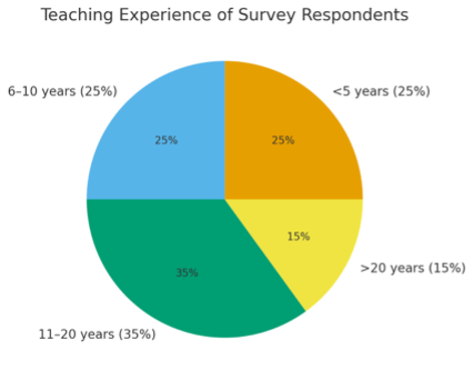
Marshall, 2009). Teachers with less than 5 years of teaching experience made up
25% of the respondents to the survey, and teachers with 6 to 10 years of
experience made up 25% of the respondents; 35% had 11 to 20 years of experience,
and 15% had more than 20 years of teaching experience.
Figure 1
Teaching
experience distribution among survey respondents.
Overview of
Quantitative Findings
Descriptive
statistics from the LAPP survey revealed that teachers’ mindsets did not fall
neatly into a dichotomy between skills-based and contextual-based approaches.
Instead, most teachers endorsed elements of both, suggesting a more nuanced
understanding of early reading instruction than contemporary polarized
discourse implies. A one-way ANOVA explored relationships between teachers’
years of experience and their endorsement of skills-based and contextual-based
subscales. No statistically significant differences were found. Similarly, no
meaningful differences emerged between teachers of K–3 and teachers of grades
4–5. This finding contrasts with earlier U.S.-based studies using the LAPP
(e.g., Giles & Tunks, 2015), which reported
clearer divisions aligned with years of experience and initial teacher
preparation.
Figure 2
Distribution of
teachers’ responses across the two LAPP subscales.
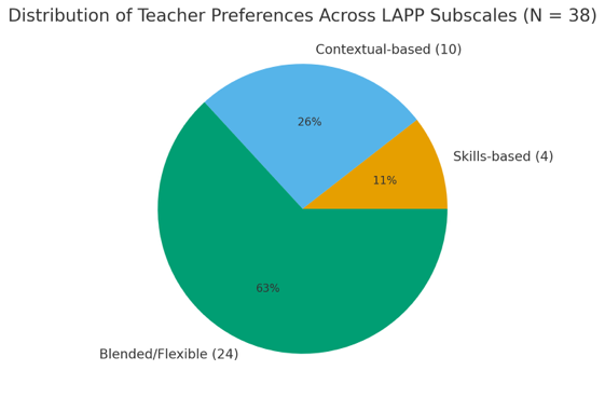
This distribution—4 teachers
primarily favoured skills-based approaches, 10 teachers primarily favoured
contextual-based approaches, and 24 teachers endorsed both approaches,
indicated a blended or flexible mindset and suggests that
teachers in this sample resisted the polarized ‘choose a side’ framing
prevalent in recent discourse about the science of reading. Instead, most
appear to draw on a hybrid model that integrates skills instruction with
contextual and motivational elements.
In addition, the LAPP results did not show
statistical significance in terms of years of teaching experience or grade
level. An analysis of variance was conducted using a one-way ANOVA to compare
teachers’ mindsets on the accumulated skills-based and contextual-based literacy
subscales with the length of their teaching experience. We found no statistical
significance with either subscale of these two ways of understanding reading
development and its instruction based on teachers’ years of experience. A one-way
ANOVA was used to compare teachers’ experiences at various grade levels
(respondents with experience in either Kindergarten-grade 4 or experiences in
grades 5 and above), with similar results. Our statistical findings show there was
less of a dichotomy than we might have anticipated based on current dialogue
about reading in school. This finding is particularly salient given the
present-day discourse prompted by reports and media pointing towards what they
identify as the superiority of skill-based approaches and recent changes in
curriculum that represent these approaches (Gear, 2021; Routman, 2023). It
contrasts with Giles & Tunks’ study (2015),
whereby teachers with similar years of experience favoured either skills-based
or contextual-based approaches, which the researchers ascribed to the prevalent
pedagogical views when they were first trained in their teacher educator
programs.
The
teachers in this study appeared to embrace aspects of both approaches in their
pedagogy. This is important because it suggests that the teachers demonstrated
a nuanced approach to teaching reading, one that recognizes that science is
always evolving (Tierney & Pearson, 2024). Seidenberg (2013), as referenced
in Alexander (2020), thoughtfully articulates this approach, indicating that
reading does not begin or end with phonics or whole-word instruction, and that
reading is viewed as broader and more complex than might be suggested by recent
media depictions of reading science. Through an analysis of individual responses
and across responses to three open-ended questions on the survey, we viewed
further elaboration of teachers’ mindsets and identified key themes about what
teachers are most confident and challenged about in teaching reading. We also
gained insight into the role of PD in teacher mindsets about reading. The
open-ended questions posed on the LAPP survey were:
●
What are you
most confident about in teaching reading?
●
What are your
challenges in teaching reading?
●
What
education, practices, resources, or professional development have been the most
significant to you and your literacy instruction?
We found that teachers showed high levels of
confidence in teaching the foundational areas of literacy—phonological
awareness, phonics, vocabulary, and comprehension. They also relayed confidence
in creating language-rich environments, supporting high expectations, and
promoting student engagement in learning. Teachers identified the areas of
student success and student engagement as providing them with high levels of self-efficacy
and excitement.
Teachers identified their greatest challenges
as meeting varied learner needs and classroom complexities, organizing for
instruction, structuring effective intervention for struggling readers, and
finding sufficient time to support students most in need. Although our PD
sessions emphasized foundational reading skills, teachers frequently used
discussion periods to raise concerns about the increasingly politicized climate
surrounding reading instruction—particularly mandates promoting specific
programs or materials and the perception that certain skill-based approaches
were being imposed. These concerns were openly addressed within PD,
underscoring teachers’ desire for professional learning that not only
strengthens instructional skill but also acknowledges the broader sociocultural
and political contexts in which they work. This aligns with recent scholarship
noting that teachers are navigating literacy debates shaped by public
discourse, advocacy pressures, and policy agendas (Aukerman, 2022; Reinking et
al., 2023), pointing to the need for PD that attends to both instructional
practice and contextual realities.
Perceived
self-efficacy and the perceived direction of literacy instruction—in their
school divisions and their provinces, as well as media coverage about reading—all
affected their confidence and challenges in teaching reading. Teachers with
more experience (11 years or more) were less challenged with the varied
learning needs of students and providing intervention strategies, which might
be expected and suggests the value in pairing novice teachers with experienced
teachers in schools for mentorship. With regards to the question about what has
been most significant to teachers’ understanding of reading and its
instruction, opportunities for PD provided by their school divisions were
referenced as having the greatest impact on them and their practice.
Pre- and Post-Interview Results
The pre- and post-interviews with teachers
were conducted and analyzed, and the results are consistent with those from the
LAPP survey, with some notable exceptions. Eight teachers participated in the
pre-interviews in the fall of 2023 and the post-interviews in the spring of 2024,
ranging in teaching experience from three to twenty-two years. Our analysis identified
four major themes in the interviews. We refer to these as the ‘4-Ps of Teaching
Early Reading.’ These are: 1) passion, 2) purpose, 3) pain, and 4) promise.
The teachers spoke passionately about wanting
to see each of their students become readers, and
interestingly, they all spoke about being ardent readers themselves. Each of
the teachers valued reading for the role it plays in their own lives and wanted
the same for their students. The teachers’ attitudes towards teaching reading
epitomized the phrase, ‘when I know more, I do better,’ and they shared that
they found purpose in the work they did in teaching their students not only how
to read, but also in developing the motivation for and love of reading. They
appeared to be guided by this ‘purpose’ in seeking PD for themselves, through
working collaboratively with colleagues, and by being intentional in their
instruction. The interviews revealed the “pain” and challenges associated with
teaching early reading. They mentioned the lack of clear instruction at the post-secondary
level for reading instruction, but acknowledged that
they themselves often ‘guarded’ their ELA teaching when supervising student
teachers, contributing to the problem of helping new teachers learn to teach
reading in their practicum experiences. They discussed the problems caused by
teacher turnover; for instance, they mentioned losing colleagues due to cuts in
funding, reassignments, relocations, attrition, and leaves (mental health and
maternity were both mentioned). The three most important aspects the teachers
said caused pain were lack of time, lack of resources, and class dynamics.
These areas of concern were also observed in responses to the open-ended
questions on the LAPP survey, pointing to the need for politicians to more
fully address classroom complexity, time for teachers to plan instruction, and
more support from paraprofessionals in the classroom. A common lament was, “I
do need to read more one-on-one with my students. I just need to find time.” These
finding replicates those from Chambers Cantrell & Hughes (2008), who
concluded “in this study, the greatest barrier to improved efficacy was
time—time to teach, time to collaborate, and time to learn” (p. 122). The
teachers also discussed the importance of accessing resources that meet
students’ needs. One teacher commented, “I would love to have more money to buy
books that I know my students would like to read.”
Seven of the eight teachers mentioned how
classroom dynamics affected both the quantity and quality of their instruction:
two factors identified by Shanahan (2023) as essential to impacting reading
development. “The dynamic changes everything, because I have different students
in attendance each day,” “more and more, I have children who don’t speak
English,” and “it is only me in the classroom and I want to work with some
students who are really stuck on a skill but others are ready for more
challenging reading and that’s hard” are typical of the kinds of situations
that the teachers discussed in their interviews.
Lastly, the theme of ‘promise’ emerged
particularly from the post-interviews. By promise, teachers talked about the
value of PD, collaboration with colleagues, receiving support from their school
administration, and maintaining a positive outlook when teaching reading.
Research tells us that ongoing PD and support are crucial to ensuring that all
teachers know how to implement excellent literacy instruction (Snow, Griffin,
Burns, and the NAE Subcommittee on Teaching Reading, 2005). Shanahan (2024)
identifies key aspects of professional development that need to be addressed in
order to be effective in impacting student learning. These include the
following: 1) PD leads to teacher learning and improvements in practice, 2) PD
leaders are knowledgeable about research-informed practices, 3) teachers are
empowered and supported in their efforts to implement PD, and 4) PD in one area
does not weaken strengths in other areas of literacy.
Though the interview sample was small, these themes align with prior
research and illustrate the contextual factors shaping teacher mindsets. These
comments did not always map directly onto the LAPP subscale categories because
teachers focused on the practical and emotional realities of their work.
Allowing this flexibility was important for documenting teachers’ authentic
perspectives.
The most striking finding from this study is the lack of polarization in
teachers’ responses. Unlike U.S.-based studies, where teachers often aligned
with one philosophical stance, teachers in this Canadian sample showed blended
orientations. This may reflect:
·
less politicization around
reading instruction in Canada (though signs of polarization are emerging)
·
evolving provincial curricula
that integrate both structured skills instruction and broader literacy
practices
·
longstanding Canadian commitments
to balanced literacy frameworks
Teachers’ resistance to polarized categorization suggests that, in
practice, they do not view reading instruction as a binary choice. Teachers may
be drawing on varied knowledge sources to make instructional decisions in
complex classrooms.
This mindset is similar to that articulated
by the researcher, P. David Pearson, who considers himself in the ‘radical
middle’ between the skills-based (what he terms phonics) and the
contextual-based (what he terms whole language) reading camps. The binary
nature of the current reading discourse does not appear to dominate these
teachers’ mindsets about reading and its instruction. Indeed, this discourse is
not serving students, and teachers appear to know this and avoid it in their
practice.
Hattie (2017) identified a list of factors
related to student achievement, and ‘collective teacher efficacy’ is listed as
the top influence on ‘what works best in education.’ The recent curriculum changes
do not appear to be one of the factors that impacts teachers’ mindsets and
efficacy as evidenced in their interviews, although it could be argued that
teacher confidence in addressing the components of reading (phonemic awareness,
phonics, fluency, vocabulary, and comprehension) could be affected by changes
to the curriculum, particularly in Alberta, which identify these as ‘organizing
ideas.’ Indeed, if teachers adopt
either, but most likely both of these approaches, changes to curriculum do not
account for predicting how well students will learn to read. Instead, teacher
knowledge about how reading acquisition occurs in children (the science of
reading acquisition), along with an understanding of what constitutes a
comprehensive research-informed reading/literacy instruction program (the art
of teaching reading), seems to account for teachers’ efficacy. Equally
important, these mindsets—embracing both the science and art of reading—can
be strengthened through high-quality PD and division support.
Conclusions
Our findings indicate that the impact of
teacher mindsets in teaching reading in K to grade six classrooms cannot be
overestimated. Our data suggest that teacher mindsets are influenced by knowledge of
both skills-based and contextual-based approaches, and that this knowledge may
relate to perceived efficacy. However, the study design does not allow us to
establish direct causal links between knowledge levels and self- or collective
efficacy. Further research is needed to explore this relationship more explicitly.
Teacher mindsets and their actual and
perceived knowledge often mix to produce a teaching practice. If teachers' daily teaching
practices are filtered through the belief that they can do very little to
influence student achievement, then it is likely these beliefs will manifest in
their practice (Donohoo, 2016). If a classroom teacher understands the
science behind how a child acquires reading ability, and if that understanding
culminates in teaching methods that are predictably known to be effective—even
when challenges come to bear on the teaching process—classroom teachers can be
confident that what they know and do will produce reading achievement in their
students.
The role of resources was important to
teachers in how they teach reading. On this front, teachers appeared to be open
to using a variety of resources and indicated they used Heggerty, UFLI, Jolly
Phonics, LETRS, and Secret Stories, to name a few. Teachers themselves
indicated that they needed more support in the areas of meeting a variety of
learner needs, addressing learning complexities, organizing for instruction,
and having more time to support students most in need, and this is where school
divisions can make a difference. Teachers overwhelmingly identified PD as the strongest influence on
their developing understanding of reading instruction. With approximately 400
teachers attending PD across divisions in this study, this finding is
consistent with research demonstrating that sustained, collaborative PD
enhances teacher confidence and shared instructional vision.
This can be achieved by partnering with PD
leaders and researchers, providing opportunities for teacher collaboration, and
offering in-class coaching (Audisio et al., 2023). By
understanding the differences among instructional studies, observational
studies, and research that utilizes one approach and attempts to generalize
results, we can “avoid overconfidence, selective memory, lack of systematicity,
lack of reliable evidence, incorrect causal attribution, and the narrowness of
individual experience” (Shanahan, 2018, para. 6). Likewise, building confidence
(and having confidence) in teachers—through knowledge acquisition or trust in
their professional judgement—empowers them to try new ideas they’ve learned
through effective and ongoing PD. This bolsters confidence, raises teacher self-efficacy,
and creates a culture where solutions to difficult learning situations in
teaching beginning reading can be found.
Limitations of this study, including the small interview sample, the
one-time administration of the LAPP, and the dual researcher–facilitator role,
suggest the need for cautious interpretation. Nonetheless, the study provides
valuable insights into teachers’ strengths, challenges, and instructional
reasoning. Teacher comments about areas such as classroom complexity, resource
constraints, and contextual realities offer important contributions to
understanding literacy instruction, even when not directly tied to LAPP
constructs.
Future research should explore how teacher mindsets evolve over time,
how PD influences changes in instructional practices, and how policy shifts
affect teacher efficacy and beliefs. Comparative studies between Canadian and
U.S. contexts may further illuminate the role of national literacy cultures in
shaping teacher orientations. Additional research could also examine how
mandated programs interact with teacher knowledge, particularly when district
budgets or ministry directives constrain teacher autonomy.
It has to be acknowledged that when it comes
to teaching reading, the research is clear about some things, but our knowledge
continues to develop and evolve. It is imperative that we remain open to new
understandings that will guide teachers in making the best instructional
decisions for their students.
References
Adams, M. J.
(1990). Beginning to read: Thinking and learning about print. MIT
Press.
Alexander, P.
A. (2020). The science of reading: A personal perspective. Reading
Research Quarterly, 55(S1), S151–S159. https://doi.org/10.1002/rrq.344
Audisio, A. P.,
Taylor-Perryman, R., Tasker, T. B., & Steinberg, M. P. (2023). Does
teacher professional development improve student learning? Evidence from
Leading Educators’ fellowship model (EdWorkingPaper
No. 22-597). Annenberg Institute at Brown University. https://doi.org/10.26300/ah2f-z471
Aukerman, M.
(2022). Media coverage of the “science of reading”: How current reporting
undermines education. Literacy Research Association.
Aukerman, M. (2024). Toward comprehensive, research-informed literacy instruction: Thinking
with, against, and beyond the science of reading [Webinar]. Ithaca College
Department of Education 2024 educational Freedom Lecture and Community.
Beachy, R., Guo, D., Wright, K., & McTigue,
E. (2023). The teachers’ perceptions and knowledge of reading assessment
survey: A validation study. Reading &
Writing Quarterly, 39(6), 559-582. https://doi.org/10.1080/10573569.2022.2156954
Burns, M. K., & Ysseldyke,
J. E. (2009). Reported prevalence of evidence-based instructional
practices in special education. The Journal of Special Education, 43(1),
3-11. https://doi.org/10.1177/0022466908315563
Cantrell, S. C., & Hughes, A. K.
(2008). Teacher efficacy and content literacy implementation: An
exploration of the effects of extended professional development with
coaching. Journal of Literacy Research, 40(1),
95-127.
Carlisle, J. F., Kelcey, B., Rowan, B., &
Phelps, G. (2011). Teachers’ knowledge about early reading: Effects on students’
gains in reading achievement. Journal
of Research on Educational Effectiveness, 4(4), 289-321. https://doi.org/10.1080/19345747.2010.539297
Chall, J. (1979). On reading: Some thoughts on
the old and the new. Bulletin of the
Orton Society, 29, 6-16. https://doi.org/10.1007/BF02653728
Cochran-Smith, M., & Lytle, S. (2009). Inquiry as stance: Practitioner research for
the next generation. Teachers College Press.
Corbin, J.,
& Strauss, A. (1988). The articulation of curriculum and the coding of
data. Qualitative Sociology, 11(1-2), 109-127.
Corbin, J., & Strauss, A. (2015). Basics
of qualitative research: Techniques and procedures for developing grounded
theory (4th ed.). Sage.
Cresswell, G., & Garrett, A. L. (2008). The
“movement” of mixed methods research and the role of educators. South African Journal of Education, 28(3),
321-333. 10.15700/saje.v28n3 a176
Dehaene, S. (2009). Reading in the brain: The new science of how we read. Penguin.
Donohoo, J. (2016). Collective efficacy: How educator’s beliefs impact student learning. Corwin
Press.
Donohoo, J., Hattie, J., & Eells, R.
(2018). The power of collective efficacy. Educational Leadership, 75(6),
40-44.
Eells, R. (2011). Meta-Analysis of the Relationship Between Collective Teacher Efficacy
and Student Achievement
(Publication No. 133) [Doctoral dissertations, Loyola University
Chicago]. https://ecommons.luc.edu/luc_diss/133
Ehri, L. C. (2022). What teachers need to know
and do to teach letter-sounds, phonemic awareness, word reading, and phonics. The Reading Teacher, 76(1), 53-61. https://doi.org/10.1002/trtr.2095
Giles, R. & Tunks,
K. (2015). Teachers’ thoughts on teaching reading: An investigation of early
childhood teachers’ perceptions of literacy acquisition. Early Childhood Education Journal, 43, 523-530. https://doi.org/10.1007/s10643-014-0672-3
Hattie, J. (2008). Visible learning: A synthesis of over 800 meta-analyses relating to achievement.
Routledge.
Hattie, J. (2017, December). Visible Learningplus 252 influences on student achievement.
Visible Learning. https://visible-learning.org/wp-content/uploads/2018/03/VLPLUS-252-Influences-Hattie-ranking-DEC-2017.pdf
Joshi, R. M., & Aaron, P.
G. (2012). Componential model of reading (CMR): Validation
studies. Journal of learning disabilities, 45(5),
387-390. https://doi.org/10.1177/0022219411431240
Kirschner, P. A., & Hendrick, C. (2020). How learning happens: Seminal works in educational
psychology and what they mean in practice. Routledge.
Mardhani-Bayne,
A., & Shamshuk, L. (2022). Early literacy learning for future library
paraprofessionals: Authentic learning in library education. Canadian Journal of Library and Information
Practice and Research, 17(2), 1-21. https://doi.org/10.21083/partnership.v17i2.6808
Mausbach, A., & Kazmierczak,
K. M. (2023). Meeting teachers where they are. Phi
Delta Kappan, 104(8),
25-30. https://doi.org/10.1177/00317217231174709
McMahon, R., Richmond, M. G., &
Reeves-Kazelskis, C. (1998). Relationships between kindergarten teachers’
perception of literacy acquisition and children’s literacy involvement and
classroom materials. The Journal of
Educational Research, 91(3),
173-182. http://www.jstor.org/stable/27542148
McMahon, R., Richmond, M. G., &
Reeves-Kazelskis, C. (2001, November). Early childhood teachers'
perceptions of literacy acquisition. Paper presented at the annual meeting
of the Mid-South Educational Research Association, Little Rock, AR.
Moats, L. C. (1999). Teaching reading
is rocket science: What expert teachers of reading should know and be able to
do. American Federation of Teachers.
Moats, L. C., & Foorman,
B. R. (2003). Measuring teachers’ content knowledge of language and reading. Annals
of Dyslexia, 53(1), 25-43. http://www.jstor.org/stable/23764733
National Institute of Child Health and Human
Development. (2000). Report of the National Reading Panel: Teaching
children to read: Reports of the subgroups (NIH Publication No.
00-4754). U.S. Government Printing Office. https://www.nichd.nih.gov/publications/product/247
Ontario Human Rights Commission (2022, February).
Right to read: Public inquiry into human rights issues affecting students
with reading disabilities. Government of Ontario.
Reinking, D., Smagorinsky,
P., & Yaden, D. (2023). On the latest obsession with phonics. The
Washington Post. https://www.washingtonpost.com/education/2023/05/23/phonics-reading-analysis/
Reinking, D., Hruby,
G. G., & Risko, V. J. (2023). The
science of reading: A response to policy and practice. Literacy
Research and Instruction, 62(3), 175-196.
Reutzel, D. R., & Cooter Jr., R. B. (2024).
Teaching children to read: The teacher makes the difference (9th
ed.), Pearson.
Saldaña, J.
(2021). The coding manual for qualitative
researchers (4th ed.). Sage.
Seidenberg, M. S. (2013). The
science of reading and its educational implications. Language Learning
and Development, 9(4),
331–360. https://doi.org/10.1080/15475441.2013.812017
Shanahan, T. (2002). What
reading research says: The groundwork for reading instruction. In A. E.
Farstrup & S. J. Samuels (Eds.), What research has to say about
reading instruction (3rd ed., pp. 12-33). International Reading
Association.
Shanahan, T. (2023, April 29). Which reading model
would best guide our school improvement efforts? Shanahan on Literacy. https://www.shanahanonliteracy.com/blog/which-reading-model-would-best-guide-our-school-improvement-efforts
Shanahan, T. (2024, May 13). Unpacking the “science of reading”. Institute of Education Sciences. https://ies.ed.gov/learn/blog/unpacking-science-reading-dr-tim-shanahan
Sims, S., & Fletcher-Wood, H. (2020). Identifying the characteristics of effective teacher professional development: A critical review. School Effectiveness and School Improvement, 32(1), 47-63. https://doi.org/10.1080/09243453.2020.1772841
Skaalvik, E. M.,
& Skaalvik, S. (2007). Dimensions of teacher
self-efficacy and relations with strain factors, perceived collective teacher
efficacy, and teacher burnout. Journal of
Educational Psychology, 99(3), 611-625. https://doi.org/10.1037/0022-0663.99.3.611
Tay, L. Y., Tan, L. S., Aiyoob, T. B., Tan, J.
Y., Ong, M. W. L., Ratnam-Lim, C., & Chua, P. H. (2023). Teacher reflection
– call for a transformative mindset. Reflective
Practice, 24(1), 27-44. https://doi.org/10.1080/14623943.2022.2130224
Tierney, R. J., & Pearson, P. D.(2024).
Fast-checking the Science of Reading: Opening up the Conversation. Literacy
Research Commons. https://literacyresearchcommons.org
Tschannen-Moran, M., & Barr, M. (2004).
Fostering student learning: The relationship of
collective teacher efficacy and student
achievement. Leadership and Policy in
Schools, 3(3), 189-209. https://doi.org/10.1080/15700760490503706