Between Digital
and Analogical: Familial Perspectives on Teaching to Develop
21st-Century Competences
María
Mairal-Llebot, University of Zaragoza
Cecilia Latorre-Cosculluela, University of Zaragoza
Marta
Liesa-Orús, University of Zaragoza
Authors’ Note
María Mairal-Llebot https://orcid.org/0000-0001-9424-1478
Cecilia
Latorre-Cosculluela https://orcid.org/0000-0002-6083-8759
Marta Liesa-Orús https://orcid.org/0000-0002-9685-8399
This study received approval from the
Research Ethics Committee of the Autonomous Community of Aragón (CEICA) during
its meeting held on 08/09/2021 (Act No. 16/2021). Funding for this work was
provided through a grant from the Department of Science, University and
Knowledge Society of the Government of Aragon, as established in the
institutional document “ORDEN CUS/803/2021, of 8 July, which calls for grants
for the recruitment of predoctoral research staff in training for the period
2021–2025 (BOA 146 of 12 July 2021).” We would like to express our gratitude to
all participants in the study, especially the family members of the students
who completed the questionnaire.
Correspondence concerning this article should
be addressed to María Mairal-Llebot at mmairal@unizar.es.
Abstract
In recent decades, education has transformed
due to new demands, requiring constant updates to teaching methods. Training in
21st-century competences is essential for preparing students for a
changing future. Education 4.0, driven by Information and Communication
Technologies (ICT), plays a key role in this process. However, some argue that
a blend of traditional methods and technology enhances learning. This study
examines the perceptions of families of students aged 3-18 on adapting teaching
with ICT versus traditional methods to promote the development of 21st-century
skills. It also explores how family relatives’ education levels influence their
views on the best methodologies for teaching these competences. Data from 720 family
relatives were collected through an online questionnaire. The analysis showed
that families see a clear connection between the competences studied. However,
there were significant differences in their perceptions of teaching methods
with and without ICT for developing certain skills. The study also found that family
relatives’ education levels affected their views. Overall, the research
concludes that a balanced approach, integrating ICT with traditional teaching
methods, is essential for enriching education and preparing students for the
future.
Keywords: 21st-century competences, family
relatives, ICT, analogical resources
Over recent decades, education has undergone
a transformation owing to the rapid social progress, demands and challenges that
people must face (González-Pérez & Ramírez-Montoya, 2022). Nowadays,
society’s expectations (e.g., emphasizing digital literacy and collaborative
problem-solving) demand skills and competences that extend beyond conventional
educational approaches (i.e., lecture-based teaching and standardized testing)
(Ghavifekr & Wong, 2022). Therefore, this context
highlights the need to adopt pedagogical methods aligned with these emerging
demands, thus encouraging education systems to focus on preparing students
integrally so that they acquire the necessary competences to face a complex and
rapidly changing future (Ghavifekr & Wong, 2022;
Karakoyun & Lindberg, 2020; Kornytska et al.,
2023; Koul & Nayar, 2020).
The recent
social and educational transformation brought about by integrating Information
and Communication Technologies (ICT) (Schlomann et al., 2020) has led to different phases of Internet evolution
known as Web 1.0, Web 2.0, Web 3.0 and Web 4.0 (Huk, 2021; Maria et al., 2018).
These phases are closely linked with the changes in education known as
Education 1.0, 2.0, 3.0, and 4.0, reflecting the growing influence of
technology on teaching and learning. Education 1.0 refers to a teacher-centred
model focused on knowledge transmission and memorization. Education 2.0 emerged
with early internet use, allowing limited interactivity and some learner
engagement. Education 3.0 introduced more participatory and collaborative
approaches, promoting active learning and digital content creation. Education
4.0, the current phase, emphasizes personalized learning, real-time feedback,
integration of AI and big data, and the development of competences aligned with
the OECD Learning Compass and ATC21S frameworks
(Ghavifekr & Wong, 2022; González-Pérez &
Ramírez-Montoya, 2022; Griffin et al., 2012; Himmetoglu
et al., 2020; Huk, 2021; Maria et al., 2018; OECD, 2019).
Education 4.0
goes beyond the mere presence of technology, requiring profound transformations
in educational approaches to respond to contemporary and future demands.
Strongly supported by digital technologies, this phase promotes the integration
of ICT as pedagogical tools to create flexible curricular systems aligned with
current needs and guided by frameworks such as DigComp
and DigCompEdu, which provide structured guidelines
for developing digital competences in both students and teachers (González-Pérez
& Ramírez-Montoya, 2022; Prasojo et al., 2019;
Redecker, 2017; Vuorikari et al., 2022). Effectively
incorporating these tools into teaching and learning processes is therefore
essential to strengthen education and foster the development of 21st-century
competences (Agaoglu & Demir, 2020; Ghavifekr & Wong, 2022; Huk, 2021; Karakoyun &
Lindberg, 2020).
It is
important to acknowledge that many competences now considered essential for the
21st-century have been cultivated within traditional educational
approaches long before the widespread integration of ICT (González-Salamanca et
al., 2020; Willis et al., 2018). However, the inclusion of ICT enriches these
competences by introducing new dimensions, such as digital literacy and
citizenship, which are vital for effective participation in modern society. While
ICT may not be indispensable for all competences, they are powerful tools for
enhancing learning efficiency, motivation, accessibility, and personalisation.
Therefore, several authors advocate approaches that combine digital and
analogue resources to optimise the educational process and meet diverse
learning needs (Agaoglu & Demir, 2020; Lytvyn et
al., 2020; Willis et al., 2018).
These competences correspond to skills
considered necessary to face future challenges and participate effectively in
society (Ghavifekr & Wong, 2022;
González-Salamanca et al., 2020; Kornytska et al.,
2023). Interrelated and complementary 21st-century competences
jointly contribute to holistic development, as highlighted in frameworks such
as the OECD Learning Compass and ATC21S (González-Pérez & Ramírez-Montoya,
2022). Developing such competences is essential to manage today’s challenges
and to promote significant personal and professional progress in a complex and
interconnected world (González-Pérez & Ramírez-Montoya, 2022; Karakoyun
& Lindberg, 2020).
Although ICT offer benefits for future
training (Carrión-Martínez et al., 2020; Das, 2019; Lawrence & Tar, 2018; Prasojo et al., 2019), some researchers emphasize the
importance of integrating conventional and digital tools (Agaoglu
& Demir, 2020; Lytvyn et al., 2020; Willis et al., 2018). Such integration
enriches the education experience by providing teachers and students with a
diverse series of tools to provide more effective learning (Lytvyn et al.,
2020). It is also important to distinguish between education and training,
which, although related, are distinct processes: education encompasses holistic
development across multiple domains, whereas training focuses on developing
specific practical skills. ICT play a valuable role in both areas by enhancing
theoretical understanding and practical skill acquisition.
In the Spanish
Autonomous Community of Aragón, the integration of ICT into education is
supported by national and regional policies, such as the LOMLOE curriculum
(BOE, 2020) and the Digital Education Action Plan of Aragón (Gobierno de Aragón, 2021). These policies provide the
infrastructure, teacher training, and curricular guidance necessary to develop
students’ 21st-century competences. By linking these policies
explicitly to the research objectives, this study analyzes
how family relatives perceive the effectiveness of ICT-based versus
conventional teaching methods.
Despite the
central role of families, relatively few studies have explored how they
perceive education delivered through ICT compared to conventional
methodologies, particularly regarding the development of 21st-century
competences. This constitutes a relevant gap in current research, especially
within the Spanish context. In the Autonomous Community of Aragón, ICT
integration in education is supported by both national and regional policies,
including the LOMLOE curriculum and the Digital Education Action Plan. Schools
in the region generally have access to digital devices and internet
connectivity, and ongoing teacher training initiatives—aligned with the
European DigCompEdu framework—reinforce a commitment
to digital competence and technological innovation.
Considering these
aspects, the present study aims to analyze
perceptions of family members of students aged 3-18 years in Aragón regarding
the suitability of education delivered through ICT compared to conventional
teaching methods for developing 21st-century competences. The
relevance of this study lies in focusing on families’ viewpoints—a perspective
that remains underrepresented in the literature—and in exploring a topic of
growing importance: how different educational methodologies are perceived in
relation to the development of competences regarded as fundamental for
students’ present and future.
Objective of This Study
In general terms, and by considering the
aforementioned theoretical background, the objective of this study was to analyze the perceptions of the family relatives of students
aged 3-18 years from Aragón regarding the suitability of ICT-based and
conventional teaching methodologies for fostering 21st-century
competences. To fulfil this overall objective, the following specific objectives
were set out:
1.
Evaluate family relatives’ perceptions of the
suitability of ICT-based teaching methodologies for fostering 21st-century
competences
2.
Examine family relatives’ perceptions of the
suitability of conventional teaching methodologies for fostering 21st-century
competences
3.
Examine whether family members consider analog teaching more or less suitable than
ICT-based teaching for developing specific 21st-century skills.
4.
To analyze the
differences in the perception of family members regarding the suitability of
analog and ICT-based teaching methodologies for promoting 21st-century
skills according to the educational level of the family members.
Method
Participants
The
sample in this work consisted of the family relatives of students aged 3-18
years from Aragón (Spain). For the purpose of this research, the term “family
relatives” encompasses parents, guardians, and other close family members who
play an active and significant role in the educational and developmental
processes of the students. The only eligibility requirement for participation
was having at least one child currently enrolled in school within the 3-18-year
age range. Families were invited to participate through the Parents'
Associations of the different schools in the region, as well as directly via
the schools, which helped disseminate the information among families. The
study's objective was communicated by email, providing participants with the
option to participate voluntarily and assuring that all data would remain
confidential. The invitation also included a web link giving direct access to the
questionnaire. The instrument was designed and developed using Qualtrics
software. After reviewing the valid questionnaires for our research, there were
720 participants, whose characteristics are reflected in Table 1. In addition to the variable concerning the relative’s educational
level, which is directly related to one of the main objectives of the research,
information on other variables was collected to characterize the sample and
facilitate the interpretation of the generalisability of the findings. The
final sample size was considered appropriate for the descriptive and
comparative analyses planned, in line with the exploratory scope of the study
and the diversity of the target population.
Table 1
The Sample’s Socio-Demographic Characteristics (N=720).
|
Variables |
N |
% of the sample |
|
Gender |
|
|
|
Female |
574 |
79.7 |
|
Male |
146 |
20.3 |
|
Age (M=45.88;
SD=5.53) |
|
|
|
Between
18-32 years old |
7 |
0.97 |
|
Between
33-42 years old |
169 |
23.47 |
|
Between
43-52 years old |
470 |
65.28 |
|
|
Between
53-62 years old |
74 |
10.28 |
|
|
Province |
|
|
|
|
Huesca |
121 |
16.8 |
|
|
Zaragoza |
557 |
77.4 |
|
|
Teruel |
42 |
5.8 |
|
|
Highest level of education attained |
|
|
|
|
Primary/Secondary |
84 |
11.6 |
|
|
Baccalaureate |
81 |
11.3 |
|
|
Vocational
training |
194 |
26.9 |
|
|
University |
361 |
50.1 |
|
|
Type of school your children attend |
|
|
|
|
Public
school |
75 |
10.4 |
|
|
State school |
645 |
89.6 |
|
|
Children's school environment |
|
|
|
|
Municipality
with less than 2,000 inhabitants |
77 |
10.7 |
|
|
Municipality
between 2,000 - 10,000 inhabitants |
201 |
27.9 |
|
|
Municipality
with more than 10,000 inhabitants |
441 |
61.3 |
|
|
Total |
720 |
100 |
|
Definition of Variables
The variables that the present study took as
an analysis object were the so-called 21st-century competences. The
literature offers no unanimous definition of this term (Loução
& Pedro, 2023; Tight, 2020). However, 21st-century competences
are understood as a set of essential skills to face future challenges and
requirements. Although the employed terms may change, the basic idea is that
these competences are crucial for making people capable and enabling them to
actively participate in society (Ghavifekr &
Wong, 2022; González-Salamanca et al., 2020; Kornytska
et al., 2023).
These
competences include creativity, critical thinking, problem solving, decision
making, communication capacity, teamwork, seeking and organising information, digital
citizenship, ICT competences, adapting to changes, initiative-taking capacity,
productivity, leadership capacity skills and the capacity to be enterprising (Agaoglu & Demir, 2020; González-Pérez &
Ramírez-Montoya, 2022; González-Salamanca et al., 2020; Koehorst
et al., 2021).
For this
study, educational approaches were classified as ICT-based or analogue.
ICT-based education integrates digital technologies, such as online platforms,
educational apps, or interactive whiteboards, whereas analogue education relies
on traditional, non-digital methods like printed books, notebooks, and
face-to-face instruction.
Instrument
The instrument employed to collect data was
designed ad hoc by taking the available literature about the study theme
as a basis. Having written the first version of the instrument, it was judged
by a panel of experts to determine the suitability, match and wording of items.
During this process, 10 professionals with experience in the academic university
domain came from different disciplines (inclusive education, use of technologies
in the education context and methods of research). The instrument was also
delivered to 10 mothers and fathers of students aged 3-18 years to collect
their opinions about its formulation and understanding. The aim was to check if
the vocabulary and instructions in the instrument were easy for family relatives
to understand. For this stage, family relatives with different incomes, levels
of education and socio-cultural levels were intentionally selected. In this
research, the term “suitability” was understood as the judgments made by family
relatives regarding the appropriateness of both ICT-based and conventional
teaching methodologies in supporting the development of 21st-century
competences in their children, which was a central focus of the instrument’s
evaluation. These judgements were considered as expressions of perception,
understood here as subjective evaluations shaped by beliefs and attitudes
towards the effectiveness of different teaching approaches.
Based on this analysis,
and bearing in mind the contributions provided, the next stage involved
restructuring the instrument to obtain its definitive version. With this final
version, the instrument was divided into two sections: the first part centred
on collecting data about the participants’ socio-demographic characteristics;
the second part included the indicators that family relatives had to score. This
second part contained 14 items that, on two Likert-type scales from 0 to 10 points,
had to be valued by the participants according to how they perceived the
adaptation of teaching with ICT and by analogical teaching (i.e., without ICT)
for students to develop and acquire 21st-century competences. The
full wording of the questions, the scale points, and the grouping of items into
subscales are provided in Appendix A.
Data Analysis
The data collected with the instrument were
coded and analysed using version 22.0 of the SPSS statistical package. According
to the research objectives, descriptive statistics were applied (in terms of
means and standard deviations), as was the inferential type. Differences in
means (Student’s t) were applied for paired samples, given that the same
participants evaluated both analogical and ICT-based teaching methodologies. To analyze differences according to the
educational level of family relatives, one-way analyses of variance (ANOVA)
were performed. When the ANOVA results were statistically significant, post hoc multiple comparisons using
Tukey’s HSD test were conducted to identify which groups differed significantly
from each other. Pearson’s
correlation coefficient was employed to establish linear relations among the 21st-century
competences set out in the questionnaire.
Results
Table 2 (Appendix
B) provides the data obtained
from the descriptive statistics in terms of means (M) and standard deviations
(SD). It also includes results on the perceived suitability of analogical and
ICT-based teaching for developing 21st-century competences.
Regarding
perceptions of the suitability of analogical teaching, the competences that
received the highest scores were teamwork (M = 7.62; SD = 1.92) and
communication capacity (M = 7.53; SD = 1.93). Conversely, family relatives more
negatively evaluated the adaptability of teaching without digital resources for
developing digital citizenship (M = 5.18; SD = 2.58) and ICT competences (M = 4.9;
SD = 2.55). Notably, these competences also showed the highest SDs, reflecting
greater variation in how participants perceived the suitability of analogical
teaching to support 21st-century competences.
Regarding the results
obtained about adapting ICT-mediated teaching to work on 21st-century
competences, the highest scores were for seeking and organizing information (M
= 8.24; SD = 1.87) and ICT competences (M = 8.11; SD = 1.8). These scores
presented comparatively lower SDs, indicating greater consistency in
participants’ perceptions of ICT-mediated teaching. Conversely, the more
negatively valued competences were critical thinking (M = 6.46; SD = 2.06) and
leadership capacity (M = 6.46; SD = 2.19).
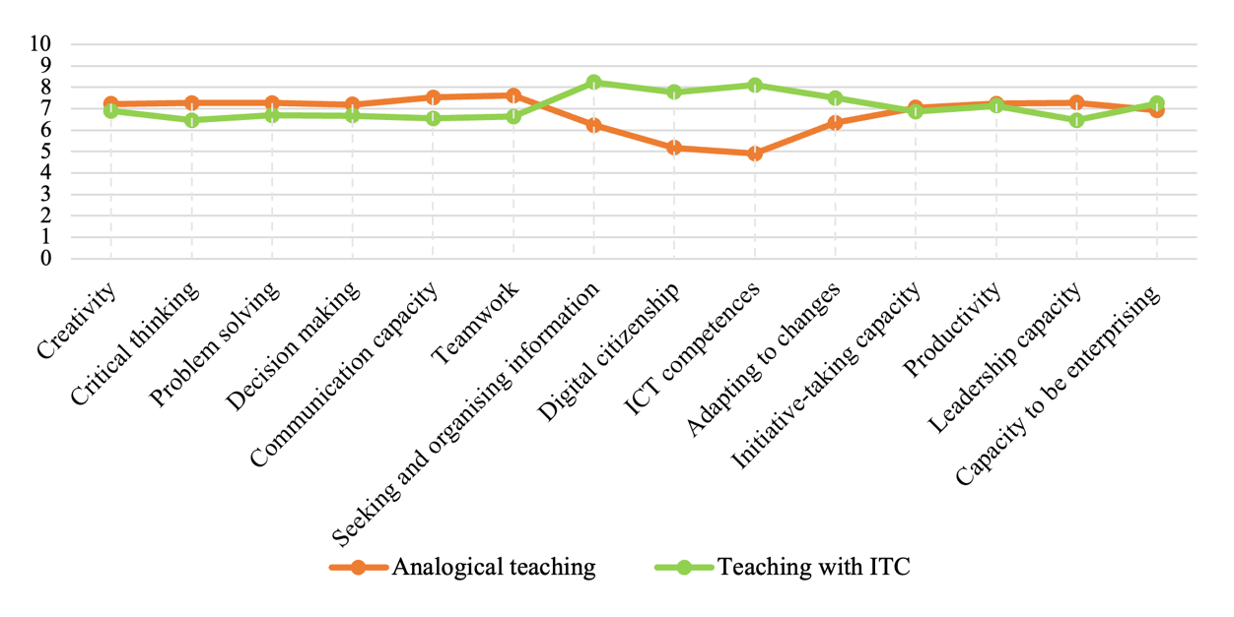
A
paired-sample t-test revealed statistically significant differences in how
family relatives perceived the suitability of analogical
teaching and ICT-mediated teaching methods. Table 2 presents
these results, and Figure 1 graphically represents them. Regarding
competences where analogical teaching was perceived as more suitable than
ICT-mediated teaching, family relatives rated creativity (t = 2.99; p <
.01), critical thinking (t = 8.06; p < .001), problem
solving (t = 5.80; p < .001), decision making (t =
5.41; p < .001), communication capacity (t = 8.03; p <
.001), teamwork (t = 9.21; p < .001), and leadership
capacity (t = 8.25; p < .001) as significantly more
suitable.
Conversely, for
competences where ICT-mediated teaching was perceived as more suitable than
analogical teaching, the highest ratings were observed for seeking and organising information (t = −17.87; p <
.001), digital citizenship (t = −21.02; p < .001), ICT
competences (t = −26.63; p < .001), adapting to changes (t
= −10.74; p < .001), and being enterprising (t =
−3.44; p < .001).
Figure 1
Comparing the Means between Analogical Teaching
and Teaching with ICT
Pearson’s
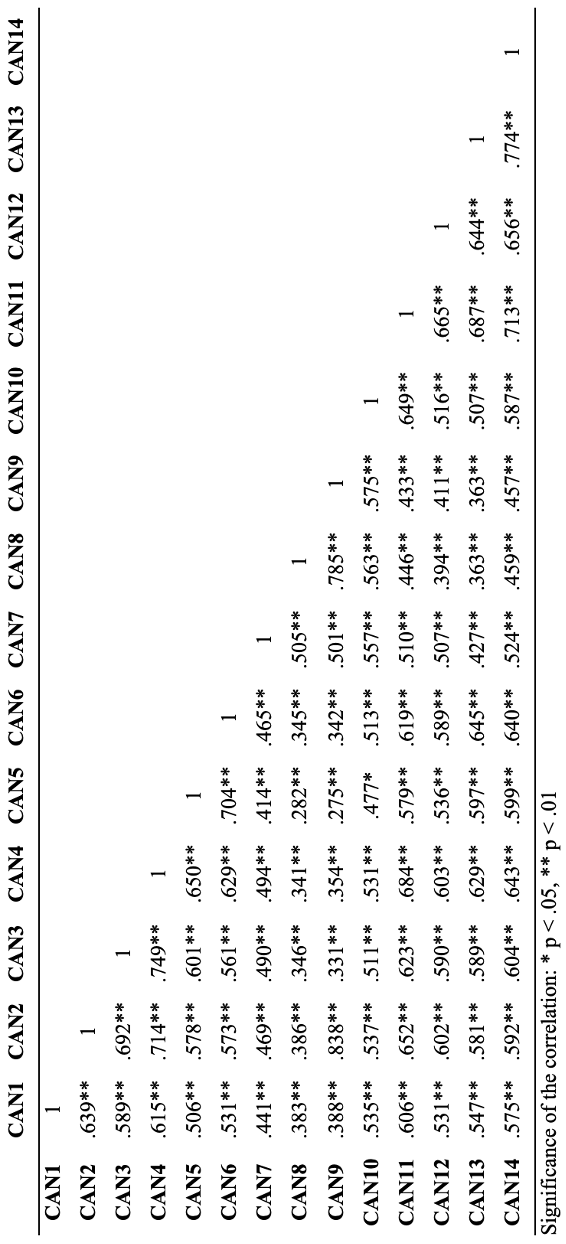
correlation analysis was used to examine the relationships among the 21st-century
competences studied. As Table 3 shows (Appendix C), the obtained results
evidenced strong positive correlations, which consistently appeared among this
set of variables. Nevertheless, it is worth pointing out that some relations stood
out for their marked significance. The strongest positive correlation emerged
between critical thinking (CAN 2) and ICT competences (CAN 9) (r = 0.838; p
< .01). Strong positive relations were also found between digital
citizenship skills (CAN 8) and ICT competences (CAN 9) (r = 0.785; p <
.01); leadership capacity (CAN 13) and capacity to be enterprising (CAN 14) (r
= 0.774; p < .01); and problem-solving capacity (CAN 3) and
decision-making skill (CAN 4) (r = 0.749; p < .01).
Although all
correlations were positive and statistically significant, some were weaker in
magnitude, including communication capacity (CAN 5) with ICT competences (CAN
9) (r = 0.275; p < .01); communication capacity (CAN 5) with digital
citizenship (CAN 8) (r = 0.282; p < .01); problem solving (CAN 3)
with ICT competences (CAN 9) (r = 0.331; p < .01); and teamwork (CAN
6) with ICT competences (CAN 9) (r = 0.342; p < .01). Despite being
comparatively lower, these correlations also indicate meaningful relationships
among competences.
Next, an
inferential analysis was performed by applying the ANOVA test and considering
the independent variables referring to the surveyed family relatives’ highest
level of education (Table 4, Appendix D). Post hoc comparisons using Tukey’s HSD test were conducted to determine which
education-level groups differed significantly from each other. The results
generally revealed more pronounced differences across education levels in
perceptions of analogical teaching than ICT-based teaching.
Significant
differences were observed in perceptions of the suitability of analogical
teaching for developing creativity (F = 4.809; p < .01), problem
solving (F = 2.934; p < .05), seeking and organising information (F =
4.305; p < .01), and productivity (F = 2.662; p < .05),
with contrasts emerging mainly between participants with Primary/Secondary
education and those with university studies. For digital citizenship (F =
7.234; p < .001) and ICT competences (F = 11.023; p <
.001), significant differences also appeared between Primary/Secondary and
university education groups and between Vocational Training and university
groups.
For
suitability linked to adapting to changes (F = 4.304; p < .01),
significant differences were found between participants with Primary/Secondary
and university studies, and between Primary/Secondary and Vocational Training
studies. Finally, perceptions related to being enterprising (F = 4.583; p
< .01) showed significant differences between Primary/Secondary and Higher
Secondary Education groups, and between Vocational Training and university
groups.
For ICT-based
teaching, significant differences were found only for communication capacity (F
= 3.460; p < .05) and ICT competences (F = 3.496; p < .05),
both appearing among relatives with Vocational Training and university studies.
These results suggest that education level influenced perceptions more clearly
in relation to analogical teaching than ICT-based teaching.
Discussion and
Conclusions
Using appropriate statistical techniques,
this study described how students’ family members perceive the suitability of
conventional teaching methods compared to ICT-mediated methods for fostering 21st-century
competences throughout the educational process. These findings directly address
the study’s aims, particularly those related to comparing both teaching
approaches and analyzing how they support competence
development. This study goes beyond descriptive parental surveys by directly
comparing analogue and ICT-mediated methodologies across competence domains in
a large regional sample spanning ages 3–18.
The research
works by authors like González-Salamanca et al. (2020) and Willis et al. (2018)
point out that some 21st-century competences were already present
even before technology emerged in our lives and in different education stages. These
authors highlight competences such as critical thinking, problem solving,
decision making, communication skills, and teamwork. They argue that these
skills were effectively developed even before ICT was integrated into education.
Consequently, researchers ensure that technologies are not essential for
dealing with these competences but can be very useful tools for improving the
process of acquiring and developing them. This improvement would take place in
terms of efficiency, motivation and personalization of learning.
In relation to
this, family relatives perceived that conventional teaching methodologies might
be more suitable for promoting and developing the competences mentioned in this
section compared to ICT-guided teaching. This perception appears to align with the
perspectives discussed by González-Salamanca et al. (2020) and Willis et al.
(2018), who note that these competences have historically been developed
without relying on technology. These patterns are
consistent with cognitive development theories, suggesting that families may
prefer analogical methods for competences like creativity, communication, and
teamwork due to their alignment with children’s developmental trajectories and
prior parental experiences. From a socio-cultural perspective, such preferences may
also reflect families’ beliefs about learning as a socially mediated and
relational process, in which face-to-face interaction, dialogue, and shared
experiences play a central role. This supports Objective 2 of
the study, as relatives attributed greater suitability to conventional teaching
for fostering competences linked to learning processes. Apart from critical
thinking, problem solving and decision making, communication capacity and
teamwork, family relatives added creativity and leadership capacity to this
list.
It is also
relevant to consider insights from cognitive development and neuroscience,
which suggest that human cognition and brain function are closely linked to
analogical processes, particularly in early childhood. Children’s neurological
networks mature progressively, and as such, certain cognitive abilities develop
over time. This developmental trajectory implies that ICT-based methods may not
be as beneficial or appropriate during very early educational stages, where
hands-on, analogy experiences could better align with children’s evolving
cognitive capacities. Families’ preferences for analogue approaches may
therefore be informed not only by tradition, but also by intuitive judgments
about age-appropriateness and developmental readiness, addressing the study’s
focus on perceptions across the 3–18 educational range.
It is
important to highlight that the literature categorizes 21st-century
competences based on their focus or area of application. The competences that refer
to critical thinking, problem solving, decision making, communication capacity
and teamwork have been grouped by several authors (Agaoglu
& Demir, 2020; González-Pérez & Ramírez Montoya, 2022;
González-Salamanca et al., 2020) under the heading of “skills or capacities for
learning”. These competences are those that the participating family relatives
point out as those that can be developed without relying on ICT; that is, they could
potentially be worked on from a more conventional educational approach. This thematic
alignment strengthens the interpretation of Objective 2 and clarifies why
analogical methodologies were rated as suitable for these competences.
Another
broadly recognized category includes ‘digital literacy skills,’ which cover ICT
competences as well as abilities related to searching for and organizing
information (Agaoglu & Demir, 2020;
González-Pérez & Ramírez Montoya, 2022). Indeed, according to the perceptions
of the family relatives who participated in this study, ICT seem to be
perceived as indispensable as tools for developing these competences. Apart
from them, family relatives added other closely linked competences, such as
digital citizenship, to the list of competences that might require ICT in the
classroom. This distinction suggests that families differentiate between
competences grounded in experiential or interpersonal learning and those
inherently linked to technological environments, directly responding to
Objective 1 by demonstrating that participants viewed ICT-guided methodologies
as more suitable for developing digital-related skills. From the perspective of
the TPACK framework (Mishra & Koehler, 2006), these findings suggest that
while families recognize the technological component, they may not yet perceive
the effective integration of pedagogy and content through digital means for
complex "soft skills". This indicates a tendency to view ICT as a
tool for information access rather than a medium for high-level cognitive and
creative development.
Regarding
students’ use of ICT for holistic competence development, numerous authors
highlight the benefits technology offers in delivering education geared towards
future needs (Carrión-Martínez et al., 2020; Das, 2019; Lawrence & Tar,
2018; Prasojo et al., 2019). Some authors (Hafifah,
2020; Schlomann et al., 2020) have recently reported that for today’s society
and that of the future, acquiring skills in ICT could be considered an unavoidable
need. Emphasis has also been placed on the skill to browse with and efficiently
apply digital tools because they are not only useful in the professional area
but are also essential to fully participate in day-to-day living. Those with
technological skills not only have advantages in the present but will be better
prepared to face the challenges and to make the best of the opportunities that
the digitized future will present (Hafifah, 2020).
The literature
supports the idea that integrating ICT into teaching practices and curricula is
likely to be essential for developing certain 21st-century competences
(Ghavifekr & Wong, 2022; Huk, 2021). Consequently,
ICT-guided methodologies will not only empower education quality but will also
contribute to reinforcing essential skills for students in the present and the
future; that is, to develop 21st-century competences (Agaoglu & Demir, 2020; Ghavifekr
& Wong, 2022; González-Pérez & Ramírez-Montoya, 2022; Huk, 2021;
Karakoyun & Lindberg, 2020). Taken together, these findings reinforce
relatives’ perception that ICT plays a critical role in fostering
future-oriented competences, echoing the framework guiding this study.
Although
family relatives in this study believe conventional analogy methods better
promote some competences, and ICT-based methods are highly effective for
others, some authors stress the importance of leveraging the benefits of both
approaches in education. Agaoglu and Demir (2020),
Lytvyn et al. (2020), and Willis et al. (2018) acknowledge that the complementarity
between analogical and digital methods might significantly empower the
educational process. This integrating approach seeks to make the best of both
worlds by favouring an enriched pedagogical environment that attends to
learners’ diversity through a wide range of tools and strategies. This
perspective helps explain why families’ preferences are not necessarily
contradictory, but context-dependent, aligning with the comparative objectives
of the study while avoiding overgeneralized conclusions.
Similarly, the
results of this study show that students’ family members perceive a strong
interconnection among different competences. According to González-Pérez and
Ramírez-Montoya (2022), 21st-century competences are not isolated
aspects, but interdependent components that converge to shape global
development. This integrating approach of competences promotes an educational
paradigm that goes beyond merely acquiring knowledge, a perspective that some
researchers consider should be ruled out (González-Pérez & Ramírez-Montoya,
2022; Kornytska et al., 2023; Koul & Nayar, 2020)
to encourage significant learning that falls in line with today’s demands. This
interpretation responds to Objective 3 by demonstrating that relatives
recognized significant relationships among competences, consistent with the
correlational findings.
The results
regarding the differences in perceptions based on educational level also merit
discussion and conclusion. Bolaños and Rivero (2019) point out that the family is
the first socialization context in which the bases for children’s academic and
personal development are set. Ludeke et al. (2021) emphasize the influence that
the family setting has, particularly mothers’ and fathers’ level of education,
because it plays a key role in their children’s educational process. The
present research work verifies differences in the perceptions regarding the
suitability of analogical teaching compared to ICT-mediated teaching to deal
with 21st-century competences, which could interfere with students’
education according to the aforementioned authors. This finding directly
addresses Objective 4 by demonstrating that relatives’ educational level
influenced perceptions of teaching suitability. These differences may also
reflect unequal access to digital resources, varying levels of confidence in
supporting ICT-based learning, and distinct forms of engagement with schools.
This variation aligns with the ‘second-level digital divide’ (Hargittai et al., 2019; Scherder et al., 2017), suggesting
that higher educational levels correlate with greater digital capital and a
more positive perception of ICT’s pedagogical value.
These
differences are evident when comparing family members with Primary/Secondary
education, who tend to favour conventional methods, with those holding
Vocational Training or University degrees, who generally prefer technological
approaches. Authors like Shafie et al. (2019) stress the importance of teaching
training in competences from earlier education stages. Nonetheless, many studies
(Abelha et al., 2020; Sá & Serpa, 2018; Sousa &
Wilks, 2018) attach importance to dealing more specifically with 21st-century
competences in the education stages that prepare students for the labour market;
that is, Vocational Training and University. This may help explain why
relatives with higher education levels show greater alignment with ICT-mediated
approaches, as these have been more prominent in their own academic and
professional trajectories.
At this point,
it is necessary to revisit the idea of González-Salamanca et al. (2020) and
Willis et al. (2018), which was previously considered. They suggest that some
competences presently identified as being typical 21st-century ones
have existed for years and do not need to rely on ICT. Based on this premise,
this finding suggests that family relatives with Primary/Secondary studies tend
to prefer conventional methods based on the personal experience that they
acquired when they were students, which allowed them to develop such
competences without technology. Some other previously mentioned authors (Abelha et al., 2020; Sá & Serpa, 2018; Sousa &
Wilks, 2018) indicate that people with Vocational Training and University
studies highlight the value and importance of 21st-century competences,
and also emphasize the growing presence of technology in education today
(Carrascal et al., 2021; Carrión-Martínez et al., 2020; Das, 2019; Khattri, 2021; Lawrence & Tar, 2018; Prasojo et al., 2019; Willis et al., 2018). These ideas
contextualize why relatives with higher levels of education may view ICT-based
methodologies more positively, deepening understanding of Objective 4.
Considering
all these factors, this study suggests that while the literature supports ICT
integration to prepare individuals for a digital future, family members hold
differing preferences. For example, the family relatives with Primary/Secondary
education favour what is traditional, while those with higher education studies
are more inclined to prefer ICT. What these differences suggest is that family
relatives’ level of education is related to how they perceive different
methodologies. From a school–home partnership perspective, these findings
underline the need for differentiated communication and support strategies that
acknowledge families’ diverse backgrounds and experiences with technology. This
reinforces the importance of acknowledging diverse perspectives when designing
teaching approaches that aim to foster 21st-century competences. Nevertheless,
the literature suggests that 21st-century competences can be
developed by both conventional and ICT-based methods, but depending on the
specific goals and learning context. Thus, we stress that an integrating
approach might be needed that takes the best of both worlds to enrich the
educational process and to prepare students for their personal and professional
future.
This study
highlights the crucial role of families in children’s development, but also
reveals a gap in actively involving family relatives in educational
interventions. These findings suggest the importance of exploring ways to
effectively engage family relatives, especially in supporting ICT-based
learning. Providing guidance, training opportunities, and accessible resources
may help reduce perceived barriers and strengthen families’ capacity to support
competence development at home. Future research could examine how family
training and resources might strengthen relatives’ capacity to contribute to
competence development, particularly in digital contexts. It should be noted,
however, that the sample for this study was drawn exclusively from the autonomous
community of Aragón, which may limit the generalizability of the findings to
other regions or contexts.
References
Abelha, M., Fernandes, S., Mesquita, D., Seabra, F., &
Ferreira-Oliveira, A. T. (2020). Graduate employability and competence development in higher education—A
systematic literature review using PRISMA. Sustainabillity,
12(15), 1-27. https://doi.org/10.3390/su12155900
Agaoglu, O., & Demir, M. (2020). The integration of 21st
century skills into education: an evaluation based on an activity example. Journal
of Gifted Education and Creativity, 7(3), 105-114. https://dergipark.org.tr/en/pub/jgedc/issue/56934/811066
Bolaños, D., & Rivero, A. J. S. (2019). La familia y
su influencia en la convivencia escolar. Universidad y Sociedad, 11(5),
140-146. http://scielo.sld.cu/pdf/rus/v11n5/2218-3620-rus-11-05-140.pdf
Bronfenbrenner,
U. (1979). The ecology of human development: Experiments by nature and
design. Harvard University Press.
Carrascal, M., Silva,
E., Hernández, I., & Pino, U. (2021). ICT and educational
innovation: Demands and expectations. Revista Ingenierías Universidad de
Medellín, 20(39), 71-83. https://doi.org/10.22395/rium.v20n39a4
Carrión-Martínez,
J. J., Luque de la Rosa, A., Fernández-Cerero, J., & Montenegro-Rueda, M.
(2020). Information and communications technologies (ICTs) in education
for sustainable development: A bibliographic review. Sustainability 2020, 12(8),
1-12. https://doi.org/10.3390/su12083288
Cohen, J. (1988). Statistical
power analysis for the behavioral sciences (2nd ed.). Erlbaum.
Das, K. (2019). The role and impact of ICT in improving the quality of
education: An overview. International Journal of Innovative Studies in
Sociology and Humanities, 4(6), 97-103.
Ghavifekr, S., & Wong, S. Y. (2022). Technology leadership in
Malaysian schools: The way forward to Education 4.0 – ICT utilization and digital
transformation. International Journal of Asian Business and Information
Management (IJABIM), 13(2), 1-18. https://doi.org/10.4018/IJABIM.20220701.oa3
González-Pérez, L. I., & Ramírez-Montoya, M. S.
(2022). Components
of Education 4.0 in 21st century skills frameworks: Systematic review. Sustainability, 14(3),
1-31. https://doi.org/10.3390/su14031493
González-Salamanca, J. C., Agudelo, O. L., & Salinas,
J. (2020). Key
competences, education for sustainable development and strategies for the development
of 21st Century skills. A systematic literature review. Sustainability, 12(24),
1-17. https://doi.org/10.3390/su122410366
Griffin,
P., McGaw, B., & Care, E. (Eds.). (2012). Assessment and teaching of
21st century skills. Springer. https://doi.org/10.1007/978-94-007-2324-5
Hafifah, G. N. (2020). Teachers perspectives of
ICT integration in English language teaching: A review of literature. Journal
of English Educators Society, 5(1), 9-15. https://jees.umsida.ac.id/index.php/jees/article/view/205/343
Hargittai, E., Piper, A. M., & Morris, M. R. (2019). From
internet access to internet skills: Digital inequality among older adults. Universal
Access in the Information Society, 18(2019). https://doi.org/10.1007/s10209-018-0617-5
Himmetoglu, B., Aydug, D., & Bayrak, C.
(2020). Education 4.0: Defining the teacher, the student, and the school
manager aspects of the revolution. Turkish Online Journal of Distance
Education, 12-28. https://doi.org/10.17718/tojde.770896
Hoover-Dempsey,
K. V., & Sandler, H. M. (1995). Parental involvement in children's
education: Why does it make a difference? Teachers College Record,
97(2), 310-331. https://doi.org/10.1177/016146819509700202
Huk,
T. (2021). From Education 1.0 to Education 4.0 – Challenges for the contemporary
school. The New Educational Review, 36-46.
Karakoyun,
F., & Lindberg, O. J. (2020). Preservice teachers’ views about the
twenty-first century skills: A qualitative survey study in Turkey and Sweden. Education
and Information Technologies, 25, 2353-2369. https://doi.org/10.1007/s10639-020-10148-w
Khattri, N.
(2021). Practice of ICT tools during classroom teaching in private universities
of Jaipur, Rajasthan, IN. International Journal of Future Generation
Communication and Networking, 14(1), 157-173. https://papers.ssrn.com/sol3/papers.cfm?abstract_id=3800146
Koehorst, M. M.,
van Deursen, A. J. A. M., van Dijk, J. A. G. M., & de Haan, J. (2021). A systematic literature
review of organizational factors influencing 21st-Century skills. SAGE Open,
11(4). https://doi.org/10.1177/21582440211067251
Kornytska, L., Alforof, A., &
Honcharuk, V. (2023). Some aspects of adapting the educational process of Ukrainian
higher education to the global challenges of the XXI Century: A forecast of the
future. Futurity Education, 3(2),122-133. https://doi.org/10.57125/FED.2023.06.25.08
Koul,
S., & Nayar, B. (2020). The holistic learning educational ecosystem: A
classroom 4.0 perspective. Higher Education Quarterly, 75(1), 98-112. https://doi.org/10.1111/hequ.12271
Lawrence, J. E., & Tar, U. A. (2018). Factors that influence
teachers’ adoption and integration of ICT in teaching/learning process. Educational
Media International, 55, 1-27. https://doi.org/10.1080/09523987.2018.1439712
Loução, A., & Pedro, A. (2023). What do we know about 21st
Century skills, technologies and initial teachers training? A scoping literature
review. Journal of Learning Styles, 16(31), 45-55. https://doi.org/10.55777/rea.v16i31.5405
Ludeke, S. G.,
Gensowski, M., Junge, S. Y., Kirkpatrick, R. M., John, O. P., & Andersen,
S. C. (2021). Does parental education influence child educational outcomes? A
developmental analysis in a full-population sample and adoptee design. Journal of
Personality and Social Psychology, 120(4), 1074-1090. https://doi.org/10.1037/pspp0000314
Lytvyn,
A., Lytvyn, V., Rudenko, L., Pelekh, Y., Didenko, O.,
Muszkieta, R., & Żukow,
W. (2020). Informatization of technical vocational schools: Theoretical
foundations and practical approaches. Education and Information Technologies,
25, 583-609. https://doi.org/10.1007/s10639-019-09966-4
Maria,
M., Shahbodin, F., & Che Pee, N. (2018). Malaysian higher education system
towards Industry 4.0 – Current trends overview. AIP Conference Proceedings, 2016(1),
1-7. https://doi.org/10.1063/1.5055483
Meza Rueda, J. L., & Páez Martínez, R. M. (2016). Familia,
escuela y desarrollo humano. Rutas de investigación educativa. Kimpres.
Mishra, P., & Koehler, M. J. (2006). Technological
pedagogical content knowledge: A framework for teacher knowledge. Teachers
College Record, 108(6), 1017-1054. https://doi.org/10.1111/j.1467-9620.2006.00684.x
Organisation
for Economic Co-operation and Development. (2019). OECD Learning Compass
2030: A series of concept notes. OECD. https://www.oecd.org/education/2030-project/
Prasojo, L. D., Habibi, A.,
Yaakob, M. F. M., Mukminin, A., Haswindy, S., & Sofwan, M. (2019). An explanatory
sequential study on Indonesian principals’ perceptions on ICT integration barriers.
The Electronic Journal of e-Learning, 17(1). https://eric.ed.gov/?id=EJ1213053
Redecker,
C. (2017). European framework for the digital competence of educators: DigCompEdu. Publications Office of the European Union. https://doi.org/10.2760/159770
Sá,
M. J., & Serpa, S. (2018). Transversal competences: Their importance and learning
processes by higher education students. Education
Sciences, 8(3), 126. https://doi.org/10.3390/educsci8030126
Scherder, A., Van Deursen, & A. y Van Dijk, J.
(2017). Determinants of internet skills, uses and outcomes. A
systematic review of the second and third level digital divide. Telematics
and Informatics, 34(8), 1607-1624. https://doi.org/10.1016/j.tele.2017.07.007
Schlomann,
A., Seifert, A., Zank, A., Woopen, C., & Rietz,
C. (2020). Use of Information and Communication Technology (ICT) devices among
the oldest-old: Loneliness, anomie and autonomy. Innovation in Aging, 4(2),
1-10. https://doi.org/10.1093/geroni/igz050
Shafie,
N. H., Majid, F. A., & Ismail, I. S. (2019). Technological pedagogical content
knowledge (TPACK) in teaching 21st Century skills in the 21st Century classroom.
Asian Journal of University Education, 15(3), 24-33.
Sousa,
M. J., & Wilks, D. (2018). Sustainable skills for the world of work in the digital
age. Systems Research and Behavioral Science, 35(4),
399-405. https://doi.org/10.1002/sres.2540
Tight,
M. (2020). Twenty-first century skills: meaning, usage and value. European
Journal of Higher Education, 11(2), 160-174. https://doi.org/10.1080/21568235.2020.1835517
Vuorikari, R., Kluzer, S., & Punie, Y. (2022). DigComp 2.2: The Digital Competence Framework for
Citizens - With new examples of knowledge, skills and attitudes.
Publications Office of the European Union. https://dx.doi.org/10.2760/115376
Willis, R. L., Lynch, D., Fradale, P., &
Yeigh, T. (2018). Influences on purposeful implementation of ICT into the
classroom: An exploratory study of K-12 teachers. Education and Information
Technologies, 24, 63-77. https://link.springer.com/article/10.1007/s10639-018-9760-0
Appendix A—Instrument
Socio-Demographic Data
1. Gender:
o
Female
o
Male
o
Other
o
Prefer not to answer
2. Year
of birth (indicate with a four-digit number): ____________
3. Current
province of residence:
o
Huesca
o
Zaragoza
o
Teruel
4. Select
your highest completed level of education (or equivalent):
o
Primary
o
Secondary
o
High School
o
Vocational Training
o
University
5. Type
of school attended by your child(ren):
o
Private
o
Private-Subsidized
o
Public
6. Location
of your child(ren)’s school:
o
Municipality with fewer than 2,000
inhabitants
o
Municipality with 2,000–10,000
inhabitants
o
Municipality with more than 10,000
inhabitants
21st-Century Competences
We
want to compare traditional education without technology and education with
technology. The so-called “21st-century competences” refer to the most important skills for
children’s personal and professional future. Indicate to what extent you
consider that each teaching context (traditional and ICT-based) is adapted to
developing each of these competences, where 0 = “not adapted” and 10 = “fully
adapted.”
|
|
Enseñanza tradicional |
Enseñanza con TIC |
||||||||||||||||||||
|
Creativity |
0 |
1 |
2 |
3 |
4 |
5 |
6 |
7 |
8 |
9 |
10 |
0 |
1 |
2 |
3 |
4 |
5 |
6 |
7 |
8 |
9 |
10 |
|
Critical Thinking (Analyze problems and make
appropriate decisions) |
0 |
1 |
2 |
3 |
4 |
5 |
6 |
7 |
8 |
9 |
10 |
0 |
1 |
2 |
3 |
4 |
5 |
6 |
7 |
8 |
9 |
10 |
|
Problem Solving |
0 |
1 |
2 |
3 |
4 |
5 |
6 |
7 |
8 |
9 |
10 |
0 |
1 |
2 |
3 |
4 |
5 |
6 |
7 |
8 |
9 |
10 |
|
Decision Making |
0 |
1 |
2 |
3 |
4 |
5 |
6 |
7 |
8 |
9 |
10 |
0 |
1 |
2 |
3 |
4 |
5 |
6 |
7 |
8 |
9 |
10 |
|
Communication Skills |
0 |
1 |
2 |
3 |
4 |
5 |
6 |
7 |
8 |
9 |
10 |
0 |
1 |
2 |
3 |
4 |
5 |
6 |
7 |
8 |
9 |
10 |
|
Teamwork |
0 |
1 |
2 |
3 |
4 |
5 |
6 |
7 |
8 |
9 |
10 |
0 |
1 |
2 |
3 |
4 |
5 |
6 |
7 |
8 |
9 |
10 |
|
Information Searching and Organization |
0 |
1 |
2 |
3 |
4 |
5 |
6 |
7 |
8 |
9 |
10 |
0 |
1 |
2 |
3 |
4 |
5 |
6 |
7 |
8 |
9 |
10 |
|
Digital Citizenship (Active
and responsible citizens in a digital world) |
0 |
1 |
2 |
3 |
4 |
5 |
6 |
7 |
8 |
9 |
10 |
0 |
1 |
2 |
3 |
4 |
5 |
6 |
7 |
8 |
9 |
10 |
|
ICT Competences |
0 |
1 |
2 |
3 |
4 |
5 |
6 |
7 |
8 |
9 |
10 |
0 |
1 |
2 |
3 |
4 |
5 |
6 |
7 |
8 |
9 |
10 |
|
Adaptability to Change |
0 |
1 |
2 |
3 |
4 |
5 |
6 |
7 |
8 |
9 |
10 |
0 |
1 |
2 |
3 |
4 |
5 |
6 |
7 |
8 |
9 |
10 |
|
Initiative |
0 |
1 |
2 |
3 |
4 |
5 |
6 |
7 |
8 |
9 |
10 |
0 |
1 |
2 |
3 |
4 |
5 |
6 |
7 |
8 |
9 |
10 |
|
Productivity (Satisfactory achievement of learning
outcomes) |
0 |
1 |
2 |
3 |
4 |
5 |
6 |
7 |
8 |
9 |
10 |
0 |
1 |
2 |
3 |
4 |
5 |
6 |
7 |
8 |
9 |
10 |
|
Leadership Skills |
0 |
1 |
2 |
3 |
4 |
5 |
6 |
7 |
8 |
9 |
10 |
0 |
1 |
2 |
3 |
4 |
5 |
6 |
7 |
8 |
9 |
10 |
|
Entrepreneurial Skills |
0 |
1 |
2 |
3 |
4 |
5 |
6 |
7 |
8 |
9 |
10 |
0 |
1 |
2 |
3 |
4 |
5 |
6 |
7 |
8 |
9 |
10 |
Appendix B—Table 2. Descriptive
Statistics and Student’s T-Test to Compare Means
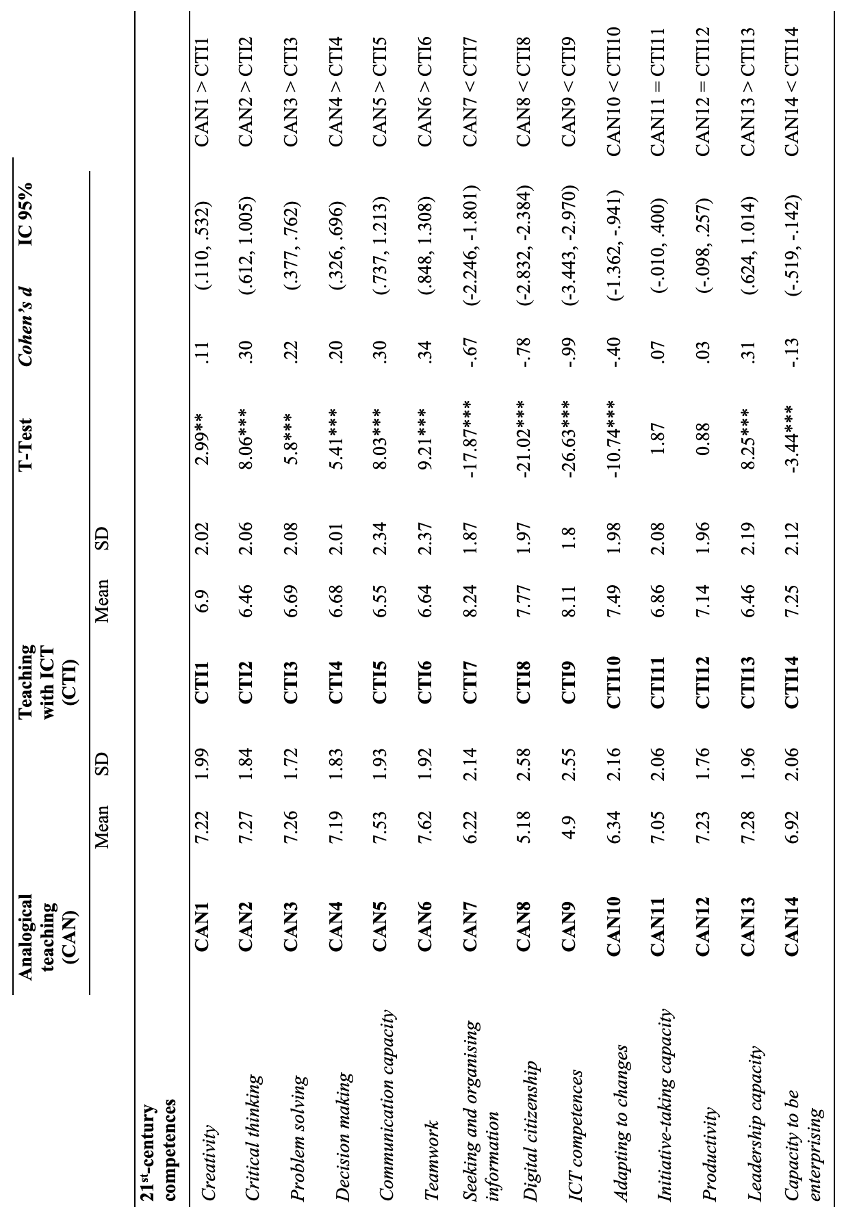
On a scale from 0 to 10. According to
Cohen’s (1988) criteria, values of d around .20 indicate a small effect, around
.50 a medium effect, and .80 or above a large effect.
Appendix C—Table 3. Correlations
among 21st-Century Competences
Appendix
D—Table 4. The ANOVA Test for Comparing Means
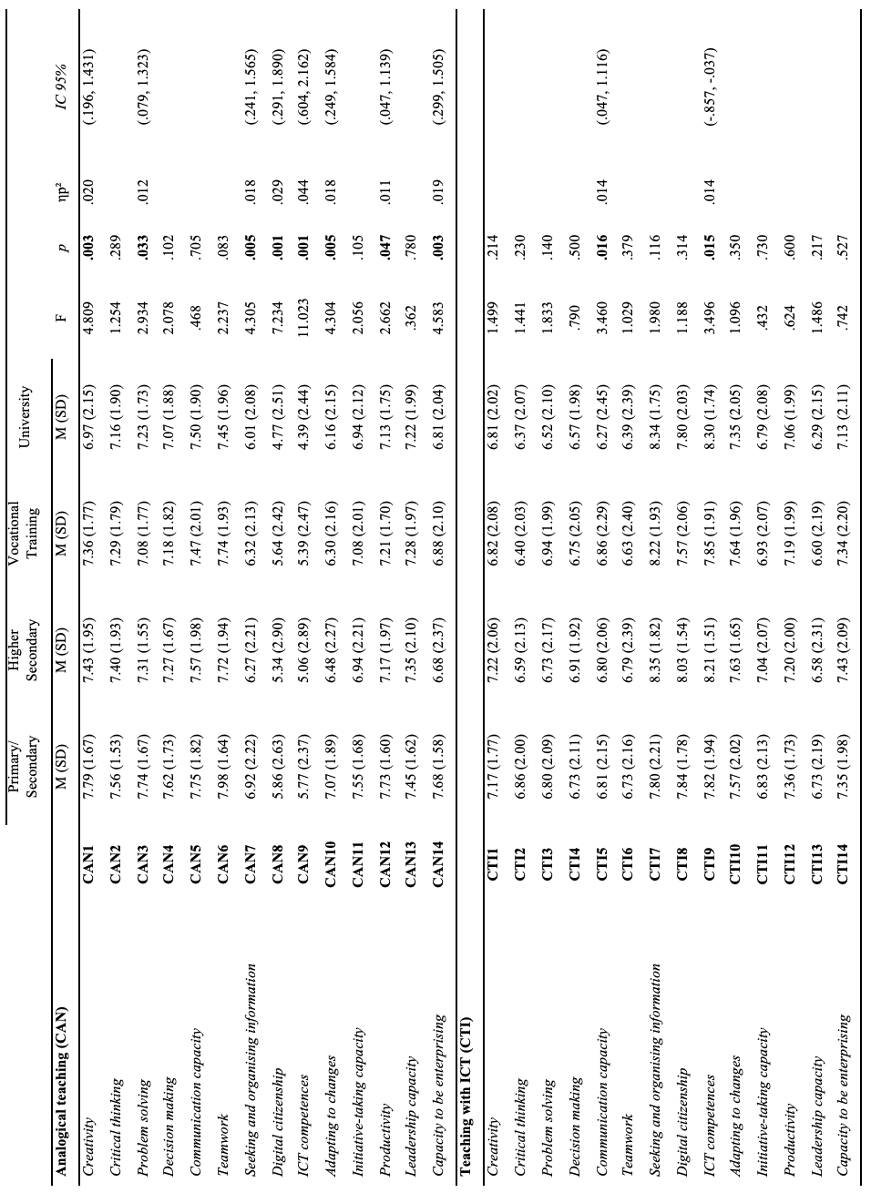
Effect sizes are reported as partial eta squared (ηp²). According to Cohen’s (1988) guidelines, ηp² values of approximately .01 indicate a small effect, .06 a medium
effect, and .14 a large effect.