in education Volume 31, Number 3, 2026 Autumn (Special Issue)
Socioscientific Issues in Education: Voicing Canadian Perspectives
Editorial by Guest Editors
Latika Raisinghani, University of Winnipeg
Ellen Watson, Brandon University
Lilian Pozzer, University of Manitoba
Photo
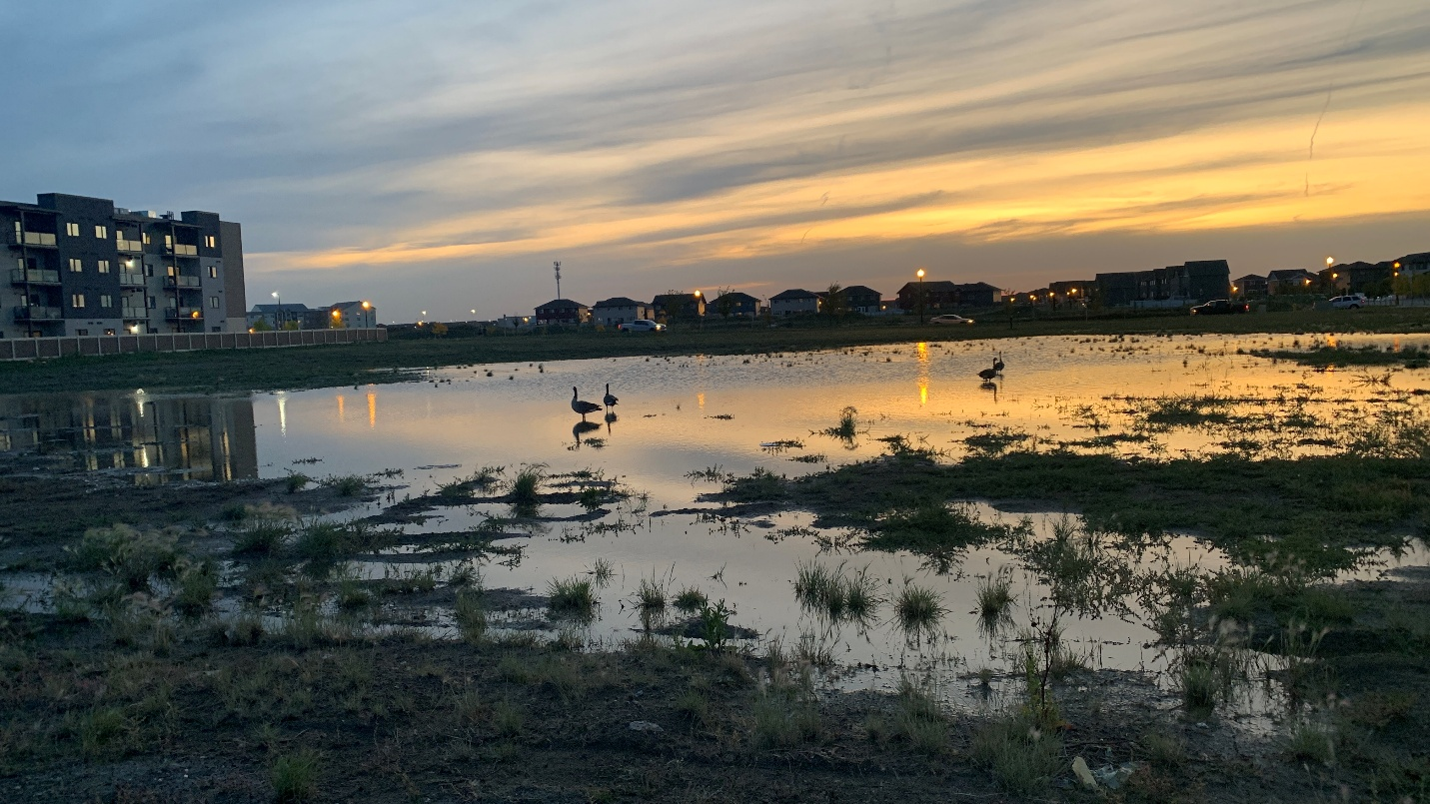
Credit: Latika Raisinghani, 2019
The above photo was taken by Latika Raisinghani in Regina on September 16, 2019, as she went for an evening walk. At that time, Latika did not imagine that experiencing nature’s beauty through such walks would become a rare event only six months later. On March 11, 2020, the World Health Organization (WHO) formally declared Coronavirus disease 2019 (COVID-19) a pandemic (Cucinotta & Vanelli, 2020). Soon after, classes were suspended and then moved online indefinitely; people were advised to maintain social distancing and to work and study from home. Locked indoors for days, Latika remembers looking at the photo above and feeling that, despite we, as humans, were imprisoned within the boundaries of our homes, nature outside continued to thrive. The science around this novel respiratory disease also evolved as its cause was eventually identified as severe acute respiratory syndrome coronavirus-2, or SARS-CoV-2, but its implications went well beyond health. Economic, political, and social disparities between the Global South and the Global North became more obvious as the race to find a ‘cure’ intensified. Once vaccines were developed, access to them and the effort of educating people about the benefits of getting vaccinated became prominent issues. Six years later, with the severity of the pandemic having now subsided, many people still live with long COVID, and others still suffer the rare side effects of vaccines. The COVID-19 pandemic is just one example of a socioscientific issue.
Socioscientific issues (SSI)1 are complex, wicked, real world problems that have no easy answers (Frisch et al., 2026). Rooted in scientific concepts, SSI are shaped by sociocultural values along with ethical, environmental, political, economic, and geographical considerations, and the decision making processes of an informed citizenry. Identifying and addressing SSI is crucial for cultivating critical scientific literacy, promoting responsible citizenship, and ensuring social and ecological justice. As Canadian science educators and guest editors of this special issue, we see a need for this understanding like never before, with scientific thinking (or the lack thereof) at the root of many SSI, such as climate change, vaccinations, genetic engineering, energy and water use, and the social inequities that accompany these issues. Addressing SSI requires crossing disciplinary boundaries, building cross-curricular bridges, and connecting science with social, cultural, environmental, ethical, political, and economic dimensions of specific SSI to promote contextualized learning, informed decision-making, and responsible actions that are socially and ecologically just.
The integration of SSI in science education is a progressive sociocultural movement that shares roots with Science Technology Society and Environment (STSE) (Bencze et al., 2020; Pedretti et al., 2008) and Socially Acute Questions (SAQ) (Simonneaux & Simonneaux, 2012) movements. SSI may focus on raising awareness of and addressing ethical, political, economic, and technological dilemmas that arise from complex STSE interrelationships (Viehmann et al., 2024). The SSI approach extends STSE education by integrating moral and ethical considerations related to social and environmental responsibility into science teaching and learning. In doing so, it promotes scientific literacy by inviting students to critically examine the benefits, limitations, and broader implications of scientific and technological advancements (Zeidler, 2014). Although SSI have been the focus of international scholarship (e.g., Högström et al., 2024), there is a need to create spaces that recognize the contributions of Canadian scholars.
To amplify Canadian voices on SSI education, this special issue of in education, Socioscientific Issues in Education: Voicing Canadian Perspectives, highlights 16 Canadian scholars from 12 educational contexts. It offers four research articles, two essays, and two book reviews that explore various SSI in Canadian and broader global contexts to inform social and ecological justice in education. Canadian education has a long history of including SSI in its classrooms (Pedretti & Nazir, 2011), but recent studies (Field et al., 2023; Schatz, 2021) indicate that Canadian curriculum documents, and consequently Canadian education, may benefit from further integration of SSI in teaching and learning science at K-12 levels as well as in teacher education programs. This is particularly evident when considering the rise of misinformation and disinformation related to SSI such as climate change, artificial intelligence (AI), post-pandemic debates around vaccine efficacy and long COVID, and the social and ecological disparities many Indigenous communities in Canada face in accessing clean water and natural resources.
Increasingly, mistrust in science is leading to a rise in diverse partisan polarization across the educational sphere. Hence, the articles and book reviews in this issue address the central question: “How can Canadian science students be prepared for a world where SSI are so strongly polarizing?” The contributions to this issue respond to this central question by inviting readers to think about the following:
Whose knowledge and voices are valued and promoted in contemporary educational spaces when discussing SSI?
How might students be prepared to critically analyze SSI and become responsible decision makers?
What challenges are inherent in implementation and enactment of SSI in teaching at K-12 levels and in teacher education programs? How might we prepare teachers for these challenges?
In what ways might holistic education be invited into science classrooms, addressing SSI and cultivating relational connectedness with the human and more-than-human world as informed by the Truth and Reconciliation Commission of Canada’s (TRC) Calls to Action (TRC, 2015)?
The first three articles, by Emily Krushelnycky and Xavier Fazio, Carol Brown, and Norris Erhabor and Giuliano Reis respond to the second and third questions above. Focusing on preparing teachers for SSI integration, Krushelnycky and Fazio highlight the importance of integrating SSI education into Ontario’s primary classrooms and offer strategies to support teachers in this work. Brown reflects on her experiences of providing professional development and teaching about misinformation in science education, as well as on a scoping literature review exploring how teachers might be prepared to help students address complex SSI. Based upon a review of selected Canadian literature, Erhabor and Reis argue that teachers face persistent barriers to implementing SSI education in underserved settings in Canada. These authors offer a solution by presenting a cross-cultural case analysis that discusses how a low-cost, community-driven approach to teaching SSI to Nigerian pre-service teachers might inform SSI pedagogy in Canadian rural, francophone, and Indigenous contexts. In response to the second question presented above, Erin Sperling and G. Michael Bowen analyze Canadian citizen science projects and ask whether participation in these projects promotes an understanding of SSI.
The essays by Deer and Dmello et al. both speak to questions one and four presented above. In his essay, Frank Deer, a Mohawk (Kanien’kéha) scholar, contrasts Eurocentric and Onkwehón:we (“the Original Peoples”) perspectives on time, inviting science educators to consider the reductionism of the former and the different ways of organizing and interpreting temporal experience. In the essay by Steffie Dmello, Michelle Leonard, and Floriane Lévéder, the authors advocate for a transformative model of science education, in which SSI are enacted through relational, post-human, and Indigenous epistemologies.
Finally, this special issue offers two book reviews. Puvithira Balasubramaniam reviews Rola Khishfe’s The Complexities of Socioscientific Issues in Education: Research-Based Insights and Practical Strategies, a book which addresses the question of how to include SSI in classrooms. Peiki Loay reviews A Sociopolitical Turn in Science Education: Towards Post-Pandemic Worlds, edited by Canadian scholar Christiano Moura. The contributions in this book focus on the implications of the SSI surrounding the COVID-19 pandemic and post-pandemic changes in science and science education in the Canadian and global contexts.
We are delighted to highlight the voices of Canadian scholars about SSI education in a Canadian journal. This special issue advances scholarly conversations in science education by providing open access to engaging with critical issues pertaining to teaching and learning in science education and the broader educational landscape, as envisioned in the scope of in education journal. We owe our special thanks to the in education Editor-in-Chief, Dr. Kathleen Nolan and to Dr. Valerie Triggs (former Co-Editor-in-Chief), for their guidance and support throughout the preparation of the manuscripts for this special issue. The contextualized contributions of Canadian scholars in this special issue promote research, teaching practice, and theory development to inform a critical scientific literacy that is highly needed to address current social and ecological justice issues. As educators continue their learning of SSI education in a world where social, political, cultural, economic, and ethical tensions prevail, the lingering question remains: How can science educators engage in learning through/with/about SSI without inciting hate speech, ensuring the well-being of individuals and the community, and inviting diverse perspectives with affirmation, solidarity, and critique? We hope you engage with this question as you invite SSI education into the contexts of your own classrooms and broader communities.
References
Bencze, L., Pouliot, C., Pedretti, E., Simonneaux, L., Simonneaux, J., & Zeidler, D. (2020). SAQ, SSI and STSE education: Defending and extending “science-in-context.” Cultural Studies of Science Education, 15(3), 825–851. https://doi.org/10.1007/s11422-019-09962-7
Cucinotta, D., & Vanelli, M. (2020). WHO declares COVID-19 a pandemic. Acta Bio-Medica: Atenei Parmensis, 91(1), 157–160. https://doi.org/10.23750/abm.v91i1.9397
Field, E., Spiropoulos, G., Nguyen, A. T., & Grewal, R. K. (2023). Climate change education within Canada’s regional curricula: A systematic review of gaps and opportunities. Canadian Journal of Educational Administration and Policy, 202, 155–184. https://doi.org/10.7202/1099989ar
Frisch, J. K., Alston, D. M., Feldman, A., Hagevik, R., & Schpakow, M. L. (2026). Wicked problems in PreK-12 science education: Stories and strategies for confronting complex topics in the science classroom. Routledge. https://doi.org/10.4324/9781003508793
Högström, P., Gericke, N., Wallin, J., & Bergman, E. (2024). Teaching socioscientific issues: A systematic review. Science & Education, 34, 3079–3122. https://doi.org/10.1007/s11191-024-00542-y
Pedretti, E. G., Bencze, L., Hewitt, J., Romkey, L., & Jivraj, A. (2008). Promoting issues-based STSE perspectives in science teacher education: Problems of identity and ideology. Science & Education, 17, 941–960. https://doi.org/10.1007/s11191-006-9060-8
Pedretti, E., & Nazir, J. (2011). Currents in STSE education: Mapping a complex field, 40 years on. Science Education, 95(4), 601–626. https://doi.org/10.1002/sce.20435
Schatz, K. (2021). Where we stand: The integration of climate change education in Canadian schools. British Columbia Council for International Cooperation. https://www.bccic.ca/wp-content/uploads/2021/11/FINAL-Climate-Change-Education-in-Canada.pdf
Simonneaux, J., & Simonneaux, L. (2012). Educational configurations for teaching environmental socio-scientific issues within the perspective of sustainability. Research in Science Education, 42(1), 75–94. https://doi.org/10.1007/s11165-011-9257-y
Truth and Reconciliation Commission of Canada. (2015). Truth and Reconciliation Commission of Canada: Calls to Action. https://ehprnh2mwo3.exactdn.com/wp-content/uploads/2021/01/Calls_to_Action_English2.pdf
Viehmann, C., Fernández Cárdenas, J. M., & Reynaga Peña, C. G. (2024). The use of socioscientific issues in science lessons: A scoping review. Sustainability, 16(14), Article 5827. https://doi.org/10.3390/su16145827
Zeidler, D. L. (2014). Socioscientific issues as a curriculum emphasis: Theory, research and practice. In N. G. Lederman & S. K. Abell (Eds.), Handbook of research on science education (Vol. II, pp. 697–726). Routledge. https://doi.org/10.4324/9780203097267.ch34
1 We are aware of the debate over the spelling of “socioscientific” vs. “socio-scientific.” Despite the grammatical acceptance of socio-scientific issues, we agree with Zeidler (2014) when he writes “the unassuming hyphen cleaves the social context […] from the science” (p. 699). Hence, we use the term socioscientific to showcase the entanglement of the social and scientific knowledges required to address these issues. However, we have allowed authors in the issue to decide which spelling they prefer.