Belonging,
Community, and Preparedness:
Teacher Experiences of Working and Living in Northern Manitoba
Natalie Pegus, Pembina
Trails School Division
Author’s Note
The author did not receive funding for this publication.
Correspondence concerning this article should be addressed to Natalie Pegus at nataliepegus@gmail.com.
Abstract
Recruitment and
retention of teachers remain persistent challenges for school divisions in
northern Manitoba. This qualitative study examines the experiences of teachers
new to working and living in northern Manitoba, with attention to recruitment,
retention, preparedness, and sense of belonging. Findings highlight the central
role of professional and social connections in shaping teachers’ early
experiences and influencing decisions to remain in the region. The study also
advances a conceptual understanding of what it means for teachers to ‘feel at
home’ in their profession, demonstrating that this experience has multiple,
interconnected personal and professional dimensions. Recognizing these varied
needs has important implications for recruitment, preparation, and retention
strategies in northern and remote contexts.
Keywords: sense of
belonging, northern Manitoba, teacher preparedness, teacher recruitment, teacher
retention
Belonging,
Community, and Preparedness:
Teacher Experiences of Working and Living in Northern Manitoba
Teachers
transitioning to new schools and communities frequently encounter challenges
related to isolation, professional identity, workload, and integration into
school culture (Anhorn, 2008; Hellsten et al., 2011; Kutsyuruba et al., 2014).
These challenges are often intensified in remote and northern contexts, where
limited resources, geographic isolation, and overlapping professional and
personal roles can contribute to stress and early-career attrition (Bjorklund,
2023; Wotherspoon, 2008). In northern Canada, teacher retention remains a
persistent concern (Greenslade, 2023; Kutsyuruba et al., 2014).
In
Manitoba, northern school divisions continue to struggle to recruit and retain
qualified teachers despite financial incentives and targeted recruitment
initiatives (Greenslade, 2023; Manitoba Teachers’ Society, 2021). While signing
bonuses and salary incentives may support initial recruitment, they reportedly have
a limited impact on long-term retention (Kitchenham & Chasteauneuf,
2010; Walker, 2024; White, 2019). Teachers who relocate to northern or remote communities
may experience culture shock, limited access to professional development, and
assignments outside their areas of specialization, which can further complicate
their adjustment to their new roles (Hellsten et al., 2011).
Despite
a somewhat growing body of research on teachers’ experiences in northern Canada
(Bowman, 2018; Danyluk & Sheppard, 2015a; Kitchenham & Chasteauneuf, 2010; Walker, 2024), there is less research
on teachers’ experiences in northern Manitoba specifically (Janzen, 2019), and
to date, no research on larger northern centres such as Thompson. Thompson,
located on Treaty 5 Territory, serves as an important regional hub for
education, health care, and other services in northern Manitoba. Although it arguably
offers more amenities than many surrounding communities, it continues to face
substantial challenges related to teacher recruitment and retention
(Greenslade, 2023).
This
qualitative study explores the experiences of teachers new to working in
Thompson, Manitoba, to better understand how to improve recruitment and
retention strategies in Northern Manitoba. More specifically, this study
addresses the following research questions:
1.
What challenges do teachers new to
northern Manitoba experience?
2.
How do teachers new to northern
Manitoba experience belonging within their schools and the broader community?
3.
In what ways are teachers prepared
to live and work in northern contexts?
4.
What factors influence teachers’
decisions to remain or leave northern Manitoba?
By
examining teachers’ sense of belonging, preparedness, and perspectives on the
challenges they face, this study makes an important contribution to the growing
body of research on recruitment and retention in northern Canada. Understanding
how new teachers navigate northern communities through a lens of belonging may
inform recruitment practices, induction programs, and professional support
systems to strengthen educational sustainability in northern Manitoba.
This literature
review aims to present and critically discuss previous research that has laid
the groundwork for this study. It is organized into three thematic sections
aligned with the research topics. The first section highlights the experiences
of teachers working in northern and isolated communities in Canada. As noted
earlier, research on teachers’ experiences in northern Manitoba is sparse.
Therefore, the scope was extended beyond Manitoba’s borders to other provinces,
territories, and rural parts of Canada, from which relevant experiences can be
drawn in similar contexts. Relevant research outside Canada was also examined.
The second section explores a sense of belonging in teaching, which has been
understudied until recently. The final section highlights teacher preparation
for working in northern Canadian communities, focusing on Manitoba’s education
programs, given the limited available research.
Teaching in Northern Communities of
Canada
Kitchenham and Chasteauneuf’s (2010) longitudinal study in British
Columbia, Alberta, the Yukon, and the Northwest Territories laid important
groundwork by documenting and underscoring chronic staffing shortages in
northern Canada. Although Manitoba was not included in their research, this
work elaborates on pertinent issues teachers may face in the more northern and
isolated regions of our country. Kitchenham and Chasteauneuf’s
research on northern Canada focuses on external issues that teachers may
encounter, such as a lack of professional development and teaching outside
one’s area of expertise. However, more recent research has adopted a different
approach in examining not only the challenges encountered by teachers working
in northern or remote Canadian communities, but also the emotional aspects of
relocating to a new community and the motivations for staying or leaving
(Janzen & Cranston, 2015).
Janzen and Cranston (2015) assert that
recent studies are insufficient in representing the complexities of teacher
career choices. Their emphasis on community integration and the emotional and
social needs of teachers helped inspire and lay the groundwork for this
research. Janzen and Cranston also recognize that much of the existing
literature and discourse on teaching in the North is positioned within
metropolitan-centric views and can hold negative assumptions and
misunderstandings about the North. This acknowledgment is important and, as an
educator originally from northern Manitoba, is appreciated. The way in which teaching
is framed in northern and rural locales is crucial, as ‘deficit’ views
perpetuate inequities. White (2019) urges that teacher education should expand
beyond the perspective of ‘classroom-ready’ to ‘community-ready.’ Looking
towards the benefits of teaching in contexts different from our own is a
helpful reframing.
Important
insights emerge from rural literature, since northern and rural communities
often face similar challenges in recruitment and retention (Hellsten et al.,
2011; Saunders, 2022; Walker, 2024; White, 2019). However, the assumptions
about what it means to reside in a rural Canadian environment differ greatly
from those about living in Canada’s North. Although certain parallels can be
drawn from northern and rural literature—such as deficit narratives—it is important
to recognize that these regions are distinct (Janzen, 2019). What it means to
live North of the 53rd parallel differs greatly from living in a
rural setting outside a large urban centre. While rural literature offers
useful parallels, it ultimately reveals a gap: the North remains underexamined
as a distinct context, particularly in relation to teachers’ lived experiences
and sense of belonging.
Sense of Belonging in Teaching
Belonging has
been conceptualized as a fundamental human need that supports psychological
well-being, identity development, and motivation (Allen, 2020; Baumeister &
Leary, 1995; Maslow, 1968). In school
contexts, research has traditionally focused on students’ belonging (Falkenberg
& Heringer, 2024; Filstad et al., 2019); however,
emerging studies indicate that teachers’ sense of belonging is equally
significant (Allen et al., 2025; Bjorklund, 2023; Özdogru,
2022; Wator et al., 2025) and often predicts a student’s
sense of belonging (Allen, 2020). Recent
research (Allen et al., 2025; Bjorklund, 2023) also reports that collegial relationships
and leadership practices shape a teacher’s sense of belonging, findings that this
research further reinforces.
Allen
et al. (2025) propose that there are interrelated factors which promote a
teacher’s sense of belonging. To further explore this, a conceptualization of
what it means to ‘feel at home’ was developed from this study (Figure 1), which
examines the multiple needs of teachers in a northern context. While analyzing
the interview data, it became evident that teachers’ needs span many levels
that must be addressed for them to feel at ease in their work. Teaching in a
northern environment adds a unique layer to this, which has not been explored
in previous studies.
Teacher Preparation for the North
Teacher education
programs are responsible for preparing teachers to work in diverse geographic
settings, yet many education programs in Canada remain urban-centric (Janzen,
2019; White & Reid, 2008). It therefore seemed worthwhile, in this study, to
examine current field experience options for teacher candidates living in
southern Manitoba. Accordingly, the 2025-2026 practicum handbooks for the
University of Manitoba, University of Winnipeg, and Brandon University were
reviewed. The University of Manitoba handbook is the only one that clearly
offers northern practicum options with financial support, though this support
is not guaranteed. Unsurprisingly, northern communities struggle with
recruitment and retention when university students are not guaranteed diversity
in their practica (Kutsyuruba et al., 2014). Facilitating and encouraging
northern practicum options would improve teacher candidates’ understanding of
the North, expose future teachers to other career options, and help retain
quality teachers in northern communities (Brandon, 2015; Janzen, 2019).
Choosing a teaching position in northern Manitoba means living in
an area home to a large Indigenous population, including First Nations, Métis,
and Inuit peoples (Janzen, 2019). Recognizing the North as an area of Canada
with unique cultural and historical elements is important. Teacher candidates
need to understand the region’s diversity and would benefit from specific,
meaningful preparation for this distinct northern culture (Danyluk &
Sheppard, 2015b). Janzen (2019) asserts that teacher candidates having access
to and proper preparedness for northern practicums is a starting point for
addressing the inequities of student learning in the North. However, she
acknowledges that simply offering northern practica options is insufficient.
Teacher candidates need to be culturally prepared. Danyluk and Sheppard (2015b)
argue that Indigenous-centred education programs can effectively prepare
teacher candidates to work and live in northern and rural communities in Canada
with larger Indigenous populations. Their research on Laurentian University’s
education program demonstrates the importance of teacher candidates building
relationships with rural and Indigenous communities throughout their program. Programs
such as Teach for Canada have sought to address staffing shortages through
accelerated training models, yet critics argue that such approaches risk
reinforcing colonial and deficit-based narratives (Canadian Teachers
Federation, 2015). The literature is clear that adequate preparation for
teaching in rural and northern communities is essential, and that reshaping how
teacher candidates are prepared may be imperative.
Methods
This section
outlines the methodological approach guiding the study. It begins with an
overview of the theoretical and conceptual framework, including the study’s
grounding in belonging and the emergent concept of ‘feeling at home in teaching’.
The research design is then described, followed by details on participant
recruitment and characteristics. The remaining sub-sections describe data
collection procedures and the processes used for data analysis and management.
Finally, ethical considerations are addressed.
Theoretical and Conceptual Framework
This study
explores the experiences and preparedness of teachers new to working in
Thompson, Manitoba, with the aim of informing recruitment and retention
strategies in northern communities. It addresses four research questions: (1)
What challenges do teachers new to northern Manitoba experience? (2) How do
teachers new to northern Manitoba experience belonging within their schools and
the broader community? (2) In what ways are teachers prepared to live and work
in northern contexts? and (4) What factors influence teachers’ decisions to
remain or leave northern Manitoba?
Theory of
Belonging and ‘Feeling at Home in Teaching’
Belonging has
been defined and operationalized differently across studies (Allen et al.,
2021). Despite needing more consistency and conceptual clarity in defining
belonging, there are commonalities across perspectives and studies. One
commonality across studies is that an individual’s sense of belonging is often
tied to their perception of a chosen group or place (Allen, 2020; Allen et al.,
2025; Bjorklund, 2023; Mahar et al., 2014). Beyond social belonging, a
connection to place and culture is also essential to recognize (Allen et
al., 2025; Janzen & Cranston, 2015). For this study, the exploration of
belonging focuses on one’s relationship to community: the workplace community
(Bjorklund, 2023) and the broader community—to place (Janzen & Cranston,
2015). Teachers’ relationships within their school community and the broader
community of Thompson, Manitoba, were explored.
Although
research is beginning to burgeon regarding belonging for teachers (Allen et
al., 2025; Özdogru, 2022; Wator
et al., 2025), more could still be known (Bjorklund, 2023; Pesonen et al.,
2021; Skaalvik & Skaalvik,
2011), especially while examining certain regions of Canada that struggle with
retention. Highlighting a
teacher’s sense of belonging has yielded unique results in the northern
context of this study. What started as an exploration of a teacher’s sense of
belonging in Thompson evolved into a broader exploration of not only what it
means to belong but to ‘feel at home’ in the teaching profession.
Research Design
This qualitative study was guided by a constructivist paradigm,
emphasizing participants’ subjective meanings and socially situated experiences
(Creswell & Creswell, 2018). This approach was well-suited to exploring
teaching experiences within a small northern community characterized by
distinct social, cultural, and historical contexts.
Participants and Recruitment
An invitation
to participate in this study was sent to school principals at the six
elementary schools and one high school in Thompson, who then distributed it to
their teachers. Interested teachers contacted me directly. Four teachers met
the inclusion criteria: they were new to teaching in Thompson, Manitoba, though
not necessarily new to the profession.
The group
of participants included three elementary teachers (middle years) and one high
school teacher, representing a range of experience levels and backgrounds. Two
participants were in their first year of teaching, while the other two had
prior teaching experience in Canada or internationally. The group included two
male and two female participants.
Given
the study’s origins as graduate research, a small sample size was intentionally
maintained to allow for in-depth exploration of participants’ experiences.
Participant characteristics are summarized in Table 1:
Table 1
Background
Information of Participants.
|
Participant |
Years of
Experience Teaching |
Grades Taught
in Thompson |
|
Participant A |
First year |
Middle Years |
|
Participant B |
First year |
Senior Years |
|
Participant C |
Fourth year |
Middle Years |
|
Participant D |
Seventeenth year |
Middle Years |
Data Collection
Data were collected
through individual semi-structured interviews conducted via Microsoft Teams
between May and June 2025. An interview guide with open-ended questions was
used to explore participants’ experiences of belonging, preparedness,
recruitment, and retention. Interviews lasted approximately 50–60 minutes, were
audio- and video-recorded with consent, and were transcribed verbatim. Participants
were provided with the opportunity to review their transcripts for member
checking, and they were invited to clarify or amend their responses.
Data Analysis and Data Management
Data were analyzed
using thematic analysis informed by In Vivo coding (Chase & Martin, 2021),
which emphasizes participants’ own language. Transcripts were reviewed
iteratively to identify recurring patterns related to preparedness, belonging,
recruitment, and retention. Although belonging and preparedness were not
initial focal themes, they emerged as central during analysis and were informed
by existing literature (Allen et al., 2025; Bjorklund, 2023).
Recordings
were stored on the UM network drive during this study. The interview data were
kept confidential using pseudonyms (participants A, B, C, D), and the schools
were not named individually. A code list connecting the actual names to the
pseudonyms, along with the Microsoft Teams interview recordings, was kept
securely on the UM network drive. Names and identifying information about
individuals or schools were removed from the transcript as an additional step
to safeguard confidentiality. Recordings were conducted via Microsoft Teams,
stored on the UM network drive, and deleted at the end of August 2025 after
transcription.
Ethical Considerations
All
participants provided informed consent and were assured of confidentiality and
the right to withdraw before data aggregation. Pseudonyms were used, and
identifying information was removed from transcripts. Ethical approval was
obtained from the University of Manitoba Research Ethics Board, and
institutional permission was secured from the participating school division.
Findings and
Discussion
This section
presents an integrated analysis of findings in relation to the existing
literature, organized around five interconnected themes: recruitment, sense of
belonging, preparedness, challenges, and retention. These themes align with the
study’s guiding questions, addressing the challenges teachers face in northern
Manitoba, how they develop a sense of belonging within their schools and
communities, how they are prepared for northern contexts, and the factors that
influence their decisions to remain or leave. Although discussed separately,
these dimensions were experienced as overlapping and mutually reinforcing in
participants’ accounts. Collectively, they reveal that teacher retention in
northern contexts is not driven by a single factor but by an evolving process
through which teachers come to ‘feel at home’ in their professional and
community lives.
Recruitment to Thompson
Across all four
interviews, recruitment was relational. It was not primarily job postings or
financial advertisements that persuaded these teachers—it was people. This
aligns with broader research on northern recruitment, which implies that
decisions to teach in northern communities are often influenced by social and
emotional considerations rather than financial ones alone (Janzen &
Cranston, 2015; Kitchenham & Chasteauneuf, 2010).
In this study, teachers were more willing to relocate when they could imagine
connection and support waiting for them.
For
Participant B, siblings already living in Thompson spoke positively about life
in northern Manitoba and encouraged her to join them. Her earlier experience
substituting in the community during the summer months also strengthened her
comfort with returning. She reflected that she was “blessed with connections”
and that these relationships helped root her decision. Participant C, a
newcomer to Canada, also had family living in Thompson, which eased his
relocation and reduced some of the uncertainty associated with moving to a new
country and region.
Participant
D’s pathway was different but equally relational. After struggling to secure
stable employment in Toronto, where positions were often part-time or
substitute-based, he accepted a position in Nunavut before eventually moving to
Thompson. He learned about opportunities in Thompson through a friend already
working there. A simple conversation—“they were looking for teachers”—led him
to contact the superintendent directly. This informal connection became the
bridge to formal employment.
Participant
A did not initially have family in Thompson, but she described being deeply
influenced by conversations with professors and others who encouraged her to
view teaching in the North as an opportunity for growth. That encouragement
reframed the move as a possibility rather than a risk. She also acknowledged
that finding a position in her specialty area closer to home would have been
difficult, which made her more open to stepping outside her comfort zone.
As
confirmed through previous literature (Kitchenham & Chasteauneuf,
2010; Walker, 2024; White, 2019), financial incentives did play an initial
role, particularly the $4,000 moving allowance, which was described as ‘attractive’
by Participant D. Participant D acknowledged that financial compensation helped
offset the sacrifices involved in moving north—distance from family, climate,
and fewer amenities. However, these incentives were not described as decisive in
and of themselves. Rather, they functioned as practical support layered onto an
already relational decision. The financial bonus made the move feasible, but it
did not make it meaningful. This aligns with White’s (2019) assertion that
financial incentives are not enough to attract teachers to certain locations.
An
important pattern emerges when recruitment is considered alongside belonging
and retention. For three participants, prior relationships with people in
Thompson eased their early adjustment and likely contributed to their initial
sense of belonging. Even before arriving, they had a connection—someone who
spoke positively about the community or personally encouraged them. Recruitment
shaped teachers’ initial sense of belonging.
Sense of Belonging
How did the
participants of this study experience a sense of belonging within their schools
and the broader community? As identified in the literature, belonging is a
fundamental human need (Allen, 2020; Maslow, 1968) that significantly
influences well-being, mental health, and decision-making (Allen, 2020;
Baumeister & Leary, 1995). The experiences shared by participants in this
study strongly reinforce the importance of belonging, particularly within the
immediate school environment, as teachers navigated both professional and
personal transitions in a northern context.
All
participants emphasized that collegial relationships were foundational to their
sense of belonging within their schools. One teacher explained, “I work in a
good environment with seven other teachers in my department. I feel a sense of
community in my department.” Another similarly noted, “I get along really,
really well with my department, and we hang out and have made friends with
teachers from other schools.” Across interviews, supportive colleagues and
administrators were described not as incidental benefits, but as essential to
feeling settled and accepted.
The
importance of administrative support also emerged clearly. One participant
reflected, “The support didn’t just stop after being hired,” explaining that
administrators checked in regularly throughout the year. Another shared, “No
one will turn you down or not welcome you.” These comments illustrate how
belonging was not confined to informal peer relationships but was reinforced
structurally through leadership practices. This finding aligns with Allen’s
(2020) assertion that the quality of a teacher’s relationship with their
principal significantly shapes their sense of belonging. In one case, a
participant’s decision to accept a position in Thompson was influenced by a
positive and welcoming interview experience: “Just from doing the interview, I
think maybe that sold me… speaking to the principal and the previous
vice-principal… made me feel like, ‘Wow, I want to work with these people.’”
This early interaction in building relational trust demonstrates how the seeds
of belonging can begin to form even before formal employment starts.
While
literature on northern education often emphasizes the importance of a
“relationship to place” and broader community integration (Janzen &
Cranston, 2015), participants in this study primarily located their sense of
belonging within their school communities. As participants acclimated to life
in Thompson, the immediate professional environment appeared to act as a
crucial anchor. Conversations about belonging consistently centred on
relationships with colleagues and administrators, rather than on external
community connections.
At
the same time, some participants described belonging as an active process. One
teacher explained that stepping outside her “comfort zone” by attending teacher
events, socializing with colleagues, and participating in recreational sports
was essential: “It’s gonna be what you make it… If you
don’t kind of push yourself outside of your comfort zone, it’s going to be
lonely.” Although she acknowledged feelings of homesickness, she ultimately
concluded, “It ended up working out a lot… I’m OK.” This reflects Johnston and
Dewhurst’s (2021) framing of belonging as an “act of doing” and aligns with
Danyluk and Sheppard’s (2015a) findings that intentional engagement can
accelerate integration in northern contexts. Belonging was not entirely
passive; it required participation, vulnerability, and effort.
For
one participant transitioning to Canada, belonging was initially complicated by
cultural shock and distance from family. However, the openness of students and
staff played a critical role in easing that transition. He recalled a student
interacting with him on his first day, “as if he knew me for a long time,” and
repeatedly emphasized the supportive nature of the school board office staff,
describing them as treating him “like you are totally… familiar with them.”
These experiences highlight the interpersonal dimension of belonging identified
by Allen (2020): feeling recognized, welcomed, and accepted within relational
spaces.
For
teachers new to Thompson, belonging was primarily cultivated within the school
community. While all teachers experienced belonging differently within their
school and broader community, strong collegial and administrative relationships
seemed to buffer against other stressors associated with relocation, cultural
adjustment, and geographic isolation (Skaalvik & Skaalvik, 2011). Broader community integration improved belonging
for some participants, though it was not a priority for all.
In
northern Manitoba, where recruitment and retention remain ongoing challenges,
fostering relationally rich school environments may be one of the most
impactful ways to support new teachers. Belonging, as demonstrated in this
study, is not incidental—it is foundational.
Preparedness
Teacher
preparedness emerged as a complex, layered theme, revealing significant gaps
between formal teacher education and the lived realities of teaching in
Thompson, Manitoba. Most participants reported feeling culturally underprepared
to work in a northern context. These findings align with research indicating
that Canadian teacher education programs remain largely urban-centric (Janzen,
2019; White & Reid, 2008), often leaving candidates insufficiently prepared
for the cultural, environmental, and social dynamics of northern communities.
Three
participants, regardless of background, stated that they did not feel
culturally prepared to teach in Thompson. One participant reflected, “My
university integrated Indigenous perspectives, but it doesn’t quite prepare you
for what’s in person.” Although Indigenous content had been included in
coursework, it did not fully equip her for the lived reality of working in a
community where Indigenous traditions were embedded in daily life. She
contrasted this with her prior experience in a predominantly white community,
where land acknowledgments felt more symbolic than integrated. This reflects
Janzen’s (2019) concern that including Indigenous content in teacher education
may not be sufficient if it does not meaningfully prepare teachers for the
relational and contextual realities of northern Indigenous communities.
Another
participant similarly noted, “I didn’t feel prepared through university, more
so, just through, you know, people talking and the news.” Her perceptions of
the North had been shaped in part by media portrayals, contributing to
apprehension and uncertainty. She acknowledged that during her degree, she
would have felt “very, very scared” at the idea of completing a practicum in
the North—if one had been offered—due to distance isolation, and lack of
connection. Although both Canadian-trained participants indicated they were
generally pedagogically prepared, their concerns centred more on cultural
unfamiliarity and the social-emotional adjustment required when relocating.
Preparedness
also intersected strongly with prior experience. One participant, who had
previously taught in Nunavut, described his initial move to northern Canada as
“kind of shocking,” particularly adjusting to extended periods of darkness. He
had not anticipated how environmental factors, such as prolonged winter nights,
would affect both his own well-being and student learning. However, by the time
he relocated to Thompson, he felt relatively adaptable, stating, “I’ve
experienced a lot of different situations… I’ve learned to adapt and change.”
For this participant, prior northern experience functioned as a preparatory
bridge, reducing the intensity of adjustment and limiting the support he
required during his transition.
In
contrast, the participant who was newest to Canada faced a multi-layered
transition. His adjustment involved not only adapting to a northern and
Indigenous context but also learning the mechanics of Canadian pedagogy. He proposed
that beginning as a substitute teacher or educational assistant might have
eased his transition: “If you work as a sub or an educational assistant, then
you will learn a lot from the teacher. If you work as a permanent teacher
directly, you have to learn a lot. You have to face a lot of challenges.” His
experience illustrates how preparedness cannot be understood as a single
dimension. For internationally trained teachers, professional, cultural, and
personal transitions occur simultaneously, intensifying the complexity of the first-year
experience.
The
findings reveal a gap between theoretical preparation and practical readiness
for teaching in the north. While universities may provide foundational
pedagogical training and incorporate Indigenous perspectives, participants’
experiences suggest that authentic exposure to northern contexts remains
limited. The absence of northern practicums—often restricted due to logistical
challenges—contributed to uncertainty and apprehension. Without direct
experience, candidates may rely on media narratives or second-hand accounts,
which can distort perceptions and heighten anxiety.
Challenges
Participants
described a range of personal and professional challenges during their first
year in Thompson, reflecting differences in background, experience, and prior
exposure to northern contexts. Several participants identified climate as an
initial difficulty, particularly the length and severity of winter. Participant
C, a newcomer to Canada, explained, “First of all, it’s very cold… the second
one is cultural difference.” Participant B similarly noted that “winter as a
whole was long.”
After
adapting to environmental conditions, participants described challenges related
to professional identity, pedagogical adjustment, and personal well-being.
Participant A emphasized that her primary concerns were connected to her status
as a beginning teacher rather than to northern living. She reflected, “I was
worried about what my colleagues thought of my teaching,” noting that these
concerns were unwarranted and diminished over time.
For
Participant C, who was new to both teaching in Canada and the local community,
professional and cultural challenges were closely intertwined. He described
learning classroom management and pedagogical practices within an unfamiliar
educational system, stating, “I didn’t have any kind of experience of the
Canadian education system.” He also observed that other internationally trained
teachers faced similar difficulties and emphasized the importance of mentorship
from experienced colleagues. These professional challenges were compounded by
geographic distance from family, contributing to feelings of isolation: “I miss
my family a lot… It’s kind of a feeling of isolation.” As Canada continues to
welcome an influx of internationally trained teachers, we must find a way to
support them so they thrive, not just survive.
In
contrast, Participant D, who had several years of teaching experience and prior
experience teaching in Nunavut, reported fewer instructional challenges.
Instead, his concerns centred on community and lifestyle factors, including
limited transportation options, access to culturally familiar food, and the
cost and distance associated with travel. He explained, “If I want to get out
of Thompson, it’s not as easy as it might seem… you’ll need a heavy wallet.”
Participants’
challenges reflected shifting needs across career stages and personal
circumstances. For less experienced teachers and those new to Canada,
challenges are centred on pedagogical adaptation, classroom management, and
cultural adjustment. For more experienced teachers, concerns were more closely
tied to lifestyle, mobility, and community integration. As teachers gain
professional confidence and cultural familiarity, the nature of their
challenges evolves, with broader community and quality-of-life factors becoming
increasingly salient.
Retention
Teacher
retention in Thompson cannot be understood as a uniform or static outcome.
Rather, it emerged in this study as a dynamic process shaped by teachers’
backgrounds, prior experiences, cultural familiarity, and evolving personal
goals. While all four participants expressed intentions to remain teaching in
the North for the upcoming school year, their long-term trajectories revealed
more complex considerations, including family proximity, professional
aspirations, and lifestyle preferences.
In
the short term, the findings paint an encouraging picture. Each participant
described generally positive experiences living and working in Thompson and
planned to continue teaching in northern Manitoba. This immediate retention
appears closely linked to the strong sense of belonging cultivated within their
schools. Supportive colleagues, welcoming administrators, and inclusive school
cultures helped teachers feel settled and capable in their roles.
However,
long-term retention was shaped by broader life considerations. Two participants
expressed intentions to eventually move closer to family. Participant A
anticipates returning to Winnipeg to pursue a master’s degree and reconnect
with friends and relatives. Participant D envisions returning to his home
country to be closer to his mother, though he emphasized that if he were to
remain in Canada, he would stay in Thompson. Participant B expressed curiosity
about exploring larger communities with additional amenities. These reflections
suggest that retention is influenced not only by professional satisfaction but
also by life stage, relational ties, and long-term identity formation.
The
advice participants offered to the school division further illuminates the
conditions that support retention. Participant D explained, “If you hire
somebody and put them here, you should not assume they are OK because not
everybody will come forward and say, I need help.” He stressed the importance
of proactive support and attention to teacher mental health, noting the risk of
burnout if needs go unnoticed. A couple of participants also recommended creating
newcomer-specific gatherings specifically for newcomers to Thompson.
Participant C explained: “When you meet the new people who are also new to the
place, then you feel like you are not alone. You can share your feelings that
they may also feel.” The participants acknowledged many opportunities for
teacher socialization through events organized by the local teachers’ union;
however, they remarked that they felt overwhelmed by meeting only ‘veteran’
teachers at these gatherings.
The
significance of mentorship also emerged. A participant who had not previously
taught in Canada noted that structured opportunities to work alongside
experienced teachers would ease the adjustment, particularly in areas such as
classroom management. Although the division had recently introduced a
mentorship initiative, not all participants were aware of it or eligible to
participate. This gap suggests that access, communication, and criteria for
support programs may influence their effectiveness. Tailored mentorship that
accounts for varied entry backgrounds may strengthen both confidence and
long-term commitment.
Participants
also highlighted the importance of community integration. Recommendations such
as offering guided tours of the town, increasing school division visibility at
out-of-province career fairs, and encouraging extracurricular involvement
underscore the relational nature of retention. Teachers who built connections
beyond their classrooms described feeling more rooted and less isolated. Two
participants advised new teachers to “put yourself out there,” emphasizing that
engagement in sports, music, or community events deepened their attachment to
the North.
Teacher
retention cannot be understood as a one-size-fits-all issue. Instead,
participants’ experiences were shaped by interconnected needs influenced by
prior experiences and cultural familiarity. Teachers who completed their
education in Canada did not need to adjust to a new pedagogical system; their
challenges were more often related to classroom management, emotional
well-being, and long-term career considerations. In contrast, participants who
immigrated to Canada navigated a broader range of challenges, including
adapting to an unfamiliar educational system, learning new cultural norms, and
developing classroom management practices, all while managing the practical
realities of settling into a new community.
These
layered experiences highlight the need for supports that are both flexible and
responsive. Approaches to retention that acknowledge the varied ways teachers
come to feel at home in their profession are more likely to address their needs
and encourage long-term commitment.
‘Feeling at Home in Teaching’
The conceptual
model presented in Figure 1 below emerged directly from the themes and
experiences shared by participants throughout the interviews. While the above
findings were organized into the broad discussion themes of recruitment,
preparedness, belonging, challenges, and retention, the five overlapping areas
in the model below represent the underlying conditions that participants
described as shaping whether they came to feel “at home” in teaching in
northern Manitoba. These conditions included basic external needs, cultural and
contextual adaptation, pedagogical confidence, sense of belonging, and
professional growth. Rather than being experienced independently, participants
described these areas as interconnected and continually influencing one another
throughout their personal and professional adjustment to northern life and
teaching. This overlapping structure of the model reflects the fluid,
relational, and evolving nature of these experiences.
Figure 1
‘Feeling at
Home in Teaching’
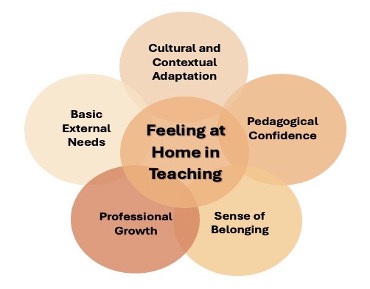
1. Basic
External Needs: Housing, transportation, winter clothes
2. Cultural
& Contextual Adaptation: Understanding northern and Indigenous contexts, adjusting to local
norms.
3. Pedagogical
Confidence: Curriculum familiarity, classroom management, student engagement
4. Sense
of Belonging: Supportive colleagues, inclusive school culture, community
connection
5. Professional
Growth:
Mentorship, leadership opportunities, advanced education
The
above figure illustrates an interconnected model of what it means for teachers
to feel at home in their profession. Rather than representing teacher
needs as a linear or hierarchical progression, this model reflects the
overlapping and relational nature of the experiences shared by participants in
this study. At the centre of the figure is the concept of ‘feeling at home in
teaching,’ surrounded by five interrelated areas of need: basic external
needs, cultural and contextual adaptation, pedagogical confidence, sense of
belonging, and professional growth. Together, these areas reflect the
conditions that supported teachers as they navigated their personal and
professional lives in northern Manitoba. This model could perhaps be applied to
other teaching contexts.
The
circular and overlapping nature of the figure emphasizes that these areas do
not operate in isolation. Rather, they continually interact, reinforcing one
another in ways that help a teacher feel settled, supported, and committed to
the profession over time. For example, when basic external needs such as stable
housing or reliable transportation are unmet, teachers may find it more
difficult to fully engage in their professional roles or invest in
relationships within the school community. Similarly, pedagogical confidence is
often strengthened through a sense of belonging, as supportive colleagues and
administrators provide guidance, reassurance, and opportunities for
collaboration. Feeling accepted within a school culture can, in turn, encourage
teachers to take professional risks, seek mentorship, and pursue leadership
opportunities that support ongoing professional growth.
Cultural
and contextual adaptation intersects with all other areas of the model. As
teachers develop a deeper understanding of northern and Indigenous contexts,
they often feel more confident in their teaching practices and more connected
to their communities. This understanding supports stronger relationships with
students and colleagues, reinforcing a sense of belonging and purpose.
Professional growth is also shaped by these interactions, as teachers who feel
culturally grounded and professionally supported are more likely to envision a
future for themselves within their school division. The figure illustrates that
‘feeling at home in teaching’ is not achieved by any single factor but by the
ongoing interaction of personal, cultural, and professional supports that
collectively sustain teacher well-being, engagement, and retention.
Implications
The findings of
this study offer several implications for educational institutions, school
divisions, and future research concerned with teacher recruitment and retention
in northern contexts. Viewing participants’ experiences through a lens of
belonging highlighted the relational and contextual factors that shaped how
teachers adapted to living and working in northern Manitoba. The following sub-sections
outline practical considerations for supporting teachers in northern
communities and identify areas where further research may deepen understandings
of belonging, preparedness, and retention in the North.
Implications for Practice
Teacher
recruitment and retention in northern Manitoba are shaped by many
interconnected factors. Rather than viewing recruitment and retention as
isolated challenges, institutions may benefit from considering how teachers
come to feel at home in their profession.
Across
participants’ experiences, a strong sense of belonging within the school
emerged as central to short-term retention. School leaders play a critical role
in fostering inclusive and supportive environments where new teachers feel
welcomed and valued. Structured opportunities for collegial connection,
accessible mentorship, and intentional onboarding processes that extend beyond
the classroom may help reduce isolation and strengthen professional confidence.
Recruitment
efforts may also benefit from emphasizing relational approaches. Word-of-mouth
encouragement and personal connections were influential in participants’
decisions to move North. Recruitment strategies that include authentic
storytelling, visible representation at career fairs, and opportunities for
prospective teachers to connect directly with northern teachers may resonate
more deeply than formal job postings alone.
Universities
likewise have an important role in shaping preparedness. While participants
often felt pedagogically prepared, many described gaps in cultural and
contextual readiness. Expanding access to northern practicums, embedding
Indigenous perspectives more meaningfully throughout teacher education
programs, and explicitly preparing candidates for the environmental and social
realities of northern communities may reduce culture shock and strengthen
resilience.
Professional
organizations, including the Manitoba Teachers’ Society, can further support
retention by increasing visibility in northern regions and offering
professional learning opportunities that reflect the specific realities of
teaching in the North. Context-responsive supports may help ensure that northern
teachers feel represented and professionally sustained.
Implications for Future Research
This study
highlights several areas for further inquiry. First, the role of collegial
relationships warrants deeper exploration, particularly in northern and remote
settings where professional and social networks often overlap. Understanding
how belonging develops within school communities may offer important insights
into retention beyond northern and remote teaching areas.
Second,
the layered experiences of internationally educated teachers in northern
contexts deserve focused attention. As Canadian school systems become
increasingly diverse, research should examine how institutions can better
support teachers navigating multiple transitions simultaneously.
Finally,
the conceptual model of ‘feeling at home in teaching’ introduced in this study
may provide a useful framework for future research. Investigating how teachers’
needs evolve over time—and how institutions can respond to these shifts—may
contribute to more sustainable recruitment and retention strategies in northern
and remote communities.
Conclusion
This study
contributes to research on teacher experiences in northern contexts by centring
belonging as a key lens for understanding how teachers navigate recruitment,
preparedness, challenges, and retention. While prior research has examined
teaching in northern Canadian settings (Bowman, 2018; Janzen & Cranston,
2015; Kitchenham & Chasteauneuf, 2010; Walker,
2024), belonging has not been consistently foregrounded in this way. Focusing
on northern Manitoba, the findings show how school-based belonging shapes
teachers’ adjustment, sense-making, and decisions to remain in the North. The
concept of ‘feeling at home in teaching’ extends existing
discussions by framing belonging as dynamic and evolving across personal,
cultural, and professional dimensions, offering a more integrated understanding
of teacher retention in northern communities.
References
Allen, K. A. (2020). The psychology of belonging. Routledge.
Allen, K. A., Longmuir, F., Thorn, M. G., Melzak, E., Berger, E.,
Gallo Cordoba, B., Phillips, M., & Reupert, A. (2025). What facilitates a
sense of belonging amongst Australian teachers? Australian Journal of
Psychology, 77(1), 2459190.
Anhorn, R. (2008). The profession that eats its young. The Delta
Kappa Gamma Bulletin, 74(3), 15-26.
Baumeister, R. F., & Leary, M. R. (1995). The need to belong:
Desire for interpersonal attachments as a fundamental human motivation. Psychological
Bulletin, 117(3), 497-529. https://doi.org/10.1037/0033-2909.117.3.497
Bjorklund Jr., P. (2023). “I kind of have that place to sit”:
First-year teachers’ experiences of belonging. Teaching and Teacher
Education, 131, 104187. https://doi.org/10.1016/j.tate.2023.104187
Bowman, M. (2018). The necessity of mentoring programs in the
north. BU Journal of Graduate Studies in Education, 10(1), 21-24. https://files.eric.ed.gov/fulltext/EJ1230322.pdf
Brandon, J. (2015). Excellent teachers for northern
and remote Alberta schools. The complexity of hiring, supporting, and
retaining new teachers across Canada, 150-168.
Brandon University, Faculty of Education. (2025). Field
experience handbook (2025–2026 academic year). https://www.brandonu.ca/education/files/FIELD-EXPERIENCE-HANDBOOK-2025-2026.p
Canadian Teachers’ Federation. (2015). Teach for Canada CTF
briefing.
Chase, E., & Martin, J. (2021). I can’t believe I’m still
protesting: Choppy waters for women in educational leadership. International
Journal of Leadership in Education, 24(1), 1-23. https://doi.org/10.1080/13603124.2019.1623917
Creswell, J. W., & Creswell, J. D. (2018). Research design:
Qualitative, quantitative, and mixed methods approaches
(5th ed.). SAGE.
Danyluk, P., & Sheppard, G. (2015a). Early teaching experiences
in northern, remote, or First Nation, Métis and Inuit communities: Implications
for initial teacher education. In Change and progress in Canadian teacher
education: Research on recent innovations in teacher preparation in Canada
(pp. 217-232). https://certarecherche.ca/wp-content/uploads/2022/12/Ntebutse_Former-pour-developpement-competence-numerique_2015.pdf#page=217
Danyluk, P., & Sheppard, G. (2015b). Preparing Bachelor of
Education candidates to teach in Ontario’s northern, remote, First Nations, Métis and Inuit Communities. Toronto, ON: Higher
Education Quality Council of Ontario.
Falkenberg, T.,
& Heringer, R. (2024). Loneliness and belonging in Canadian schools: A
knowledge synthesis study. in education, 29(2), 3-30. https://doi.org/10.37119/ojs2024.v29i2.706
Filstad, C., Traavik, L. E., & Gorli, M. (2019). Belonging at work: The experiences,
representations and meanings of belonging. Journal of Workplace Learning, 31(2),
116-142. https://doi.org/10.1108/JWL-07-2018-0091
Greenslade, B. (2023, September 6). Northern Manitoba school
division struggling with teacher shortage, increasing incentives. CBC News.
https://www.cbc.ca/news/canada/manitoba/school-teacher-shortage-manitoba-1.6957001
Hellsten, L. A. M., McIntyre, L. J., & Prytula, M. P. (2011).
Teaching in rural Saskatchewan: First-year teachers identify challenges and
make recommendations. The Rural Educator, 32(3), 11-21.
Janzen, M. D. (2019). “The event of place”: Teacher candidates’
experiences of a northern practicum. in education, 25(2), 73-90. https://doi.org/10.37119/ojs2019.v25i2.398
Janzen, M. D., & Cranston, J. (2015). Motivations and
experiences of teachers in a northern Manitoba community. Alberta Journal of
Educational Research, 61(2), 166-183. https://doi.org/10.55016/ojs/ajer.v61i2.56060
Johnston, D. H., & Dewhurst, Y. (2021). A study of student
teachers’ experiences of belonging on teaching practice. International
Journal of Educational Research, 108, 101780. https://doi.org/10.1016/j.ijer.2021.101780
Kitchenham, A., & Chasteauneuf, C.
(2010). Teacher supply and demand: Issues in northern Canada. Canadian
Journal of Education, 33(4), 869-896. https://www.jstor.org/stable/10.2307/canajeducrevucan.33.4.869
Kutsyuruba, B., & Tregunna, L.
(2014). Curbing early-career teacher attrition: A pan-Canadian document
analysis of teacher induction and mentorship programs. Canadian Journal of
Educational Administration and Policy, 161, 1-42. https://journalhosting.ucalgary.ca/index.php/cjeap/article/view/42868
Mahar, A. L.,
Cobigo, V., & Stuart, H. (2014). Comments on measuring belonging as a service outcome. Journal on
Developmental Disabilities, 20(2), 20-33.
Maslow, A. H. (1968). Toward a psychology of being (2nd
ed.). Van Nostrand.
Özdogru, M. (2022).
School administrators' behaviors in the professional belonging of teachers. Education
Quarterly Reviews, 5(2), 321-336. https://eric.ed.gov/?id=EJ1341208
Pesonen, H. V., Rytivaara, A., Palmu, I., & Wallin, A. (2021).
Teachers’ stories on sense of belonging in co-teaching relationship. Scandinavian
Journal of Educational Research, 65(3), 425-436.
Saunders, C. (2022). Teacher retention in rural Canadian
communities [Doctoral dissertation, University of Alberta].
Skaalvik, E. M., & Skaalvik, S. (2011). Teacher job satisfaction and
motivation to leave the teaching profession: Relations with school context,
feeling of belonging, and emotional exhaustion. Teaching and Teacher
Education, 27(6), 1029-1038. https://doi.org/10.1016/j.tate.2011.04.001
University of Manitoba, Faculty of Education. (2025). B.Ed.
practicum guide (2025–2026 academic year). https://umanitoba.ca/education/sites/education/files/2025-09/b.ed-practicum-guide.pdf
University of Winnipeg, Faculty of Education. (2025). Certification
student practicum handbook. https://www.uwinnipeg.ca/education/docs/practicum/cert-student.pdf
Walker, C. (2024). Recruitment and retention of teachers and
professional staff in rural and northern Alberta: Perspectives from school
leaders. Public School Boards’ Association of Alberta. https://public-schools.ab.ca/wp-content/uploads/2024/10/Recruitment-and-Retention-of-Teachers-and-Professional-Staff-in-Rural-and-Northern-Alberta.pdf
Wator, J., Patrick,
P., & Yip, S. Y. (2025). Teachers’ sense of belonging in school: A scoping
review. The Australian Educational Researcher. Advance online
publication. https://doi.org/10.1007/s13384-025-00897-3
White, S. (2019). Recruiting, retaining and supporting early career
teachers for rural schools. In Attracting and keeping the best
teachers: Issues and opportunities (pp. 143-159). Springer Nature
Singapore.
White, S., & Reid, J. A. (2008). Placing teachers? Sustaining
rural schooling through place consciousness in teacher education. Journal of
Research in Rural Education, 23(7), 1-11. https://jrre.psu.edu/sites/default/files/2019-08/23-7.pdf
Wotherspoon, T. (2008). Teachers’ work intensification and
educational contradictions in Aboriginal communities. Canadian Review of
Sociology, 45(4), 389-418. https://doi.org/10.1111/j.1755-618X.2008.00021.x